Tucked into a strip of storefronts in North Vancouver’s Lonsdale neighbourhood is Loam Bistro, a coffee and brunch spot opened by chef Rahul Negi and his partner Honoka Saito in 2024. Grab a table and you’ll quickly discover that Loam isn’t serving what Negi calls “the same monotonous brunch.” To him, it’s important that with every bite of an eight-hour roasted bone marrow omelette or sip of top-tier local coffee that diners can really notice the difference.
Running a business like Loam is a passion project – not a get-rich strategy. Negi would tell any would-be restaurateur to expect a bumpy ride. Launching Loam, he watched his original $250,000 budget, assembled from savings, Saito’s investment and family and bank loans, balloon to a starting cost of $350,000 by the time renovations were done and his business licence secured. Even now, he’s struggling to get a liquor licence, with close to $6,000 already spent navigating British Columbia’s notoriously complex system.
The cost of living in B.C. makes business expenses only harder to manage. “Everyone knows how expensive it is to live in Vancouver. Residential rents are crazy, and the commercial rents are double those,” Negi said. In the two years since Loam opened, he has watched prices rise on everything it needs to function: smallwares, wages for his staff of nine, ingredients. Since the war in Iran spiked fuel prices, delivery rates have doubled. A case of tomatoes that cost him $65 two months ago now costs him $102. Neither Negi nor his partner takes a paycheque. “Right now, the restaurant is running to break even.”
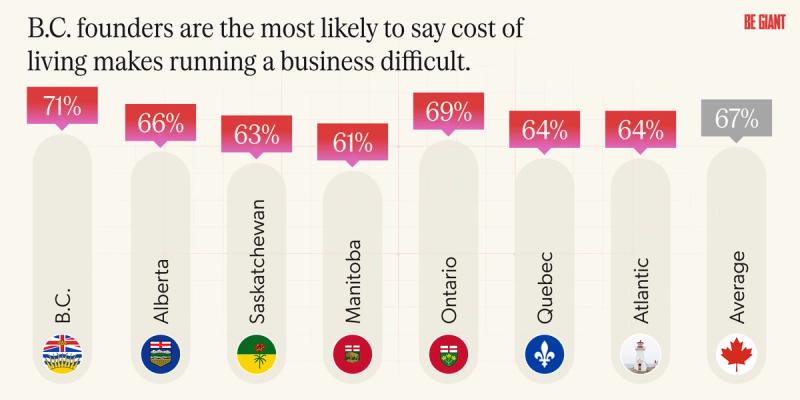
His entrepreneurial story isn’t unusual – it’s part of a pattern visible in new national data. According to Be Giant’s inaugural Upstart Index – drawn from a proprietary Ipsos poll of more than 3,000 aspiring and early-stage entrepreneurs – 71 per cent of B.C. founders say the cost of living in their area makes running a business difficult. That’s the highest figure of any province in the country.
“As an entrepreneur, you are constantly juggling feeding and housing yourself with feeding and housing your business,” said Ashley Ramsay, director of entrepreneurship at Okanagan College’s Hall School of Business and Entrepreneurship. Businesses that rely on the stability of gas prices – like those in retail, food and service trades such as plumbers and window washers that require commuting to clients – are “gritting through” current market conditions, she said.
Two hours east of Vancouver in Chilliwack, Bill Turnbull has been running The Town Butcher for 17 years. He opened just before the 2008 financial crisis and built the shop around a network of 36 Fraser Valley farms and families that help supply products to his customers. He says the cost of a Canadian beef carcass has gone from roughly $900 when he started to $5,700 today.
In Turnbull’s view, Canadian beef producers are heavily dependent on the U.S. market, so when exports are pulled south – especially if tariffs and exchange-rate conditions make the U.S. more attractive – domestic supply tightens and prices rise. The result, he said, is that buying beef from B.C. or Alberta costs almost 40 per cent more than buying it from New Zealand or Australia. “I think it’s just short-sighted for us to be exporting so much and not taking care of the Canadians who are producing it,” he said.
But Turnbull isn’t just absorbing the challenges of being a butcher in B.C. – he’s innovating around them. He’s in the early stages of opening a butchering and processing operation in Alberta, in partnership with a farmer there. The idea is to own more of his supply chain and to use profits from his Alberta operation to keep the Chilliwack store going too.
Ramsay said she has started to see many businesses relocating to Calgary, where capital is often easier to access. For Turnbull, expansion makes sense, but he won’t entirely relocate to Alberta. “I want to build a legacy and be a pillar of this community,” he said. “But affordability in the Fraser Valley is only doable if you don't have a life.” Turnbull doesn’t have kids; that’s why, he said, he can work seven days a week to keep the shop going. “For the average family, I think they're going to be very hard pressed to buy or even rent for what the prices are right now.”
Indeed, despite reporting the worst affordability pressure in the country, B.C. founders are not leaving at higher rates than their peers elsewhere. According to the Upstart Index, some 56 per cent say they have not seriously considered relocating their business outside of Canada – slightly above the 54 per cent national average. Among those who have considered relocating, the calculus is clear: 54 per cent cite cheaper cost of living elsewhere as a reason, four points above the national average.
For Negi, it’s the customers that make the difference. “Vancouver has a food culture where people are excited to discover new flavours and experiences,” he said. “At the end of the day, Loam wouldn’t be the same somewhere else. The costs are challenging, but the people who continue to support local restaurants are a big reason why we’re still here.”
“A lot of businesses here are place-based,” Ramsay said, citing Indigenous-owned operations and B.C. wine and tech startups reliant on regional talent. She believes B.C.’s government should step up to ease the squeeze, especially for small businesses. “For instance, a pilot program that would offset the cost of a lease for a startup would allow it to have a place to grow until housing costs have become a little more stable.” She argues the province should also audit business taxation rates, noting that B.C.’s employer health tax is the second highest in the country.
The Upstart Index suggests that B.C. entrepreneurs are less convinced than their peers that Canada is doing enough to support the right environment for what they’re trying to build: only 55 per cent view Canada as globally competitive for starting and growing a business.
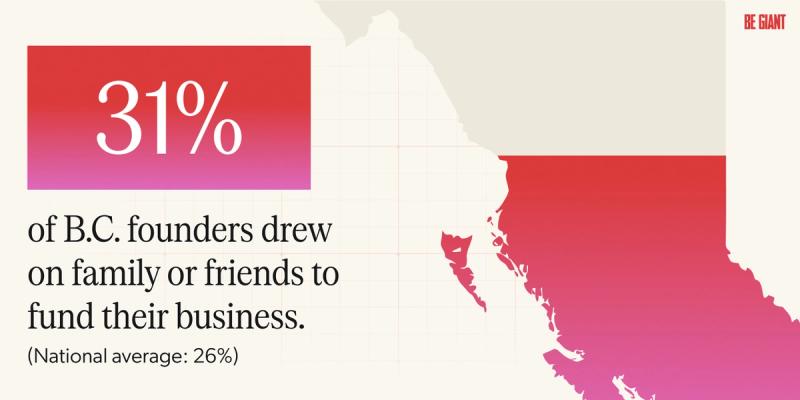
Many B.C. founders are finding other ways to stay and keep building, leaning harder on the capital sources closest to home: 31 per cent drew on family or friends to fund their business, versus 26 per cent nationally, a significant gap. They’re working differently, too. A third of B.C. founders put fewer than 20 hours a week into their business and appear to be running their startups alongside other work to make the math add up.
Get our weekly newsletter—the people, places, and ideas revealing where Canada is headed.
Christina Mattiello runs the handmade-doll company Bamboletta with a team of 23 women across Vancouver Island’s Cowichan Valley. Like Turnbull, she works around the clock to make it work. “I’d rather put in 12-hour days than raise prices,” she said, noting that many other craftspeople have switched to factory manufacturing or have licensed out their product. “A lot of people are just buying items from Shein or Temu or Alibaba and saying it’s handmade,” she said. A Bamboletta doll takes eight hours to make, and the women she employs each excel at a particular aspect, like the dolls’ hand-dyed yarn hair made from Canadian wool. Most of her staff are mothers committed to raising their families in the province, like herself, Mattiello said, which is why she’ll do what’s necessary to stay.
Absorbing the pressures of running a business in B.C. takes a toll. For many founders, the economics may no longer make sense on paper. But ties to customers, communities and the businesses they’ve spent years building remain stronger than the pull of cheaper places to live. The question is how much longer that faith can hold – and what happens to B.C. if it’s lost.