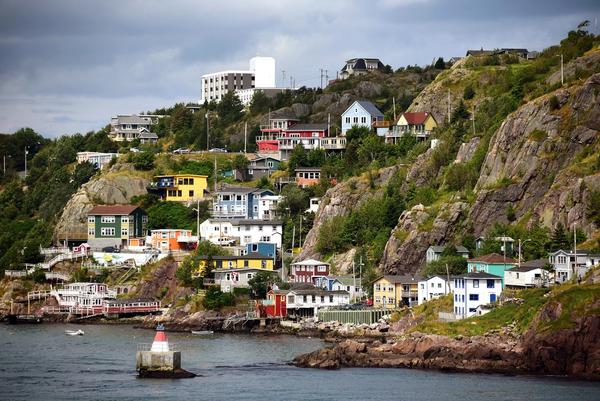
For decades, Atlantic Canada has been defined by what it lacked. But the founders building businesses there today see something different.
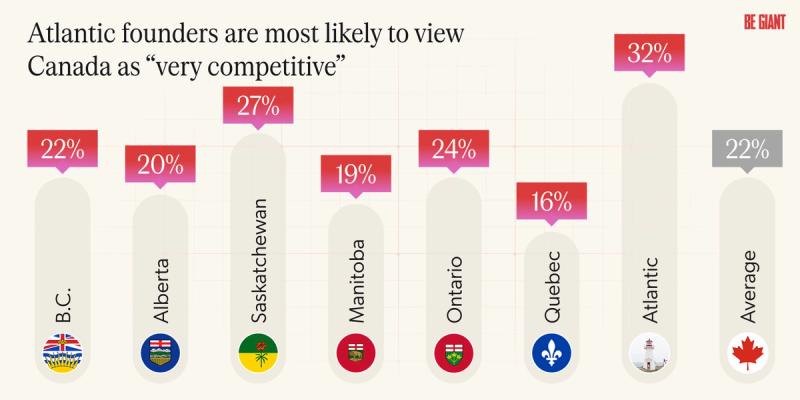
According to Be Giant's Upstart Index – a new annual survey of more than 3,000 aspiring and early-stage Canadian entrepreneurs conducted by Ipsos – Atlantic Canada scores higher than any other region on overall founder confidence: 53 out of 100 versus a national average of 50.4. The region leads the country in three of five sub-indexes: Financial Runway, Ecosystem Support and Growth Outlook. And Atlantic founders are far more likely than their peers elsewhere to view Canada as “very competitive” globally as a place to start and grow a business: 32 per cent say so versus 22 per cent nationally.
Ali Massoudi isn't surprised. As senior vice-president and chair for the Atlantic market at TD Bank Group, he's spent enough time in the region to recognize what makes its founder ecosystem distinct. “We trade not only on financial capital, but a great deal of social capital,” he said. Atlantic entrepreneurs may not enjoy the scale of Canada's larger markets, but the networks they do have are tightly knit and built on trust; they’re less fragmented than in big urban centres and more willing to vouch for one another.
Yash Mehta has experienced that dynamic firsthand. In January, he launched Mettara AI, an automation platform that helps SaaS (software as a service) clients embed AI into their workflows. Shortly after, he attended a local founder event where he discovered another entrepreneur was recommending his company in conversations across the room. “Other founders are advocating for us and selling us to others without us even knowing about it,” he said.
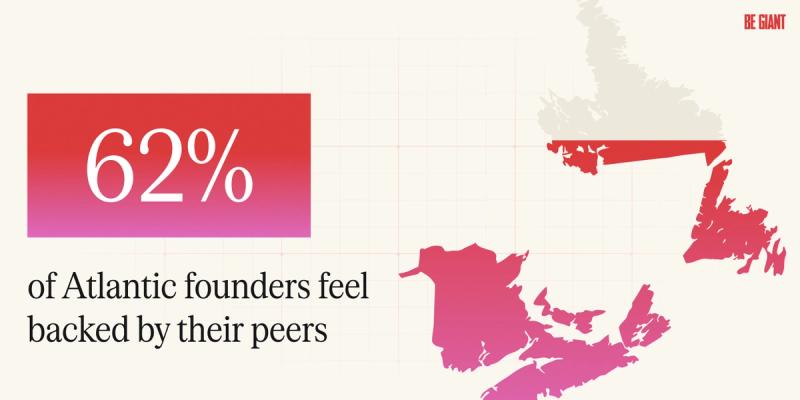
Mehta credits much of Mettara's early growth to local tech founders making introductions, opening doors and pulling him into rooms. That kind of unsolicited advocacy, he said, is hard to imagine in San Francisco or Toronto. The Upstart Index data backs the anecdote: 62 per cent of Atlantic Canadian business owners report meaningful peer support from fellow entrepreneurs, compared to 54 per cent nationally – the highest share of any region.
Capital is flowing more readily, too. Atlantic Canada leads the country on the Upstart Index’s Financial Runway sub-index, and 68 per cent of Atlantic founders say they have access to informal financial support if needed, versus 60 per cent nationally – also the highest share of any region.
Quinn Cavanagh, founder of the Halifax-based cleantech company RFINE Biomass Solutions, which turns spent coffee grounds into a cocoa powder alternative, credits much of that to the region’s angel investors, who he says are surprisingly willing to back early-stage founders.
“Our investors came in before we had a fully de-risked product or a proven commercial pathway,” he said. “They understand that markets shift, technical challenges arise and the original thesis can change significantly. That doesn’t stop them from writing a cheque if they believe in the founder and the team’s ability to navigate that turbulence.” For founders outside the typical software-startup mould, that trust matters.
The culture of collaboration also shapes who gets through the door. Savior Joseph is a founding chair at Tribe Network, an entrepreneurship and innovation hub that supports Black, Indigenous and racialized founders across Canada. Less than one per cent of Canadian venture capital dollars have gone to Black-led companies since 2020, according to a 2026 report from Rep Matters and BKR Capital, but Joseph argues that the texture of the Atlantic ecosystem makes a real difference. Entrepreneurs get into programs like Tribe, then clinch opportunities at other accelerators and incubators, which propel funding and growth. The data hints at why: 62 per cent of Atlantic founders report having access to mentors who support their growth, versus 57 per cent nationally.
“The mindset of Atlantic Canada, historically, has been to always take care of community,” Joseph said. “I really believe we lead the country in finding ways to collaborate and make people feel connected and welcome.”
That mindset, in Massoudi's view, is what's powering the optimism that the Upstart Index has picked up on. He points to a robust ecosystem of supportive industry clusters across all four provinces, including incubators, university collaborations and government initiatives. “Local industries like ocean tech, life sciences, forestry and cybersecurity aren't independently successful,” Massoudi said. “They're successful because of the ecosystems around them.”
Rural entrepreneurs in Nova Scotia are supported by Ignite Atlantic, while St. John’s-based Genesis helps early-stage tech companies scale through mentorship and programming. One St. John’s success story, CoLab AI, recently signed a multimillion-dollar contract with Bombardier. On Prince Edward Island, LaunchPad PEI supports innovative local businesses, while New Brunswick’s thriving tech and cybersecurity sectors are backed by organizations including Venn Innovation, the New Brunswick Innovation Foundation and Planet Hatch. The region is also home to major growth stories such as MDS Coating Technologies, which recently secured $110 million in government funding.
“The tech space in Atlantic Canada over the last five-plus years has grown significantly,” Massoudi said. “We’ve really shown the world that we can compete with the best of them.”
There are also financial advantages to running a business in Atlantic Canada, such as cheaper commercial industrial real estate, lower housing costs and shorter commutes compared to urban centres, plus access to strategic ports and transportation. Add in a bilingual labour force (New Brunswick has the highest rate of French speakers outside of Quebec) and a high concentration of academic institutions (Nova Scotia has more per capita than any other region in the country), and you’ve got a winning formula for doing business.
None of this is to suggest that building in Atlantic Canada is uniformly easier than building elsewhere. The Upstart Index shows the region aligns with the national average on the Friction sub-index, which measures the barriers that founders face and is the lowest score of the five sub-indexes. Atlantic founders are actually more likely than their peers in other regions to flag one specific obstacle: 57 per cent say government regulations are a significant impediment to their business, versus 50 per cent nationally.
Get our weekly newsletter – the people, places, and ideas revealing where Canada is headed.
“It’s a great place to start a business, but I think it is really hard to scale here,” Cavanagh said. “We struggle with adoption.” He characterizes the market for cleantech as much smaller but also less likely to take risks on trying new products. “Founders are having a hard time finding an eager customer to try something before it’s fully baked.”
Still, the founders building there are sticking with it. Just 28 per cent of Atlantic respondents to the Upstart Index said they've seriously considered relocating their business outside of Canada, compared to 32 per cent nationally. And they see the trajectory shifting in their favour: 23 per cent of Atlantic founders say Canada has become “much more supportive” of entrepreneurs over the past five years, versus 16 per cent nationally – the highest share in the country.
The market is smaller, but so is the noise. Customers pick up the phone. Mentors show up. “There's a quality of people here,” Mehta said. “I don't know how to put a metric to it, but the way I see it, I can go to San Francisco and raise $1 million, sure – but the people we work with in Atlantic Canada are worth way more.”
As the saying goes, a rising tide lifts all boats.