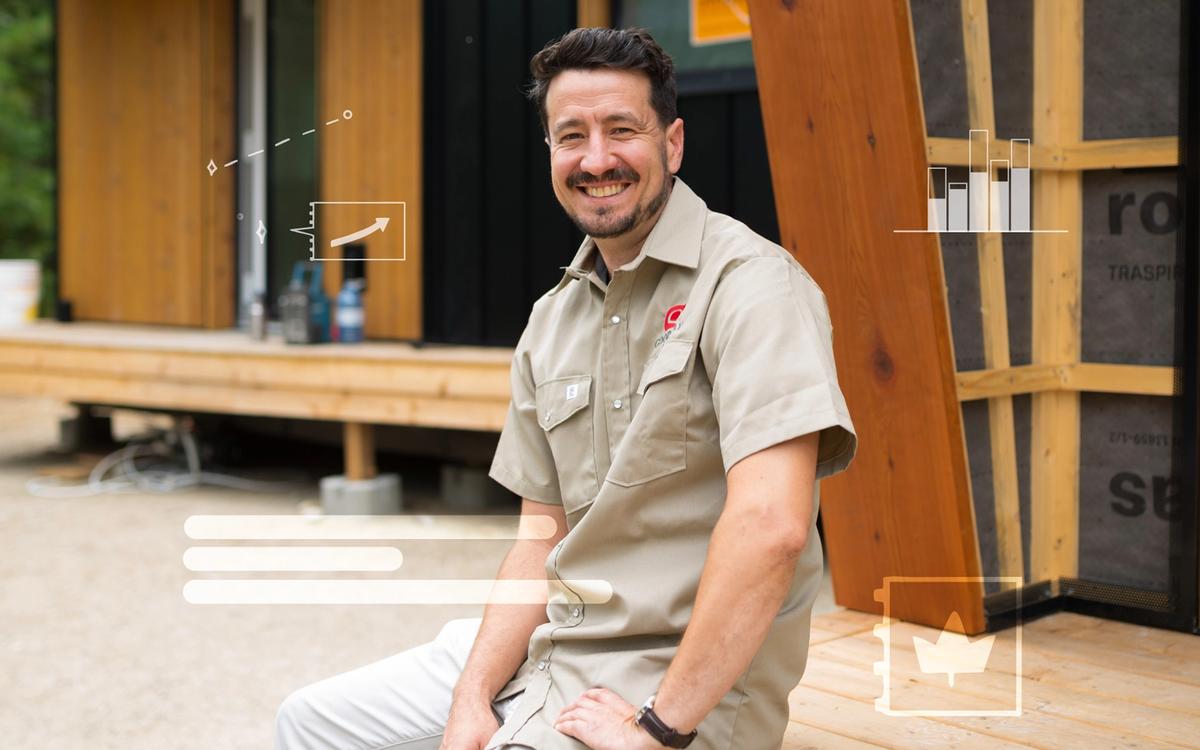
When Logan Ashley opens his new 1,600-square-metre factory in Malakwa, B.C., in August, he’ll triple his company’s production of energy-efficient prefabricated houses and add 27 jobs to his current staff of 14. The new facility sits on a little more than a hectare, up from less than half a hectare at the old Revelstoke site for Good Way Homes, which Ashley started in 2017.
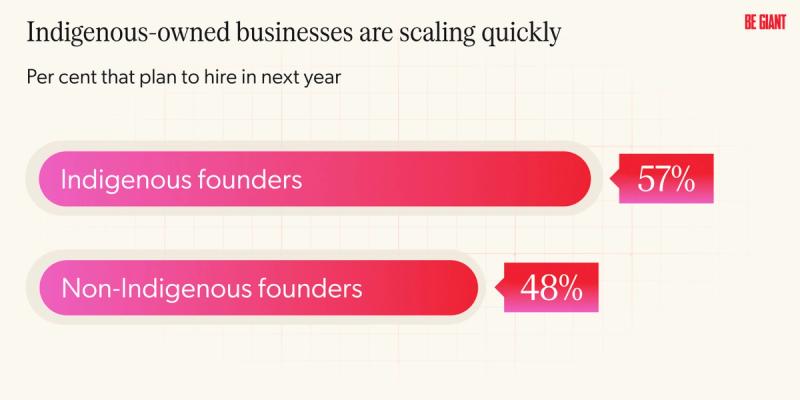
It’s the kind of growth story that turns up disproportionately often among Indigenous entrepreneurs in Canada. According to Be Giant’s Upstart Index, which surveyed 3,000 aspiring and early-stage entrepreneurs, 57 per cent of Indigenous respondents plan to hire in the next year, compared to 48 per cent of non-Indigenous founders; and 56 per cent are exploring expansion into new international markets, versus 46 per cent. On nearly every measure of scale and ambition in the survey, Indigenous entrepreneurs are out in front.
Ashley grew up in a family of tradespeople from Driftpile Cree Nation in central Alberta and worked as a journeyman and foreman before getting his commercial helicopter pilot’s licence. Flying to jobs in the Northwest Territories, he saw the poor quality of housing given the harsh climate conditions in northern communities. He launched his prefab-housing business with a partner under the name Adaptive Homes, then bought out his partner in 2024 and rebranded as Good Way Homes.
“‘Good way’ is a phrase I heard a lot growing up in my Indigenous family,” says Ashley. “Elders speak about living in a good way or operating in a good way. It means to do things with honour and integrity, protecting what’s important for the environment and doing better for our future generations.”
Currently, the majority of Good Way homes are in British Columbia, with a handful in Alberta and the United States, but Ashley is most excited about building his first on-reserve houses in B.C. soon: one for an Elder in Skwlāx te Secwepemcúl̓ecw (Little Shuswap First Nation) and another for a couple in Haida Gwaii.
Ashley’s entrepreneurial mindset isn’t unusual among his peers. Indigenous Canadians make up roughly five per cent of the Canadian population but 14 per cent of the Upstart Index’s sample of aspiring and early-stage founders – a sign that they over-index among the country’s entrepreneurs. Matthew Foss, a senior economist and the vice-president of research and public policy at the Canadian Council for Indigenous Business (CCIB), says that a combination of necessity and opportunity has made entrepreneurship a favourable path for Indigenous Canadians.
“It’s seen as a pathway to economic independence, empowerment and self-determination,” he says. “It comes down to filling gaps in their communities and a desire to make their communities better.” Foss points to opportunities in child care, landscaping, heavy equipment operation and construction, which is in greater need among Indigenous communities and is an industry where Indigenous entrepreneurs are heavily represented.
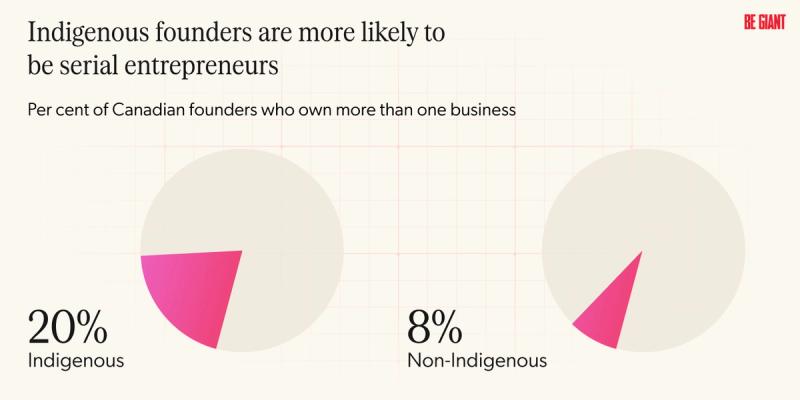
That gap-filling instinct also explains why Indigenous Canadians are more likely to be serial entrepreneurs; according to the Upstart Index, 20 per cent of Indigenous respondents own more than one business, compared to just eight per cent of non-Indigenous respondents. “In a remote region, when trying to fill gaps in the ecosystem is one of the motivations for starting businesses, that creates a desire to do more than one thing,” explains Foss.
In 2018, Teara Fraser, a Métis woman, founded Iskwew Air – the first Indigenous woman–owned airline in Canada. Fraser is a serial entrepreneur with multiple ventures under her belt: the Raven Institute, a consultancy that works with businesses through an Indigenous and reconciliatory lens; the Indigenous Lift Collective, a not-for-profit collective supporting Indigenous women entrepreneurs; and Elibird Aero, a clean aero tech company gearing up to become the first all-electric flight-training operation in Canada.
“Part of entrepreneurship is about dreaming into the future,” says Fraser. “When you see opportunities or a need, you get inspired by more than one thing.” Through the Indigenous Lift Collective and Iskwew Air, Fraser hosts Give Them Wings, an event series that inspires Indigenous youth to explore careers in aviation. “From an Indigenous perspective, we see everything as interconnected.”
Both Fraser and Ashley obtained funding through Indigenous financial institutions to start their businesses. Good Way’s expansion is backed by a BC Manufacturing Jobs Fund investment and financing from Raven Indigenous Capital Partners (no affiliation to the Raven Institute), a venture capital firm focused on Indigenous-led businesses, while Iskwew Air was supported by Tale’awtxw Aboriginal Capital Corporation. “Access to capital is critically important,” says Fraser. “It helped us take on unplanned debt during COVID-19 and make it through those incredibly challenging times.”
Upstart Index data shows that nearly half of Indigenous founders have access to investors or funding networks, statistically comparable to the 45 per cent rate among non-Indigenous respondents. Despite this, Foss says that finances remain a significant challenge for Indigenous business owners due to stubborn structural barriers.
“First Nations are struggling a lot with respect to provisions within the Indian Act that prevent securitization of on-reserve assets,” he says. “You couldn’t go to the bank and ask for a mortgage on your house or a loan against that asset because the bank can’t seize it.”
Foss points to a 2022 CCIB report stating that 43 per cent of Indigenous businesses don’t have current lending relationships with traditional financial institutions. Another CCIB report from 2024 found that 39 per cent of Indigenous businesses identified financing as a barrier, compared to 21 per cent of all small- and medium-sized Canadian enterprises.
The Upstart Index also reveals friction for Indigenous founders in the parts of life that have a real impact on the ability to run a business day to day. Fifty-one per cent say access to affordable child care limits their entrepreneurial activity, versus 39 per cent of non-Indigenous respondents; and 57 per cent say access to health-care benefits affects their entrepreneurial decisions, versus 49 per cent.
Ashley Richard is the director of Indigenous entrepreneurship at Waterloo, Ont.’s Flint Hub, an incubator at the University of Waterloo’s United College. Richard says a holistic approach to entrepreneurship support is needed to close those gaps. “It means supporting more than the costs associated with starting a business,” she says. “Entrepreneurs need support throughout all aspects of their life – to remove barriers so they can put their energy into their businesses.” Financial supports for child care, mental health, travel and technology are most needed, says Richard.
Flint Hub was launched in 2023 to support early-stage Indigenous entrepreneurs with a curriculum covering marketing, pitching and business fundamentals. Richard says it was “co-created in community” and incorporates traditional teachings and ceremonies with Elder-in-residence Wendy Phillips. “We’re surrounding the empowered entrepreneur with culture, community and ceremony,” says Richard. “We’re creating opportunities for them to come together and build relationships as a cohort and in the entrepreneurship community as a whole.”
While the challenges are real, Richard says it’s an exciting time to be an Indigenous entrepreneur: “There are so many Indigenous businesses across Turtle Island. No matter what product or service you need, there’s an Indigenous entrepreneur out there, somewhere, doing it.” Be Giant’s Upstart Index indicates that optimism is fairly widespread: 60 per cent of Indigenous entrepreneurs believe now is a good time to grow a business in Canada, compared to 52 per cent of non-Indigenous entrepreneurs. They are, on the survey’s evidence, the most optimistic founder cohort in the country.
“Indigenous founders are truly remarkable individuals to have achieved what they’ve achieved with the deck being stacked against them,” says Foss. “At the same time, there are so many more Indigenous individuals who haven’t had the opportunity to achieve those successes.”
The discrepancy is a sign the federal supports that have arrived in recent years, including the government’s five per cent Indigenous procurement target, haven’t yet translated into a level playing field on the lived experience of running a business. The infrastructure that founders like Ashley, Fraser and the Flint Hub cohort are building – Indigenous-led capital, Indigenous-led incubators, Indigenous-led procurement networks – is perhaps the answer.
Get our weekly newsletter – the people, places, and ideas revealing where Canada is headed.