
Entrepreneurs see Canada as a promising place to start a business, but new data suggests significant barriers – including cost of living, childcare and regulation – are making future growth more difficult, according to the largest independent study of its kind in the country.
A poll commissioned by Be Giant and conducted by Ipsos in March asked more than 3,000 aspiring and early-stage entrepreneurs between 18 and 65 about the realities of starting and scaling a business. The results were used to create the inaugural Upstart Index, a new annual measure of entrepreneurial sentiment that Be Giant will track year over year.
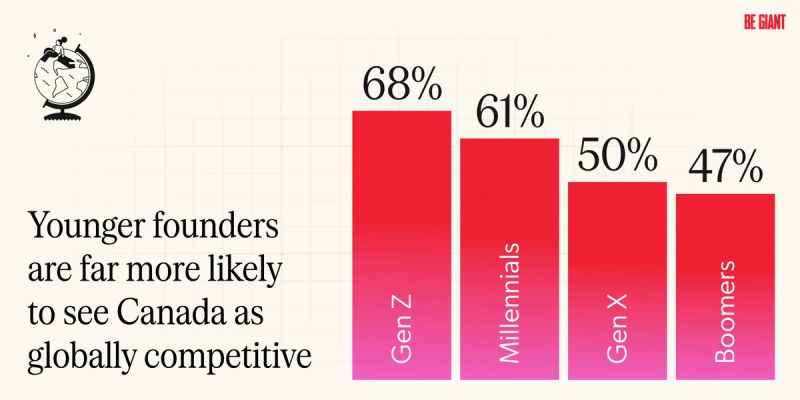
The findings show strong entrepreneurial spirit in Canada, particularly among younger founders and newer Canadians. Sixty-eight per cent of Gen Z entrepreneurs said Canada is globally competitive as a place to start and grow a business, and founders who arrived in Canada five to 10 years ago were more likely than average (62 per cent versus 53 per cent) to say that Canada offers ample opportunity.
At the same time, the poll found optimism colliding with serious headwinds. Three in five (60 per cent) believe Canada is losing entrepreneurial talent to other markets. Among respondents whose businesses are already outside Canada or who have seriously considered relocating, the most commonly cited reasons were cost of living (50 per cent), tax structure (37 per cent) and a more favourable regulatory environment elsewhere (33 per cent).
Get our weekly newsletter – the people, places, and ideas revealing where Canada is headed.
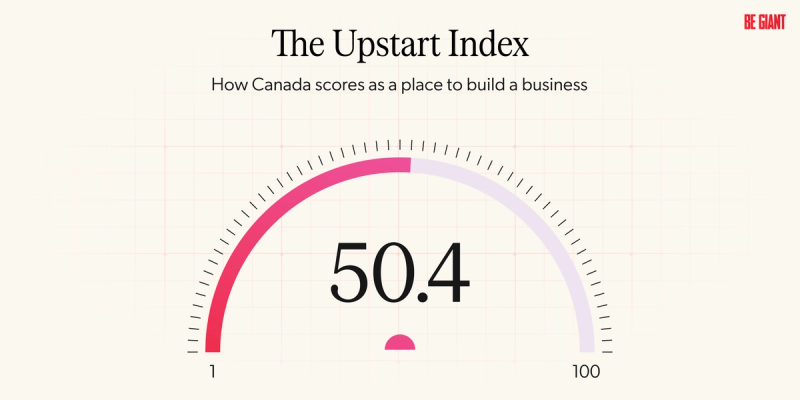
Overall, the Upstart Index scored Canada at 50.4 out of 100, reflecting an entrepreneurial environment defined by both ambition and constraint. “A score of 50.4 is exactly what it sounds like – we’re squarely in the middle,” said Sean Simpson, a senior vice-president of Ipsos Canada. “If you imagine a scale from ideal conditions to maximum friction, we’re at an inflection point. The results are promising, with high strong founder resilience and dedication, but also underscore significant hurdles, including affordability and regulatory barriers.”
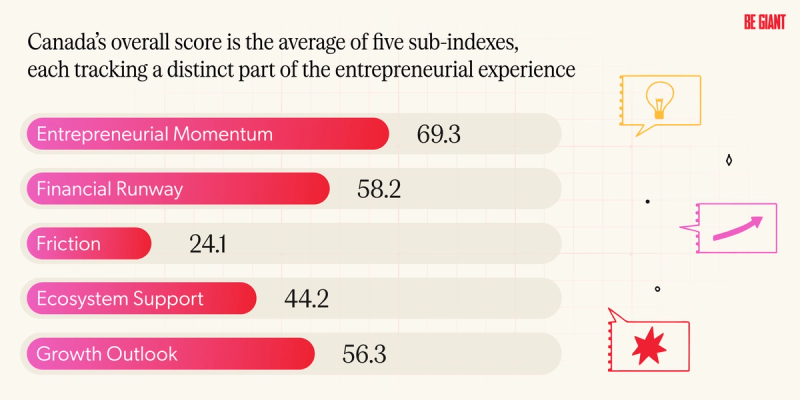
The overall Index score was calculated by averaging the scores of five sub-indexes, each based on a distinct group of survey questions:
Entrepreneurial Momentum: 69.3/100
This sub-index measures the drive behind a venture – whether founders are actively building, fully committed and increasingly earning from their work – and it posted the highest score of the five. Questions in this section of the poll asked whether respondents had taken concrete steps to advance their business in the past three months, whether entrepreneurship is their primary professional focus and whether their income is increasingly coming from their venture. Sixty-six per cent said they had moved their business forward in the past 90 days, and 79 per cent said they would continue pursuing their business even if stable employment were available, suggesting that for most respondents, their venture isn’t a side project.
Financial Runway: 58.2/100
Where Momentum measures the will to keep building, this sub-index measures the financial capacity to do so, asking whether founders could survive at least three months without revenue, whether their business is already profitable and whether they understand the funding options available to them. In total, more than half of respondents (53 per cent) said their business is already profitable, 60 per cent said they could sustain their business through a three-month revenue drought and 59 per cent said they had a handle on available funding sources.
Growth Outlook: 56.3/100
Many founders are looking ahead with confidence, according to this sub-index, which posted an above-average score. Sixty-seven per cent expected revenues to increase over the next 12 months, and 65 per cent anticipated increasing demand for their product or service. The questions also asked about hiring plans – and here the optimism tempers slightly, with fewer than half (49 per cent) saying they planned to bring on staff within the year.
Ecosystem Support: 44.2/100
This sub-index looked at the wider infrastructure around entrepreneurship, asking questions about mentors, incubators and investors. Fifty-seven per cent said they had access to mentors and 54 per cent said they received meaningful peer support from other entrepreneurs, but access drops off when it comes to formal infrastructure. Less than half (46 per cent) said they had access to funding networks, and just 37 per cent had participated in an incubator or accelerator program.
Friction: 24.1/100
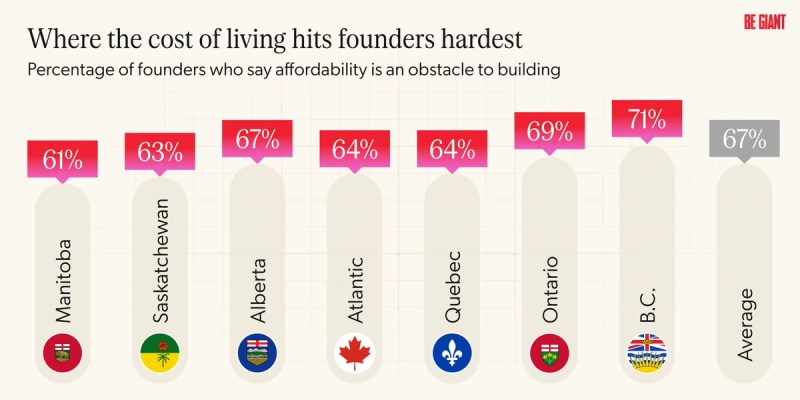
The weakest score came in the sub-index tracking barriers and the broader strain on founders. Questions measured cost of living, government regulation, childcare, health-care benefits and the personal health toll of running a business. Just over two-thirds (67 per cent) said the cost of living in their area makes entrepreneurship difficult. Beyond affordability, half (50 per cent) of respondents said regulations were a significant obstacle, and an equal share said access to health-care benefits influenced their entrepreneurial decisions.
Taken together, the five measures show not just whether founders feel optimistic but what is helping – or hindering – their ability to build in Canada. “The thinking behind this approach is that entrepreneurship is not shaped by any one factor alone: founders may feel highly motivated while still facing serious affordability pressures or uneven access to support,” said Simpson. “By understanding these challenges, we can break down barriers and make sure anyone in Canada who wants to start a business can succeed.”
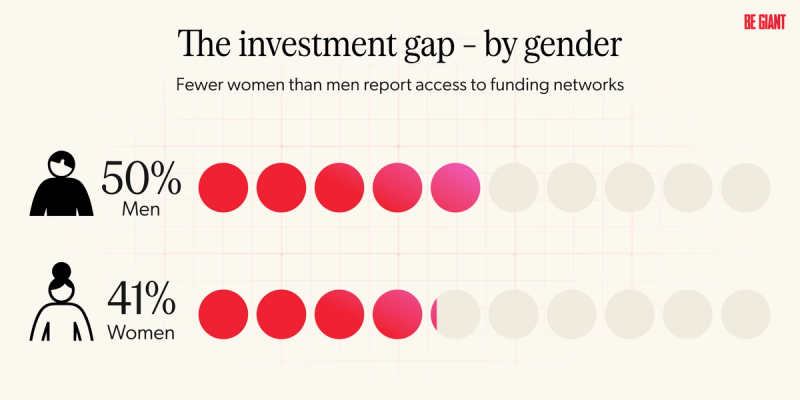
The divide is particularly visible by gender. For example, while 50 per cent of men said they had access to investors or funding networks, only 41 per cent of women said the same. Additionally, 41 per cent of men said they had participated in incubator or accelerator programs, compared with 33 per cent of women, suggesting that the broader support ecosystem remains out of reach for many.
Regional differences also stand out. Atlantic Canada was a bright spot, posting the strongest Growth Outlook score at 60.9 and one of the strongest agreements to the statement “Now is a good time to grow a business in Canada,” at 62 per cent. B.C., meanwhile, appears to be the sharpest example of the affordability squeeze in the poll: seventy-one per cent of respondents there said the cost of living makes entrepreneurship difficult, higher than Ontario (69 per cent) and the national average.
“Canadian entrepreneurs are building companies in one of the highest-cost environments,” said Patrick Searle, CEO of the Council of Canadian Innovators, a national business association of 170 of the fastest-growing Canadian companies. “And they’re choosing to stay in the fight because they care deeply about Canada and believe Canada is a home for ambitious builders.”
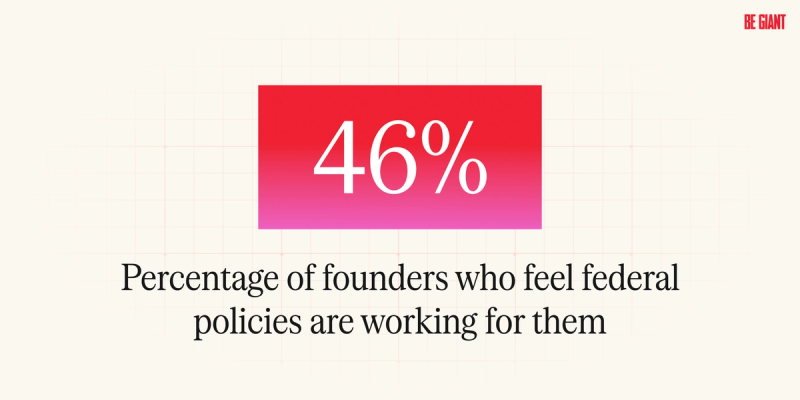
That commitment, the data suggests, is not matched by confidence in government. Just 46 per cent of respondents said federal policies and regulations are well aligned with the needs of entrepreneurs, and only 48 per cent said the same of provincial policies – a finding that cuts across all regions and demographics in the study.
“When people hear that founders are thinking about leaving, they often assume it reflects a lack of ambition or patriotism. It doesn’t,” said Searle. “Highly ambitious people make rational decisions about where they can win. We need to make sure our governments are doing everything they can to make Canada that place.”
In the weeks ahead, Be Giant will report on the most surprising findings from the inaugural study, including why women over-index as solo entrepreneurs, the optimism of Gen Z founders, the strength of Indigenous entrepreneurship, the serial entrepreneurship of New Canadians and the regional differences shaping the experience of building a business in Canada right now.
The inaugural study has created a baseline that can be tracked over time, helping to show whether Canada is becoming a more supportive environment for founders. In Year 1 of the Upstart Index, the ambition is clearly here. As future editions are released, the data will give a clearer view of whether the conditions can catch up to it – and who is best positioned to keep going.
Methodology
These are the findings of an Ipsos survey conducted on behalf of Be Giant. Fieldwork was conducted between March 16 and 26, 2026. A total of 3,014 Canadians aged 18 to 65 who are either early-stage entrepreneurs (started a business less than five years ago) or aspiring entrepreneurs (likely to start a business in the next two years) participated in the survey. Weighting was used to ensure the sample's composition reflects that of the aspiring and early-stage entrepreneur landscape in Canada by age and gender. This survey has a credibility interval of +/- 2.2 per cent 19 times out of 20 of what the results would have been had all Canadian early-stage entrepreneurs aged 18 to 65 been surveyed.