In the early days of the pandemic, Andrew Murray was at a crossroads. He had just sold his first company, a software venture he had launched a few years earlier on the heels of his undergrad degree at Dalhousie University. He was locked down in his apartment in Charlottetown, P.E.I., trying to keep active. So he would go for walks along Confederation Trail, a path that meanders across the island along decommissioned railway tracks.
Many days, he’d pass small dams, one after another. He could almost pace off the miles by them. Then he realized that these were the old sawmills and gristmills that had formed the backbone of some of the nation’s pioneering small industries and that whole communities had settled around them. He’d long been interested in renewable energy, so two questions started niggling at him. First: How many dams were there? Second: Could he bring them back to life as hyperlocal sources of clean electricity?
“That’s a hidden layer of energy that is deeply Canadian and plays a massive part in our history and could in our future, right?” he says over a cortado at a coffee shop and wine bar in Toronto, where he moved in 2025. Harnessing it became, as he puts it, “an incredible mission.”
Get our weekly newsletter – the people, places, and ideas revealing where Canada is headed.
If this sounds romantic, it is. (“Please don’t use that word!” Murray says after using it to describe the idea.) To him, this isn’t just a climate play aimed at stripping carbon emissions from energy production by replacing local diesel-fired electricity with hydro. His deeper goals are both to increase access to energy for people who live in small communities and to do it in a way that doesn’t alienate locals the way big dam projects and nuclear reactors do.
Aslan Renewables is the company he formed in 2021 to carry the idea forward. It’s named after the Christ-like lion in C.S. Lewis’s Chronicles of Narnia and is a nod to the business’s resurrectionist values.
It took a few years just to nail down the fundamentals. Murray enlisted the help of professors and students, mainly from the University of Prince Edward Island, along with local historians and families, to scour public records and piece together the story of the forgotten dams. A postwar federal initiative through the 1950s and 1960s spurred a grand decommissioning of dams across the nation, making way for provincial utilities such as Hydro-Québec and NB Power. But because the little local dams had reshaped rivers and spawned communities around them, they had to stay put to prevent flooding. That meant taxpayers were paying for their upkeep, a perpetual expense with no return.
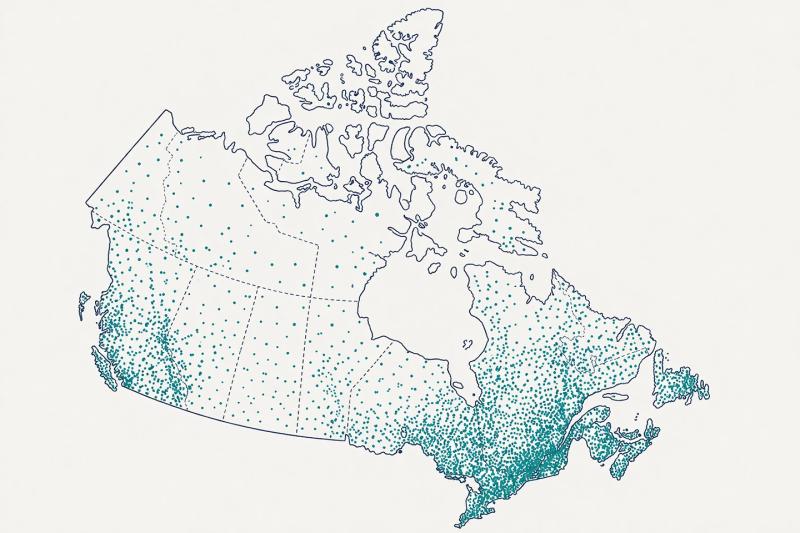
That was a surprise. More astonishing still was the sheer number of unused dams: 63,000 across Canada. Murray did the math. With the right modern turbine technology, he could count on being able to capture a megawatt of power at each one of them, feeding electricity straight into the grid. Small beer for one dam. But do it with 63,000 and that’s a lot of electrons.
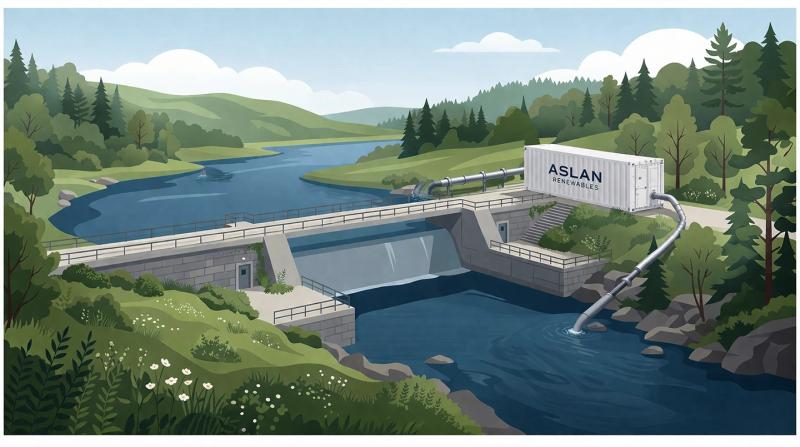
And that, in turn, led Aslan to develop what he calls an Ikea-like prefab power plant – a box that contains as many as 10 modular hydro turbines inspired by a solar panel’s ease of use: small, self-contained, no customization, no pouring of concrete. It doesn’t even have to be submerged in the river; the power plant sits on the bank, so as not to interfere with aquatic life, siphoning off maybe 10 per cent of the river’s flow through a tube. You drop it on the ground, bolt it up and that’s that. The water that enters the tube, in turn, propels the turbine, producing electricity that feeds into the local electrical distribution line, delivering power to the grid in real time. There’s no need for staff or management. Permits from community, provincial and federal authorities take five to eight weeks on average in any province. Embedded sensors in the unit track river health and disseminate the information in real time through DataStream, a national open-source platform for sharing Canadian freshwater information.
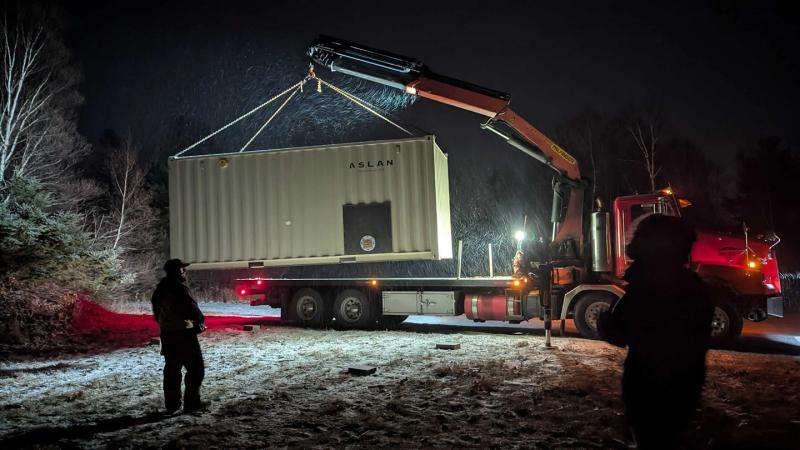
Murray pulls out his phone to show me an Aslan generator being delivered in December 2025 as part of a pilot project in Scales Pond near Kinkora, P.E.I., one of two generators currently in place in Canada. (The other is in Kingston, Ont.) In the photo, the white steel unit, about the size of a shipping container, is being winched off a flatbed truck and is about to be plopped in place in the snow. This model has been designed to fit any of the 63,000 sites. In fact, the Scales Pond generator is scheduled to be moved to Charlottetown later this summer, where Aslan will work with UPEI students and trade schools as they build a curriculum on decentralized hydro projects.
That modularity is where the innovation comes in. Typical hydro projects are tailored to each site, says Paul Norris, president of the Ontario Waterpower Association, a non-profit organization promoting hydro-power projects in the province. Aslan is a member. “Instead of looking at the site and then seeing what you can fit into it, [this is] looking at what you have and seeing where it fits,” he says.
Part of the drive is that jurisdictions across Canada are pivoting to clean electricity to power industry. Ontario, for example, will need 65 per cent more electricity by the middle of the century than it has now, its officials reckon. The province is actively seeking small local generation of all sorts. “Everybody’s talking about the electrification of the broader economy,” Norris says. “I don’t know of a jurisdiction that is projecting a reduction [in electricity use] going forward.”
And of all the types of renewable energy, hydro power is particularly prized. Unlike solar and wind energy, hydro is predictable, capable of running day and night and not subject to weather variations, says Kuljeet Grewal, an associate professor in the faculty of sustainable design engineering at UPEI. Grewal and his students helped Aslan simulate turbine flow dynamics in the early years when the idea was being developed. Although Grewal works in renewable energy, he hadn’t heard about an idea like Aslan’s before for producing electricity. “It would certainly provide diversity to [local] energy resources in terms of distributed energy, for sure.”
Mike Holland sees it as innovative too. He was New Brunswick’s energy minister when Murray showed up to make a presentation on Aslan. It stood out for ticking all the province’s boxes: increasing electrification of the power grids, cost effective, no carbon emissions. Holland left office in 2024 but says New Brunswick is still interested in the technology. Now he’s the Atlantic Canada vice-president for the consultancy Sussex Strategy Group, where Aslan is his client, and he’s in talks with the province about installing the generators. “It meets so many of the objectives that the provincial utility and provincial government are looking to achieve. So here I am a couple of years later, wearing a different hat but having the same conversation,” he says.
That conversation is a little further along in Ontario. Brad McNevin, chief administrative officer of Quinte Conservation, plans to present his board of directors with a proposal in September to install a 35-kilowatt Aslan generator on the Moira River in Belleville, an add-on to a hydro plant that’s already there. He is considering another 20 or so possible sites in his area and would like to see the idea spread to other conservation authorities in the province. “We know we need energy. We know we need clean energy. This is just making good use of a resource that is essentially travelling down through our rivers,” he says, adding, “It looks like a really, really amazing opportunity.”
The idea has also garnered some international attention. King Charles’s royal biographer Robert Jobson included a page about Aslan in his 2023 book about causes the king has championed. Last year, Aslan won a global climate-tech-innovation competition established by the Singapore-based Temasek Foundation, netting the company more than $300,000 in prize money. The company also raised $1.25 million last year from Canada- and Singapore-based tech startup funds and a few individual Canadian angel investors.
Still, there are barriers to Aslan’s success. Energy is a complex file, requiring co-ordination across multiple government departments, agencies and typically a provincial utility. “I’ll tell you,” Holland says, “from an energy perspective, if you have a project that can go from initial presentations to preparations in place to execute first of a kind in a few years, that’s lightning speed.”
Manufacturing has also been a choke point. Murray is committed to a distributed Canadian supply chain, working with building yards and small businesses across the nation. But he’s had to accept turbines from France and Japan because Canadian companies don’t make the small units he needs. If local manufacturers won’t start making them, he will take steps to build a factory, he says. He is even considering opening a mothballed automotive assembly plant to make the generator modules en masse.
And then there are the beavers. This quintessentially Canadian idea, steeped in Canadian history, has a fabled Canadian foe. Beavers like to chew. And they apparently like to chew on the units’ sensors that measure temperature, reservoir level and river health. So Murray’s team figured out how to get the generators to detect the beavers’ advances and emit a tone deep under water to keep them away.
Nevertheless, Murray says he believes that by the end of 2027, Aslan will be able to manufacture and supply the Canadian market with hundreds of mini hydro turbines. One thing is sure: demand has skyrocketed, especially as Canadians have become more worried about energy security over the past year. “All of a sudden, municipalities, private landowners, farmers, provincial governments and utilities across the country started engaging with Aslan in a way that they hadn’t before,” Murray says. “We’re desperate to move forward.”