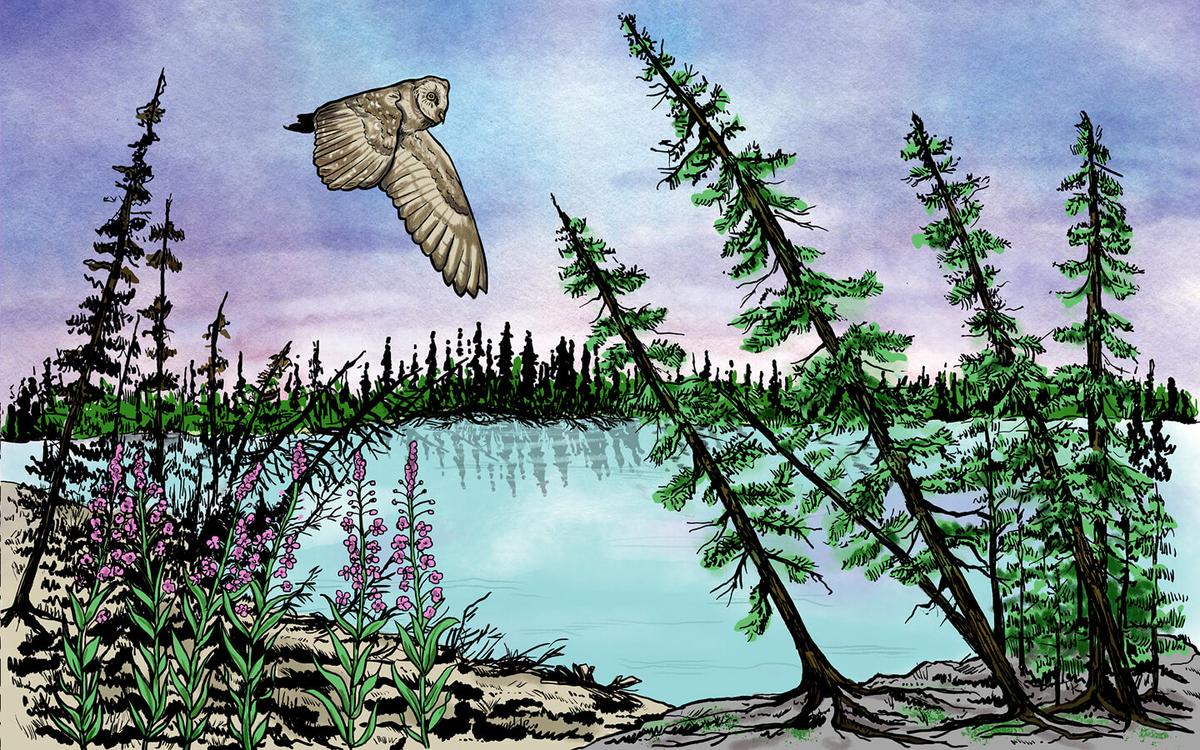
Picture a forest of black spruce in disarray, trees leaning to and fro, some tilting so dramatically they look as though they’re struggling to stay upright. If they were humans, you might suspect they’d had a wild night out – and, fittingly, trees in this state are called drunken forests.
As permafrost thaws, drunken forests, which grow above the permafrost, are increasingly common across the Arctic. While it’s hard to measure exactly how many drunken forests there are, it’s estimated that the world could lose up to 40 per cent of its current permafrost by the end of the century. In fact, the phenomenon has become a major point of study for scientists keeping a close eye on the Far North, which, according to recent studies, is warming four times more quickly than the rest of the world.
“Looking around the larger landscape, we could see trees collapsing into the adjacent wetlands, which are expanding into [areas] where forests once were,” says William Quinton, a professor in Wilfrid Laurier University’s Department of Geography and Environmental Studies and head of the Scotty Creek Research Station in the Northwest Territories, where these trees are of particular interest. “There are drunken forests everywhere. Trees just disappear into the bogs.”
How a tree gets “drunk” all comes down to the unique topography of the Arctic, where up to 80 per cent of the land includes permafrost, a frozen layer of soil and rock that can start anywhere from 0.5 metres to two metres beneath the surface of the soil. (The technical definition of permafrost is ground that remains at or below 0ºC for at least two consecutive years.) The layer of soil between the permafrost and the surface is relatively shallow, so the root systems for Arctic trees like black spruce grow horizontally, making them particularly vulnerable to any sort of instability.
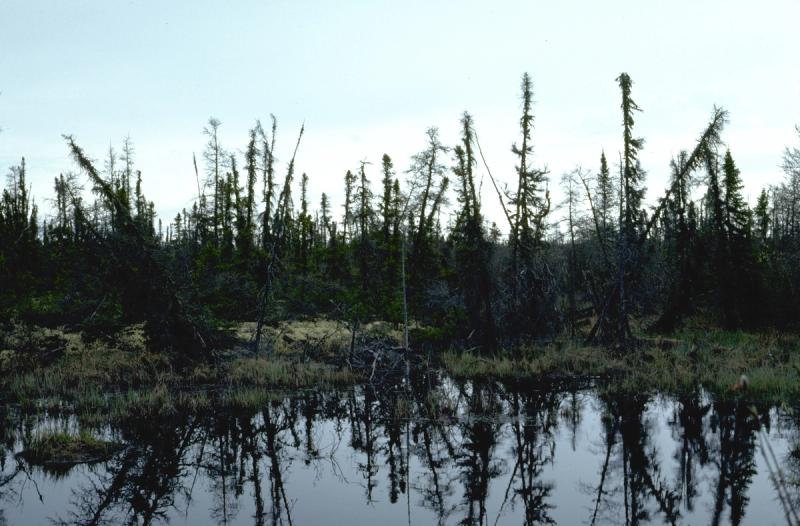
As permafrost thaws, the ground under these trees becomes unstable, causing trees to tilt or even sink into the newly boggy ground. And when drunken forests eventually die, the disruptive impact on the ecosystem extends to water quality, because dead trees falling into nearby bodies of water release carbon and mercury as they decompose.
That’s why researchers at the Scotty Creek Research Station are monitoring drunken forests, as well as other signs of climate change, including water quality, soil biogeochemistry, greenhouse gas fluxes and soil carbon storage. Quinton and a rotating group of students study these impacts of climate change on the Arctic landscape – some of which hit very close to home. The station is located just over 60 kilometres south of Fort Simpson, and started as a seasonal camp in 1999 before becoming an all-season research facility in 2003. Since then, the station has had to move twice because of rapid permafrost thaw, which caused the land around the station to become increasingly boggy.
Researchers study thaw-induced changes at Scotty Creek, including dead trees, which impact everything from the quality of the drinking water to the health of the native fish.
“Communities are asking what their water resources are going to be like in 2050 – and not just water resources, but habitat changes and accessibility to the land,” Quinton says.
As the black spruce forest has seemingly melted into the wetlands, he notes that the vegetation has also changed to favour shrubs in this part of the Arctic, which has a knock-on effect of changing animal habitats, greenhouse gas flow and water storage and movement.
That’s why drunken forests are such a valuable research tool. Using old aerial photos to figure out past forest coverage, Quinton and his team can track the loss of permafrost going back decades. In the 1950s, he says, about 70 per cent of the land by Scotty Creek sat on permafrost. Today, it’s just 30 per cent.
It’s not just science for science’s sake. The work being done at Scotty Creek is in partnership with nearby Indigenous groups who use the findings to improve their communities’ climate resiliency. Since August 2022, the lease for the research station has belonged to the nearby Łı́ı́dlı̨ı̨ Kų́ę́ First Nation, making Scotty Creek the country’s first Indigenous-led research station. In October 2022, when a wildfire torched the lands around the station and destroyed millions of dollars’ worth of equipment, researchers and the Łı́ı́dlı̨ı̨ Kų́ę́ First Nation rebuilt and reopened the station together.
“All our partnerships are based on the mutual need for new knowledge and to combine existing knowledge and expand it and apply it,” Quinton says. “We’re all concerned about the impacts of permafrost and how it’s affecting the environment.”
While Scotty Creek is mainly set up to monitor the effects of climate change, some solutions in the making are also being tested nearby. One such possibility is a thermosyphon, a passive heat exchange that involves inserting tubes into the ground where permafrost is thawing and filling them with environmentally friendly antifreeze. The air above the ground will cool the pipe and the antifreeze contained within it. Because of the difference in temperatures between the top and the bottom of the pipe, the colder antifreeze will sink and the warmer antifreeze will float. The cold liquid at the bottom will freeze the ground below to “develop a big ice bulb at the base of your thermosyphon, which persists through the summer,” Quinton says.
The idea is that these ice bulbs will help form an ice wall that stops the ground from becoming unstable. While not an entirely new idea, these systems are generally prohibitively expensive and hard to install, so it’s more common to find them next to more populated areas with infrastructure like hospitals or highways rather than less populated ones. But Quinton and his team are working on a more affordable version that would allow anyone to install them in their backyard without an engineer and a drill rig.
There are challenges to this approach, of course. Freezing the ground is a bit of a balancing act: thermosyphons can cool things down too much, causing the ground to heave upward as a result. Still, the hope is that tools like these adapted thermosyphons could one day keep Arctic land stable and help drunken forests sober up.
Get our weekly newsletter – the people, places, and ideas revealing where Canada is headed.