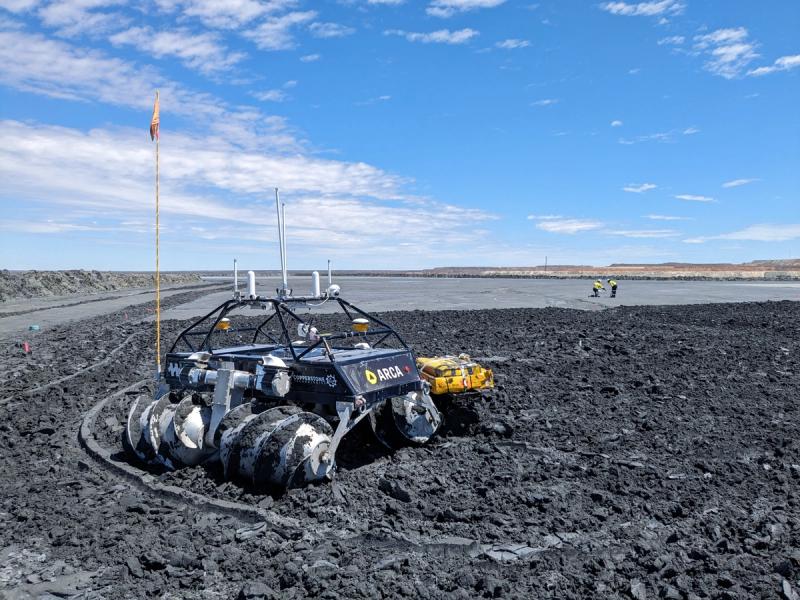
In the middle of the Western Australian desert, a team of Canadian researchers unleashed a rover on an isolated segment of a waste dump at BHP’s Mount Keith nickel mine. Nearly the height of a person and equipped with large circular tilling blades on either side, the rover spent a year regularly churning up mine waste rock as part of a 2023 pilot test.
The goal: to speed up the rate at which the rocks were sucking carbon dioxide out of the air.
Mine-waste piles have long been seen as an environmental liability. But Arca Climate, the British Columbia-based startup behind the pilot, is developing and commercializing technologies that accelerate a naturally occurring process that permanently removes carbon dioxide from the atmosphere. The process, called carbon mineralization, involves ultramafic rocks, which interact with carbon dioxide to form a magnesium-carbonate mineral.
“More than 99 per cent of carbon on Earth is stored in rocks – not in the oceans, not in the air, not in life forms,” says Greg Dipple, Arca’s co-founder and a professor emeritus of geological sciences at the University of British Columbia. “It’s a great place to put carbon. It likes to stay there.”
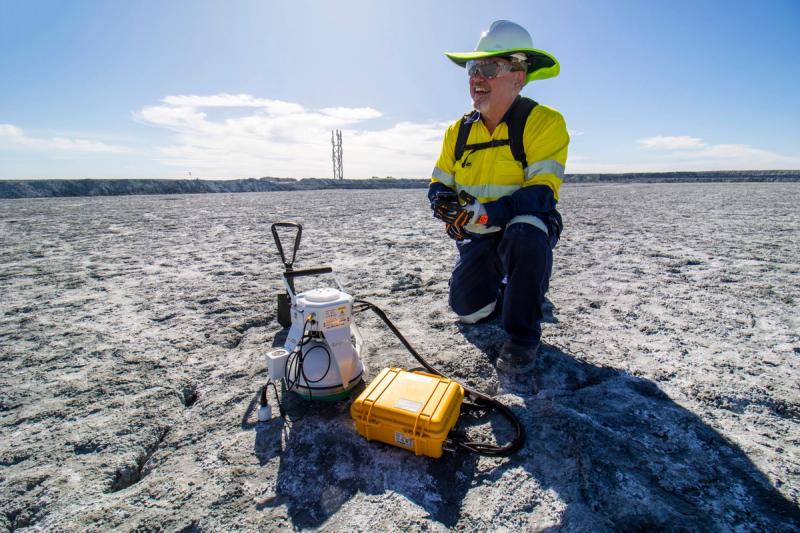
Ultramafic rock is rich in magnesium and light in silica. That combination is important: rocks with lots of silica have strong molecular bonds that are extremely hard to break. Ultramafic rocks, in contrast, have less stable bonds, which makes them more able to react with, and absorb, CO². Researchers from five institutions, including Trent University and the University of Alberta, wrote in a 2021 paper that, on average, ultramafic rocks can sequester about half a tonne of CO² for every tonne of rock. However, that reaction typically happens very slowly.
Dipple has studied carbon mineralization for more than 25 years, during which time he has realized that mine tailings are unusually well-suited to turbocharging the mineralization process – and that there are plenty of them to go around. Mine-waste piles in Canada alone contain a couple of billion tonnes of ultramafic rock, and by the time the rock reaches the waste pile, it’s been crushed up, which Dipple has found makes it even more reactive.
He and two researchers from his UBC lab, Peter Scheuermann and Bethany Ladd, launched Arca in 2022. The company has worked with mining giants BHP and Vale, among others, and signed agreements with Microsoft and Frontier Climate. An advance market commitment has been signed to buy carbon-removal credits on behalf of major tech companies for a combined total of more than 300,000 tonnes of durable carbon removal. And earlier this year, the company announced $2 million in funding from the National Research Council of Canada, which will go toward moving its tech from the lab to the field.
Here’s how it works: Arca’s rover tills and churns the surface of the tailings to increase the rate of reaction. It spreads the tailings out over a larger surface area to expose more rock to CO², and it brings up rock from the bottom of the pile; because these rocks haven’t been in contact with the air, they have less acidity and can capture more CO². The company has a monitoring system that tracks the rate of absorption 24 hours a day; if it slows in a particular spot, the rover will scoot over and start tilling. (It also monitors an undisturbed area of tailings to identify a baseline rate of capture and will be paid based on what its technologies help to capture beyond that.) The rover also controls the tailings’ Goldilocks moisture ratio: if the material is too wet, the CO² can’t reach the rock, but if it’s too dry, a reaction won’t happen. It needs “the moisture of a sand castle,” Dipple says.
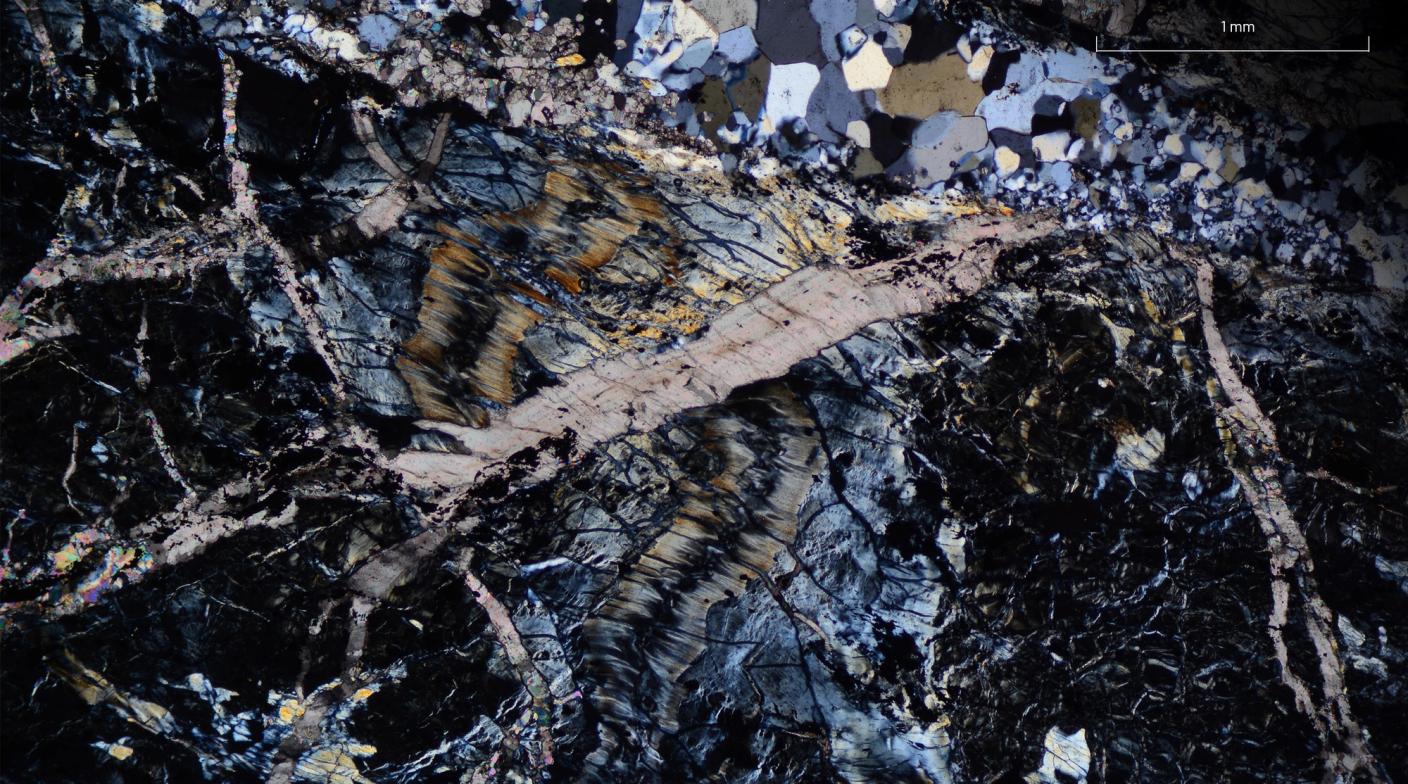
Some rocks react better than others. About three per cent of ultramafic material contains a mineral called brucite, which has no silica at all and can inhale huge amounts of carbon dioxide all on its own. That was the case at Mount Keith: Dipple and fellow researchers reported in a paper that the mine’s tailings naturally captured almost 40,000 tonnes annually, or 11 per cent of the operation’s total emissions. That’s equivalent to what 9,330 gasoline-powered cars would emit in a year.
Churning increased the mineralization rate at Mount Keith by five to 10 times, Dipple says, and helped Arca validate the technology at an active mine.
But for the majority of ultramafic rock, churning isn’t enough. The most common mineral found in ultramafic rock is called serpentine, and it naturally captures far less CO² because its structure contains water. To make it more reactive, it needs to be partially dewatered and blown up.
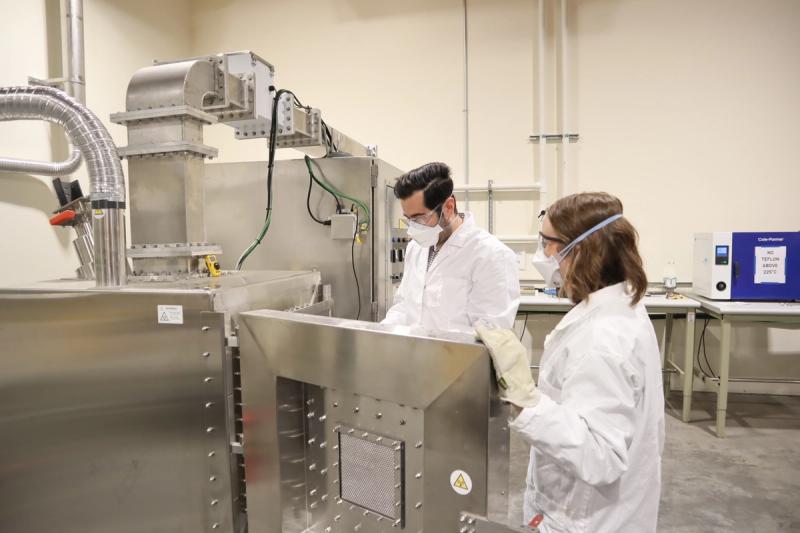
Enter Arca’s other tech: “Essentially, we’re making microwave popcorn with serpentine,” Dipple says. The material continuously flows through what he refers to as a “giant microwave” on something like a conveyor belt. After a few minutes in the microwave (which is large enough for a person to crawl into), serpentine-containing rock becomes 200 times more reactive.
The implications of this technology are profound. RMI, a clean energy-research non-profit, estimated that mineralization from tailings and mine waste could remove 5 million tonnes of CO² per year by 2030, rising to 160 million tonnes per year by 2035 and 1.3 billion tonnes per year by 2050. The 2021 paper was more modest, estimating that ultramafic tailings could remove 300 million tonnes per year by 2100 – but that figure only included newly mined rock, not existing tailings. Currently, the world is emitting about 40 billion tonnes of CO² per year.
Arca’s approach to carbon mineralization isn’t the only one, of course. Canada Nickel teamed up with researchers from three American universities to store CO² in ultramafic rock below the surface at its Crawford nickel-cobalt project site near Timmins, Ont., by injecting CO² into water and sending it deep underground to be absorbed and mineralized. The climate-tech company Deep Sky is taking the same approach in Quebec’s Thetford Mines region.
With the first test for Arca’s microwave at an active mine coming up next year, Dipple says the race is on to scale it up. The microwave, which has to be integrated into a mine’s operating circuit, can currently handle hundreds of kilograms of material in a day – and although that sounds like a lot, many mines move about 10 tonnes of rock per minute. Still, he’s optimistic.
“Things are working really well with the microwave in the lab. We know it’s got to get faster and better, and there are always challenges there,” he says. “But I think we’re over the big hump on the technology.”
Get our weekly newsletter – the people, places, and ideas revealing where Canada is headed.