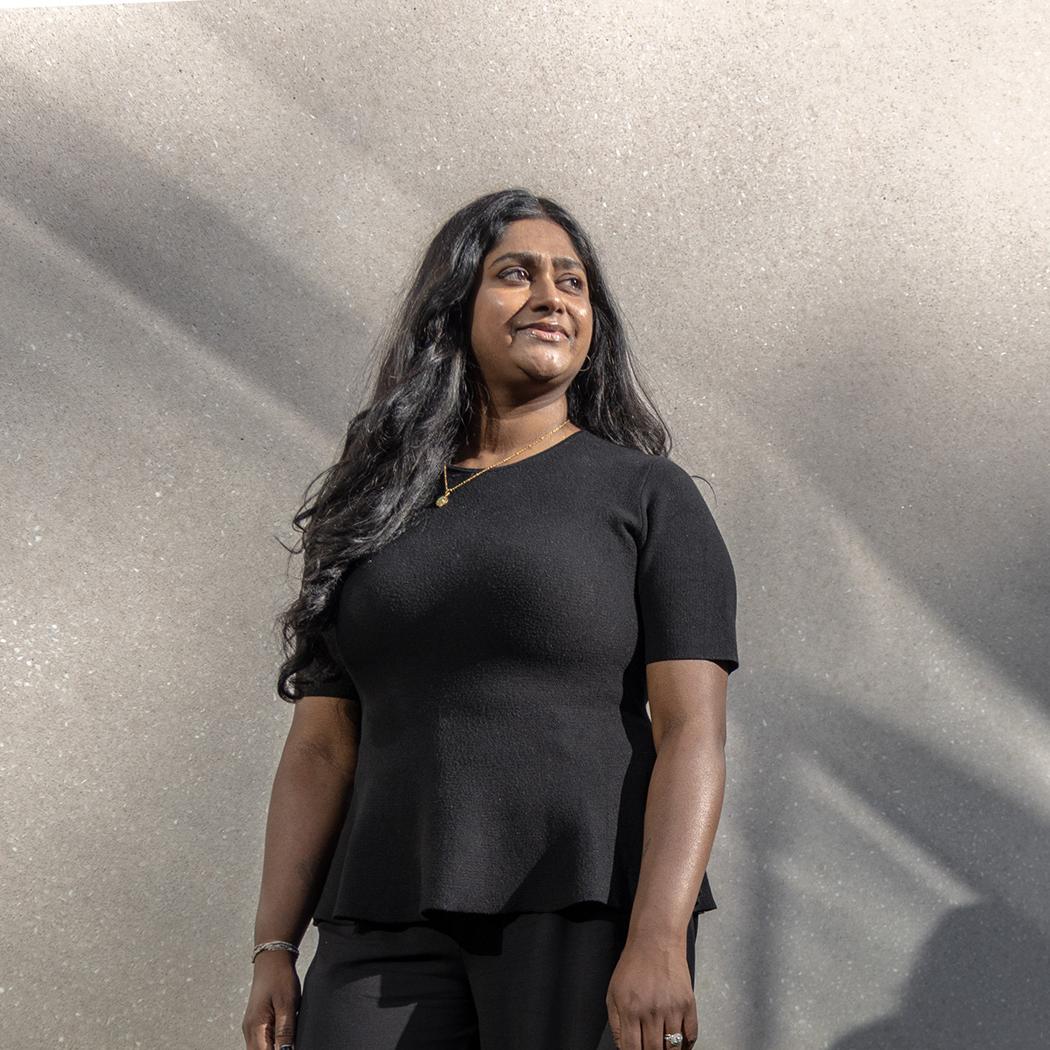
Like most high school science projects, Nivatha Balendra’s began with a hypothesis: what if naturally occurring bacteria could clean up oil spills without the harmful side effects of chemical dispersants? The experiment was inspired by the 2013 Lac-Mégantic rail disaster, when a runaway train carrying crude oil derailed in rural Quebec, killing 47 people and spilling millions of litres of oil into the surrounding community and waterways. It was an environmental catastrophe, but the cleanup protocol meant introducing another set of pollutants into an already damaged ecosystem. Balendra couldn’t get past the glaring logic gap: you wouldn’t wipe down your kitchen countertops with a contaminated dish towel, so why were we cleaning up oil spills with more toxic chemicals?
Her search for a clean alternative began close to home. Along the banks of the St. Lawrence River, the then 17-year-old Montrealer collected soil samples and brought them back to the laboratory at the Institut National de la Recherche Scientifique (INRS), where she was doing a research apprenticeship. There, she isolated a bacterium that not only was able to ingest oil particles but also appeared to be a novel (that is, previously undiscovered) strain – the “NB,” as Balendra’s fellow researchers took to calling her discovery, although she was more interested in the breakthrough than the bragging rights.
Her project, titled “Don’t Cry Over Spilled Oil!,” caught the attention of the international scientific community. After advancing through regional fairs, Balendra earned a place at the 2014 Intel International Science and Engineering Fair, held that year in Los Angeles and often described as the Olympics of high school science. She didn’t win the top prize, but her work received the World Economic Forum Future Scientist Award along with an invitation to the organization’s Annual Meeting of the New Champions in Tianjin, China.
Better known as “Summer Davos,” the gathering brings together CEOs, policy-makers, entrepreneurs and researchers from around the world. It was Balendra’s first glimpse of the long road between scientific discovery and commercial impact – a journey she would spend the next decade navigating. But first: frosh week.
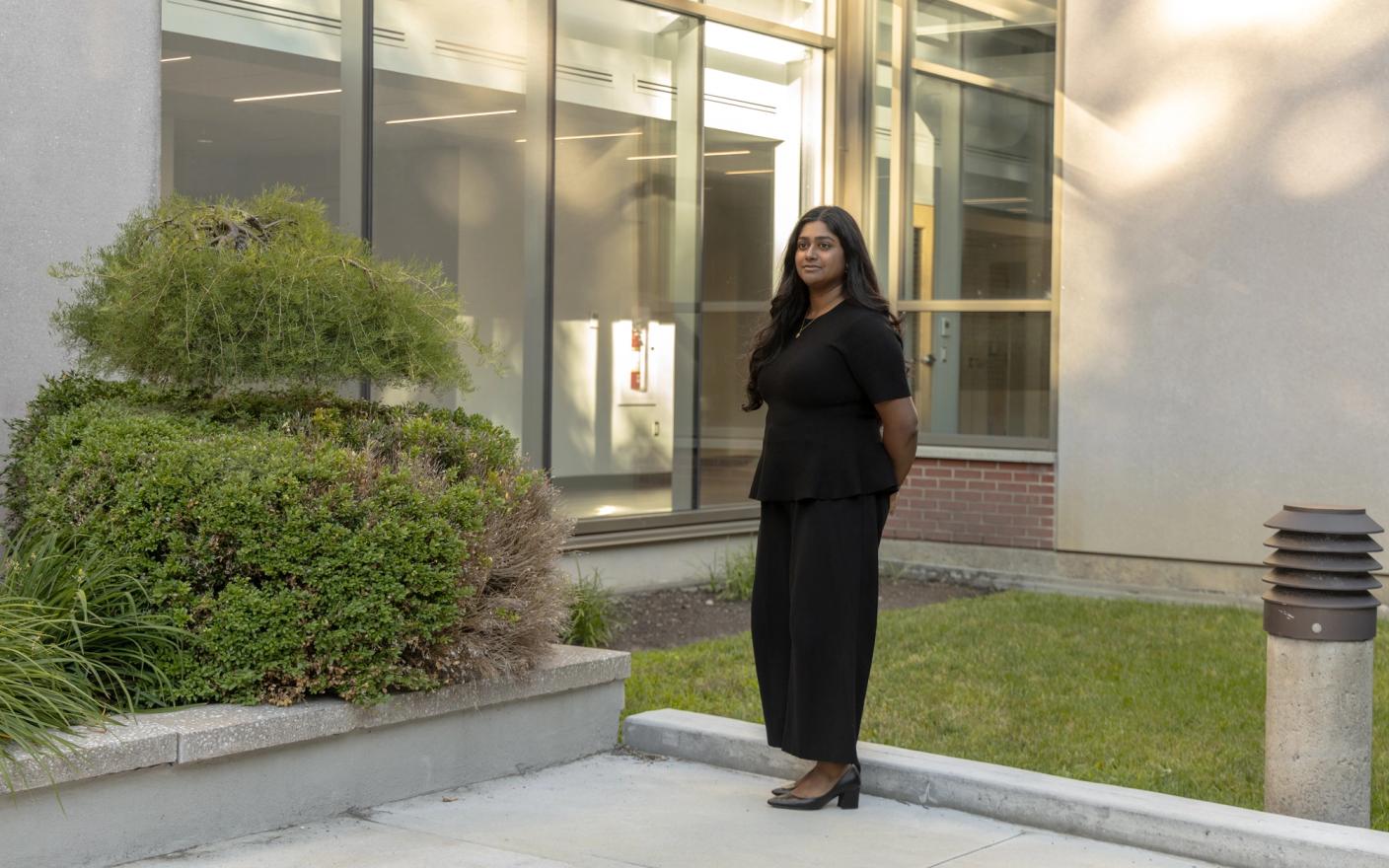
In the fall of 2015, she started her undergrad degree at McGill, studying physiology with a minor in international development. Biochemistry was more something she did on the weekends, she says, as if it were a hobby, like baking or pickleball. While classmates focused on mid-terms and weekend plans, Balendra continued advancing her research. These years also brought challenges that could not be solved in the lab. At 20, Balendra was diagnosed with Hodgkin lymphoma. Shortly after, her mother died of cancer. The experience strengthened a conviction she held that had begun with Lac-Mégantic: chemistry should solve problems without creating new ones. During treatment, she became acutely aware of the ingredients in the products people put on and around their bodies every day.
In 2018, Balendra was selected as one of six finalists in MaRS’ Women in Cleantech Challenge, a three-year accelerator designed to help women founders bridge the so-called “valley of death” between laboratory research and commercial reality. The program provided mentorship, access to federal laboratories and a generous stipend that allowed participants to focus full-time on building a business model. When Balendra launched Dispersa as a biotech company making cleaning agents in 2019, she was still intent on oil-spill remediation. Then the global pandemic arrived and opened her eyes to a much bigger opportunity.
The harmful surfactants used to break down oil slicks are also found in everyday cleaning products – from hand soap and shampoo to kitchen spray and laundry detergent. And now suddenly the world was cuckoo for cleanliness. We bathed produce like precious infants, washed our hands to the “Happy Birthday” song and debated HEPA filters with the confidence of HVAC engineers. Hygiene, once an afterthought, had become a global fixation. Balendra knew what she had to do. She gathered her small team at the office and told them, “We need to wipe the board.”
Five years later, she sits at the forefront of the circular-chemistry movement, trying to solve a problem that touches nearly every household on the planet: how to make the molecules that clean our homes without relying on petroleum or resource-intensive agriculture. Last year, she won the Governor General’s Innovation Award for Dispersa’s first product, PuraSurf, an affordable non-toxic biosurfactant that will eliminate nearly 1 million tons of CO² on scale. Now, to get that product into homes.
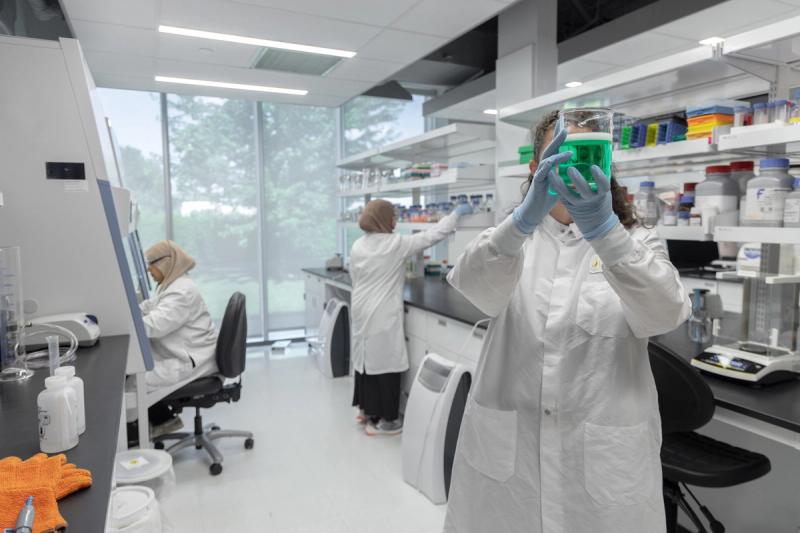
Long before the pandemic, we had quietly become dependent on an invisible class of chemicals. Every spray of glass cleaner, every pump of shampoo and every pod of laundry detergent relies on surfactants – the soaplike molecules that allow oil and water to mix. Today the global surfactant market is worth roughly $50 billion and growing, according to Globe Market Research, a market-intelligence and consulting firm. As standards of living rise around the world, so too does our appetite for these chemicals, more than half of which are still derived from petrochemical feedstocks.
The story of surfactants goes back at least as far as Babylon, when wool and textiles were washed using a mixture of animal fat and wood ash – in other words, soap. Ancient Egyptians later popularized bathing, and there’s a legend that soap was first discovered on a hill called Mount Sapo, where rain washed animal fat and ash together. The story strains credulity, but the science is solid. When fat reacts with an alkaline substance, it creates a molecule with a split personality: a water-loving head and an oil-loving tail. These surfactants (short for “surface-acting agents”) surround grease and dirt, allowing water to wash them away.
For thousands of years, soap production remained constrained by the availability of animal fats and plant oils. Then came the postwar petrochemical revolution. Synthetic surfactants were cheaper, easier to manufacture and remarkably versatile. These “miracle molecules” ushered in the dawn of domestic bliss. Automatic washing machines, sparkling countertops and freshly laundered clothes became symbols of the good life, with little awareness of the dirty little secret underpinning it all.
In the 1980s, environmentalists and chemists alike were searching for cleaner alternatives. Plant-based surfactants such as alkyl polyglycosides (APGs) proved consumers would embrace greener ingredients, but they still depended on agricultural crops such as corn, coconut and palm along with conventional chemical processing. A more transformative solution lay in actual biosurfactants (not bio-based surfactants like APGs) produced naturally by bacteria, yeast and fungi through fermentation. But the problem wasn’t the science.
“For more than 20 years, we’ve been trying to convince people that it would be a good move for industry to move from synthetic surfactants to biological surfactants,” says Eric Déziel, a professor of microbiology at INRS who has studied biosurfactants for more than three decades. “What prevented us was the cost.” According to market research by IndustryARC that was updated in 2025, synthetic surfactants typically cost around US$4 per kilogram to produce, while bio-alternatives can be upward of US$34 – a massive gap for an industry built on commodity pricing and razor-thin margins. Multinational companies including BASF, Evonik and Unilever have spent decades and billions trying to bridge it, but biology simply couldn’t compete with petrochemistry on price.
Déziel first met Balendra when she was a teenage apprentice working at his INRS lab and still pursuing a solution to oil-spill remediation. She had passion, but even more, Déziel remembers her grit: “She’s a survivor.” And to launch a startup, you need to be. Balendra spent time travelling with the findings of her science fair project. Déziel hadn’t seen her in a couple of years when she returned to tell him she was starting her own company. He watched as his former pupil assembled a team. “Nivatha is an impressive entrepreneur.”
It was the same entrepreneurial instincts that told her it was time to abandon oil spills. “You can build a cool technology, but a cool technology doesn’t necessarily mean a scalable business,” she says of the decision to shift her company’s focus to cleaning products. As she began to meet with potential clients, the demand was clear… but so was the problem of affordability.
The solution she landed on was, well, total garbage.
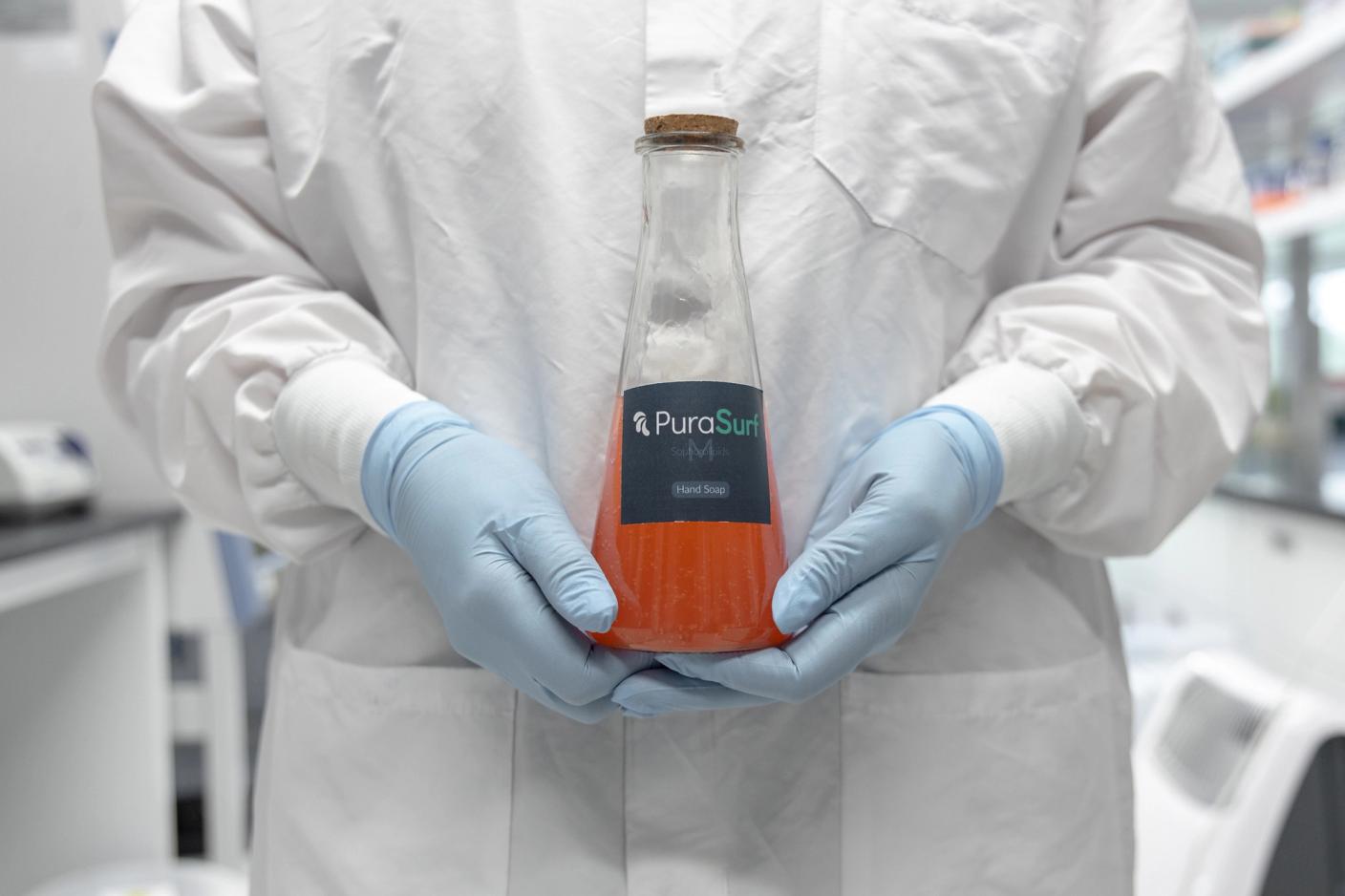
The cost of biosurfactants is multifaceted, but one of the biggest barriers has always been the inputs. In order to kick-start the fermentation process, microbes are typically fed a diet of refined sugars, plant oils and other virgin agricultural feedstocks. As Balendra looked for ways to cut costs, she wondered if maybe bacteria didn’t need a five-star meal, and she moved away from the food supply chain and started looking at waste sources. This microbiological dumpster dive, also known as circular chemistry, was exactly the kind of market differentiator she had been looking for. And it worked.
Within a few years, Dispersa went from laboratory breakthrough to commercial production, an unusually rapid trajectory in industrial biotech. In 2021, the company patented BioEterna, a proprietary fermentation process that converts waste streams into biosurfactants; in 2022, it launched PuraSurf, its first ingredient designed to replace conventional surfactants in everyday cleaning and personal-care products. Already the company was running pilot projects with two major industrial cleaning companies. Balendra can’t name them because they are in the process of negotiating longer-term commercial agreements, but these early customers were a sign that the industry might be willing to back her case.
That case became much stronger once Dispersa was able to show it had a goal of cutting production costs by roughly 50 per cent and a path to full-cost competitiveness in the years ahead. To get there, the challenge is no longer about chemistry. It’s about scale.
Last year, the company closed a $5.8-million seed-financing round, giving it the capital to hire across manufacturing, sales and operations for PuraSurf while building out its commercial production capacity in Laval, Que. The centrepiece is a jump from a 1,000-litre pilot reactor to a 50,000-litre commercial-scale fermentation system.
Even after they’ve made the business case, “the hurdles that these companies face are definitely economies of scale,” says Meaghan Seagrave, director of Bioindustrial Innovation Canada, a non-profit business accelerator. That is the challenge for companies like Dispersa. Seagrave is describing a second death valley, where companies get to the commercialization stage but are unable to produce at the scale needed to displace existing incumbents. Canada, she says, excels at funding research and early-stage innovation but has historically struggled to help companies reach the critical mass required to challenge established global manufacturers.
“You may have a new way of doing it. It may be better from an environmental perspective, and you’ve done the math to prove the economics until you’ve actually scaled that and gotten it into the hands of your off-taker, but it’s still considered high-risk,” Seagrave explains. “We think 5.8 [million dollars] is a lot of money, and it’s a lot of money for a startup, but [for] a startup in this space, it’s pennies.”
The timing may also be working in Dispersa’s favour. As regulators place greater scrutiny on legacy chemical ingredients and manufacturing byproducts – such as 1,4-dioxane, which is likely a human carcinogen and linked to liver and kidney damage – cleaning companies are under increasing pressure to find safer, more sustainable alternatives.
But first, soccer. Balendra was in the U.S. over the summer to attend a FIFA World Cup match, a bucket-list dream that she fit in between work commitments, including attending a conference in Texas organized by the American Chemical Society. Also in attendance were the same kinds of global change-makers she had once stood in awe of as a kid at Summer Davos. Only now she is one of them.
Get our weekly newsletter—the people, places, and ideas revealing where Canada is headed.