Jaiya Varshney has plenty to be excited about.
At 26 years old, Varshney is the co-founder and chief operating officer of Tydra Labs, a three-year-old Vancouver startup that has developed a proprietary process for converting food waste (like fungi and crustacean shells) into a unique fibrillated form of the natural biopolymer chitin. As someone who is passionate about sustainability, she’s lit up by the commercial and environmental potential of what the company produces, which includes applications in cosmetics, packaging, agriculture and food preservation. And in very practical terms, she’s buoyed that the market is into what Tydra has to offer: in April, the company raised $1.2 million in pre-seed funding led by Spring Impact Capital.
Yet there’s no naive idealism in Varshney’s outlook. As a savvy young businessperson with a still-fresh commerce degree, she is very aware that she and her co-founders could be building Tydra Labs elsewhere – perhaps somewhere where money is easier to come by, or universities are a little more agile, or bureaucracy is less onerous. But for now, the plan is to scale the company from her Canadian hometown.
“I think people need to recognize the pros and the cons to building here, because there are definitely both,” Varshney said. She’s encouraged by the current patriotic tenor in promises from business leaders and policymakers, especially the push toward more local supply chains, for example, and the potential ripple effects of major federal projects on manufacturing. “We’re all paying close attention to whether the actions match the words,” she said. “But I really do believe there’s a future for us in Canada.”
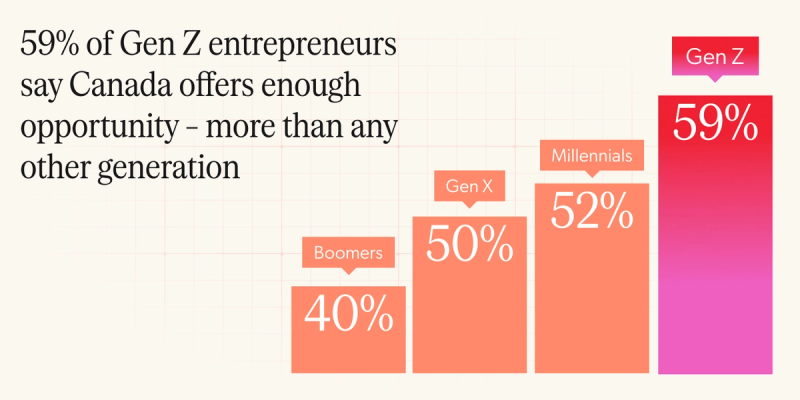
Varshney’s specific strain of optimism – cautious and clear-eyed – appears to be prevalent among her gen Z entrepreneurial peers. One of the strongest themes to emerge from Be Giant’s recent Upstart Index, which polled 3,000 aspiring and early-stage entrepreneurs to benchmark their plans and sentiments, is the sunny outlook of young founders operating in Canada today. Consider that among the gen Z entrepreneurs surveyed:
- 68 per cent said Canada is globally competitive as a place to start a business (versus 61 per cent of millennials, 50 per cent of gen Xers and 47 per cent of boomers);
- 59 per cent agreed that Canada offers enough opportunity for ambitious entrepreneurs (compared to 52 per cent of millennials, 50 per cent of gen Xers and 40 per cent of boomers); and
- 56 per cent felt Canada is more supportive of entrepreneurs than it was five years ago (versus 47 per cent of millennials, 37 per cent of gen Xers and 34 per cent of boomers).
Indeed, across nearly every measurable metric, gen Z founders (gen Zers are those born between 1997 and 2012) are feeling more confident, hopeful and equipped to build businesses in Canada than their older peers. Even amid a global trade war. Even amid the AI revolution. Even amid a “brain drain” that’s purportedly luring their contemporaries to more lucrative locales.
That bullish vibe doesn’t necessarily surprise Rob Ironside, the Calgary-based executive director of League of Innovators, a national charity that provides programs and tools meant to build entrepreneurial acumen in young Canadians. After all, as he explains, entrepreneurs tend to over-index in optimism, as do young adults. But even factoring for this rose-coloured caveat, he confirms that there’s something in the air among the current crop of young entrepreneurs.
In Ironside’s view, the economic, geopolitical and technological turbulence of 2026 is unlocking possibilities for young minds inclined toward problem solving. “The upside of a disruption of this magnitude is that there are a bunch of new opportunities in the spaces that it’s opened up,” he said. Ironside sees AI as a particularly promising playground: a generation of founders who are fully fluent in the technology have a natural edge in building AI-native businesses in a range of industries and helping established organizations adopt it.
Julian Wells is doing just that. Earlier this year, the Toronto-based 23-year-old partnered with his friend Taylor Duncan to co-found North Group, a consultancy that designs and implements AI productivity solutions for businesses. The idea for the company came from the pair’s previous ventures, where they were each building more and more custom AI tools – in Wells’s case, for the student housing data startup Studenthaus – and they discovered other businesses were struggling to do the same.
“My North Star is ‘How can I make Canada a better place?’” he said. “Productivity is one of Canada’s biggest issues, and I think AI can be that fixer that makes employees more efficient, helps them enjoy their job more and brings Canada back to dominance on the world stage.”
Wells’s choice to headquarter North Group at home is deliberate. But it wasn’t always thus: until relatively recently, he’d planned to pursue American citizenship. The geopolitical climate of the past 18 months has taken that off the table. “It’s brought up a sense of patriotism, to question how we can step up and meet this moment for Canada,” he said.
And he doesn’t feel at all alone in that mission: he’s seeing friends and former classmates activated by the circumstances they’re stepping into. “AI, geopolitical tensions and labour market insecurity are all pushing together to create a ball of kinetic energy that’s driving young people to start things – maybe a company, maybe a charity – that drive GDP growth and tons of economic spinoffs.”
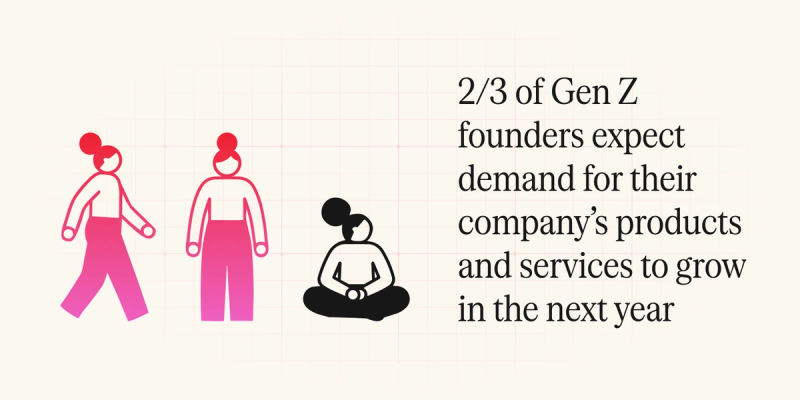
About those economic impacts: across the board, gen Z entrepreneurs have the most ambitious growth plans of any age cohort surveyed for the Upstart Index. Two-thirds expect demand for their company’s products and services to grow in the year ahead, and 70 per cent anticipate that revenues will increase. A majority (58 per cent) are exploring opportunities to expand internationally, which no other age group can claim.
These projections aren’t pipe dreams. There’s a pragmatism to the expansion intentions of many gen Z entrepreneurs, 24-year-old Diana Virgovicova among them. Virgovicova is founder and CEO of Xatoms, a Toronto-headquartered tech startup using AI and quantum chemistry to computationally discover new materials that can be used to purify water using light. As someone who was born in Slovakia, earned scholarships to study in England and Toronto and has raised nearly $4.4 million in grants and venture capital from investors around the world (including an initial fellowship from the 776 Foundation, backed by Reddit founder Alexis Ohanian), Virgovicova could build anywhere. But she feels Canada offers a sturdy foundation for the kind of growth she is chasing.
In Virgovicova’s experience, being headquartered in “the birthplace of AI” – Toronto is, after all, where computer scientist Geoffrey Hinton did the foundational work that earned him a Nobel Prize – gives Xatoms access to exceptional talent and research capabilities at a far more reasonable cost than comparable U.S. tech hubs. She also points to government-backed programs – such as the Scientific Research and Experimental Development (SR&ED) tax credit, Industrial Research Assistance Program (IRAP) grants and not-for-profit Mitacs talent supports – as meaningful boosters.
Besides, Virgovicova is not a fan of raising huge sums of money for the sake of it – something she sees backfire more often than not among her peers in Silicon Valley. “It’s kind of a fake narrative, especially for young people,” she said. “Here in Canada, I feel like people really value the dollars they raise and are able to allocate them in a very smart way to be as efficient as possible.”
None of this is to suggest that the optimism of Canada’s young entrepreneurs is unfettered. Most know there are drawbacks to building here: a high cost of living, scarce availability of risk-tolerant capital, an overabundance of red tape. More than a third of gen Z survey respondents have seriously considered relocating their business, the highest share of any age cohort.
But considering is not leaving. For every headline about Canadian talent decamping stateside, there’s a Varshney or a Wells or a Virgovicova choosing to plant a flag at home – not out of obligation, but because the math, increasingly, works. "I think the grass has always been greener on the other side," Virgovicova said. "But for me, Canada is kind of a land of opportunity."