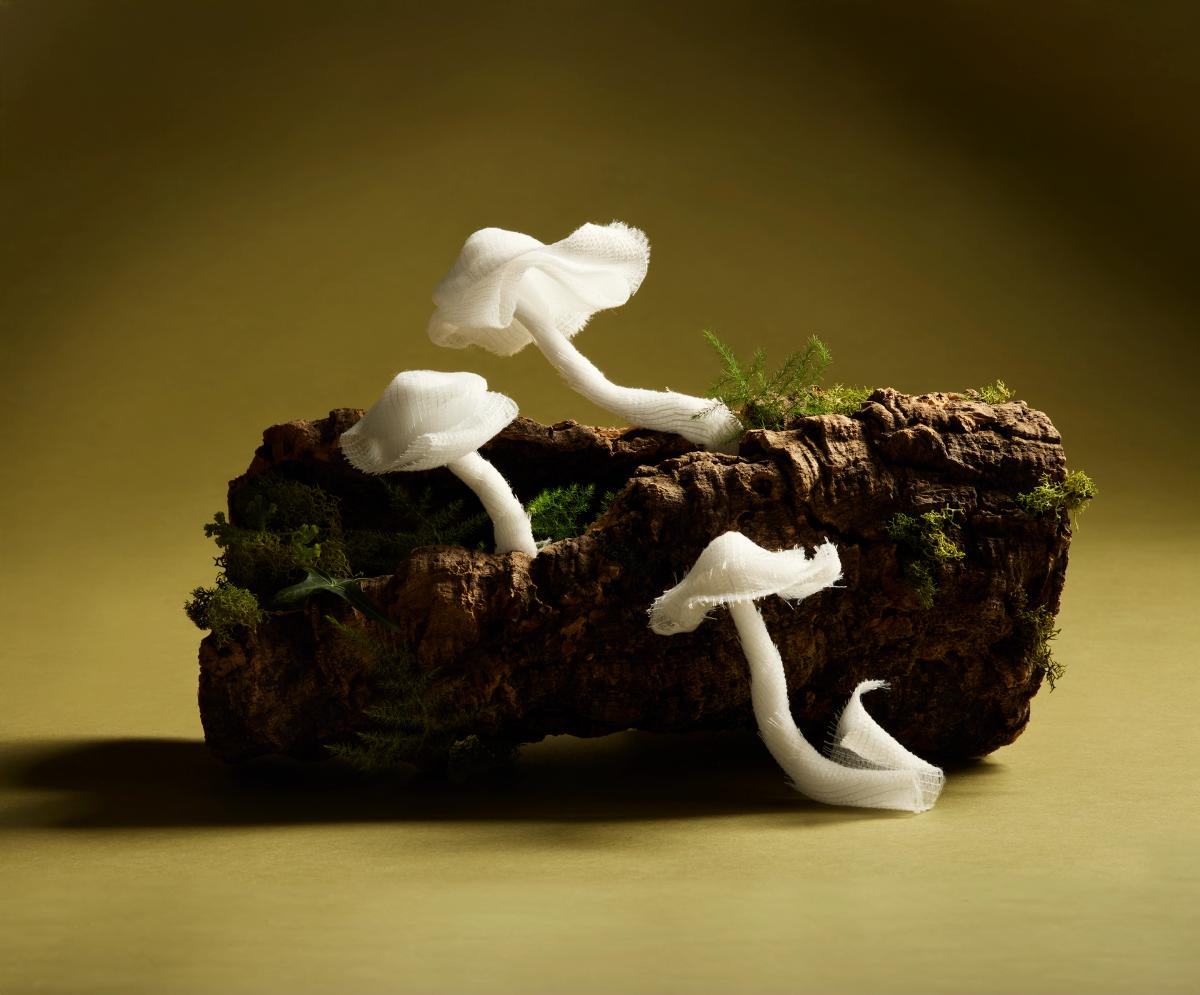
What it is: Environmentally friendly gauze made by harvesting material from mushrooms. Gauze – typically made from cotton or synthetic fibres – is used to heal wounds and stave off infection. It’s one of the most essential but waste-generating categories of medical supplies.
Who’s behind it: In 2024, a group of undergraduate students in two departments at Western University – biology, and dentistry and medicine – wrote a research proposal on using mycelium, the root-like, fibrous structure of fungi that grows in the soil, as a substitute material for gauze. The initial abstract, which outlined how to use a species of mushroom to create a sustainable gauze that would help in wound healing, was submitted to the SciNapse Undergraduate Science Case Competition hosted by the University of Ottawa.
The idea emerged from the students’ research into mycelium as a biomaterial for skin scaffolding. “We tried to find a different application of that principle that hasn’t really been done much in previous research,” says Amy Shi, one of the lead authors on the proposal and an undergraduate student at Western’s Schulich School of Medicine and Dentistry.
What problem is it trying to solve?: In 2019, a study found that just 110 of Canada’s more than 1,000 hospitals generated 87,000 tons of waste each year – the equivalent of the Great Pacific Garbage Patch. This includes items such as masks, gowns, IV bags and, yes, gauze. Most gauze is made from cotton, rayon or synthetic fibres such as polyester. Many synthetic fibres are derived from petroleum, while cotton can be a water-intensive crop.
“We have a lot of medical textile waste,” says Lisa Zhu, another co-author on the proposal and a Schulich undergrad.
The students wondered whether they could have a positive impact on the environment and climate change by using the unique properties of mycelium. “One of the benefits of mycelium is the fact that it can biodegrade,” says Zhu.
“The production of mycelia would actually be very sustainable,” adds Shi. “It doesn’t take much to grow it, and you can use things like agricultural waste [to produce it].”
How it works: We’re not quite ready to plaster our skin with mushrooms, but mycelia from various species have been studied for their potential both within and beyond the medical field. In 2020, Vogue featured mycelium as a leather alternative, and companies such as MycoWorks and Bolt were making cloth from the material. In 2022, Swiss architects reviewed the use of mycelium for building, noting that mycelium-based materials had potential for non-structural applications such as thermal or acoustic panels because of their insulative and fire-resistant properties. The following year, researchers in British Columbia looked at using mycelium for single-use face masks, perhaps the closest application to gauze.
In medical settings, using mycelia has been appealing in certain applications because some fungi species have been found to mimic the human “extracellular matrix” – a mixture of proteins and carbohydrates that exist outside of cells and help provide structural integrity to our tissues. While brainstorming, the students came across mycelium as a potential biomaterial for skin scaffolding – engineered structures that skin cells can attach to as they grow. This is especially useful in situations where wounds are chronic, such as ulcers or bed sores.
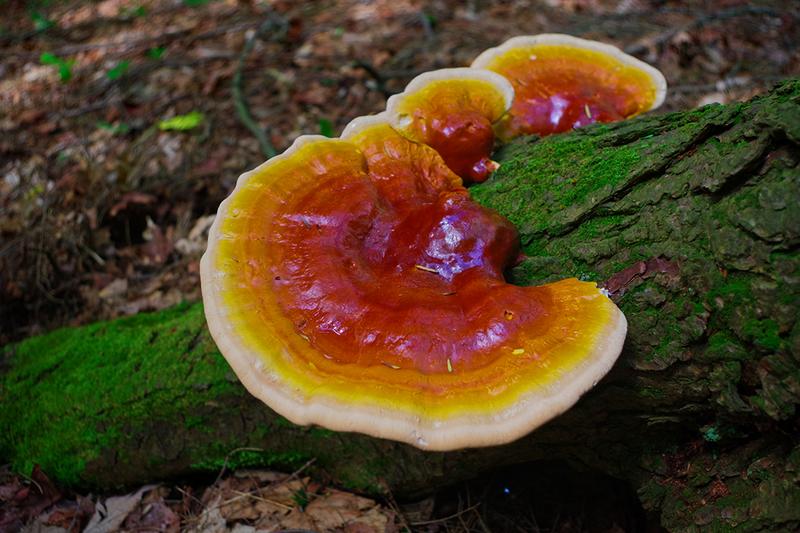
What are the main challenges it faces? Sourcing mycelium for gauze is more complicated than popping into the grocery store and picking up a container of cremini mushrooms. Based on their research, the students suggest using a species called hemlock varnish shelf (Ganoderma tsugae), which grows primarily on eastern hemlock trees.
Shi says the mycelium from this mushroom is made up of materials that bind to receptors on human immune cells to “activate an immune response and secrete factors to improve [skin] growth.” If mycelium gauze eventually comes to fruition, the students believe it might diminish the need for extensive antibacterial ointments because it would have inherent wound-healing properties.
Of course, you can’t take mycelium from the ground and apply it to skin directly. It would need to be cleaned, chemically manipulated and freeze-dried. This new material would be used to create fibres that serve as the basis for the gauze.
What’s next? The students are now back to their studies. “I think these case competitions are mostly theoretical and kind of just trying to be innovative,” says Shi.
But while they’re not pursuing the practical portion of their proposal, there’s clearly promise in their work. The project was named a finalist in the competition, and the group had the opportunity to expand on the initial abstract – including a proposed methods section – to get it peer reviewed. It’s since been published in the Undergraduate Research in Natural and Clinical Science and Technology Journal (URNCST).