It’s hard to believe now, but growing up, Cedric Attias wasn’t a big baseball fan.
“Quite frankly, I thought it was boring,” he says.
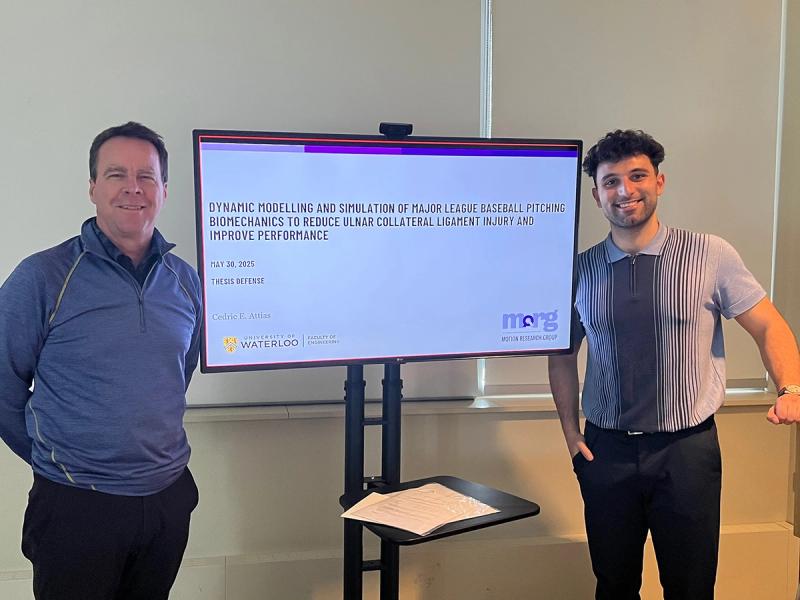
It wasn’t until he was pursuing a master’s degree in mechanical engineering at the University of Waterloo that he started paying attention to the sport – and, even then, it was for scientific reasons. Attias led a unique study that found ways to reduce the risk of an elbow injury while pitching, without compromising velocity.
He used an advanced computer model to show how pitching mechanics impact the ulnar collateral ligament (or UCL). Injuries to this band of tissue, located on the inside of the elbow, are prevalent in baseball, impacting pitchers from the major leagues right down to youth levels. The issue, Attias explains, is repetitive stress. Repeated overhead movement – such as the throwing motion needed to pitch – can cause the UCL to break down. Toronto Blue Jays fans saw this first-hand when key starter José Berrios was sidelined for the 2026 season after undergoing UCL reconstruction, also known as Tommy John surgery.
Now based in Toronto and working remotely as a biomechanist for the Seattle Mariners, Attias led research that could play a role in reducing the risk of injury and serve as a tool to teach kids safer mechanics. Be Giant chatted with him about what a biomechanist does day to day, his research and how his findings are changing the game – literally.
Get our weekly newsletter – the people, places, and ideas revealing where Canada is headed.
What does a biomechanist do?
Attias’ job with the Mariners involves examining movement data to draw conclusions about performance or injury. For instance, if a pitcher isn’t throwing as hard as he used to, Attias can examine metrics like stride length, joint angle and arm acceleration to identify the problem. On a day-to-day basis, he’s crunching numbers, coding and using different mathematical and physics principles to help make assessments. His engineering background comes in handy.
“[Engineers] can explain how things move, and we understand the principles of physics,” he says. “Because, ultimately, the way the human body works is purely physics. [How] people get injured is physics. It’s forces and torques over time or forces and torques in an instant.”
What inspired this research?
During Attias’ undergraduate degree in biomedical engineering at Waterloo, he developed an interest in biomechanics. When it was time to decide what to do after graduation, he approached John McPhee, a professor in systems design engineering, about graduate studies.
As it turned out, the Mariners had approached the university to outsource research into the best ways to maintain elite pitching performance without risking injury. If they supplied data, could a graduate student take on the project? McPhee asked Attias if he was interested. He was.
“It was my goal to create this novel research area using different theories and practices in biomechanics to balance both injury and performance,” he says.
What did he learn?
To examine the twisting forces on the UCL during the throwing motion, Attias built a predictive digital musculoskeletal model proportional to a major league pitcher. He then ran his model through different simulations.
To push it to its limit, he asked the model to throw the ball 110 miles per hour, stretching the bounds of what’s believed to be humanly possible. (For context, the fastest recorded pitch in Major League Baseball is 105.8 m.p.h.)
The model produced a pitcher that “looked like a cricket bowler,” Attias says, with an extreme torso tilt away from the throwing arm and an arm slot (the angle of the arm relative to the ground when the ball is released) that was over the head.
Attias was stunned. It didn’t look like the pitching motion we’re accustomed to seeing. However, while scrolling social media, he discovered a college-level pitcher with similar mechanics (though that athlete didn’t throw 110 mph). This reassured Attias that his model was grounded in reality. “It wasn’t something a human couldn’t feasibly do,” he says.
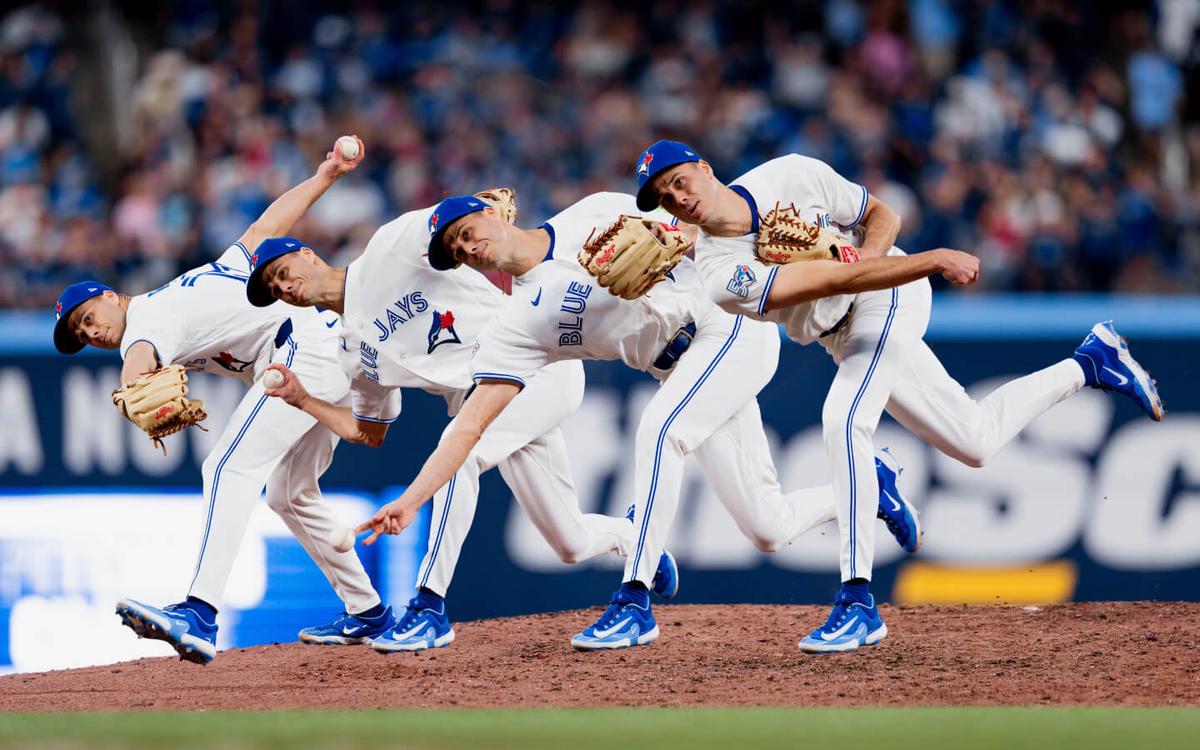
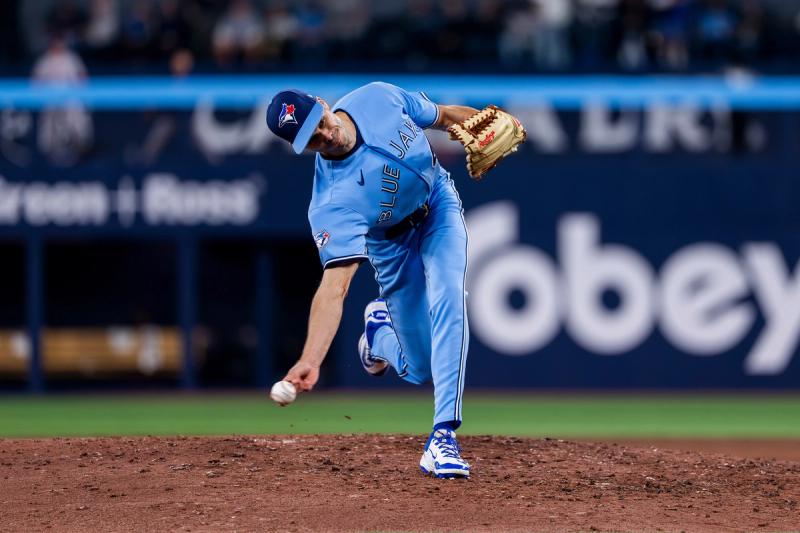
Conversely, when he told the model not to worry about velocity but to minimize torque on the elbow (which contributes to UCL injuries), he says it produced a pitching motion with the torso “tilting toward the throwing arm versus away from the throwing arm, with a really low [arm] slot.” It looked like what’s typically called a “submarine” delivery, which is when a pitcher releases the ball just above the ground.
In fact, it looked nearly identical to the delivery of Toronto Blue Jays relief pitcher Tyler Rogers, whose fastball averages 83.2 m.p.h., the slowest in the majors (and who has never had a serious UCL injury).
Why does any of this matter?
Pitching mechanics affect velocity first and foremost, Attias says. But adjusting the position of the arm slot or the degree of torso tilt could help protect players’ UCLs – without completely sacrificing speed.
“If you want to throw faster, lean further away from the throwing arm and increase the arm slot to go more overhead,” Attias says, though he notes this motion puts the elbow most at risk. “If you want to protect the UCL, lean toward the throwing arm and tuck it in and go a little bit more of a sidearm delivery.”
What’s the best real-world usage of this research?
It’s impossible to completely prevent UCL injuries. Some strain on the ligament is unavoidable, not to mention the impact of other factors like diet, sleep and strength training. How the Mariners are using the Waterloo-developed model is unclear. However, Attias hopes his public research can be applied toward educating young players on best practices for pitching.
“If you have the foundation of those mechanics in the long term, I think that will help you, especially given the nature of the injury being such a long-term accumulation injury,” he says.
So, what’s the verdict on baseball now?
While he didn’t grow up as a baseball fan, the job has led to a newfound appreciation, Attias admits.
“My job is going through data. But I watch baseball for fun now, because I do love the sport.”