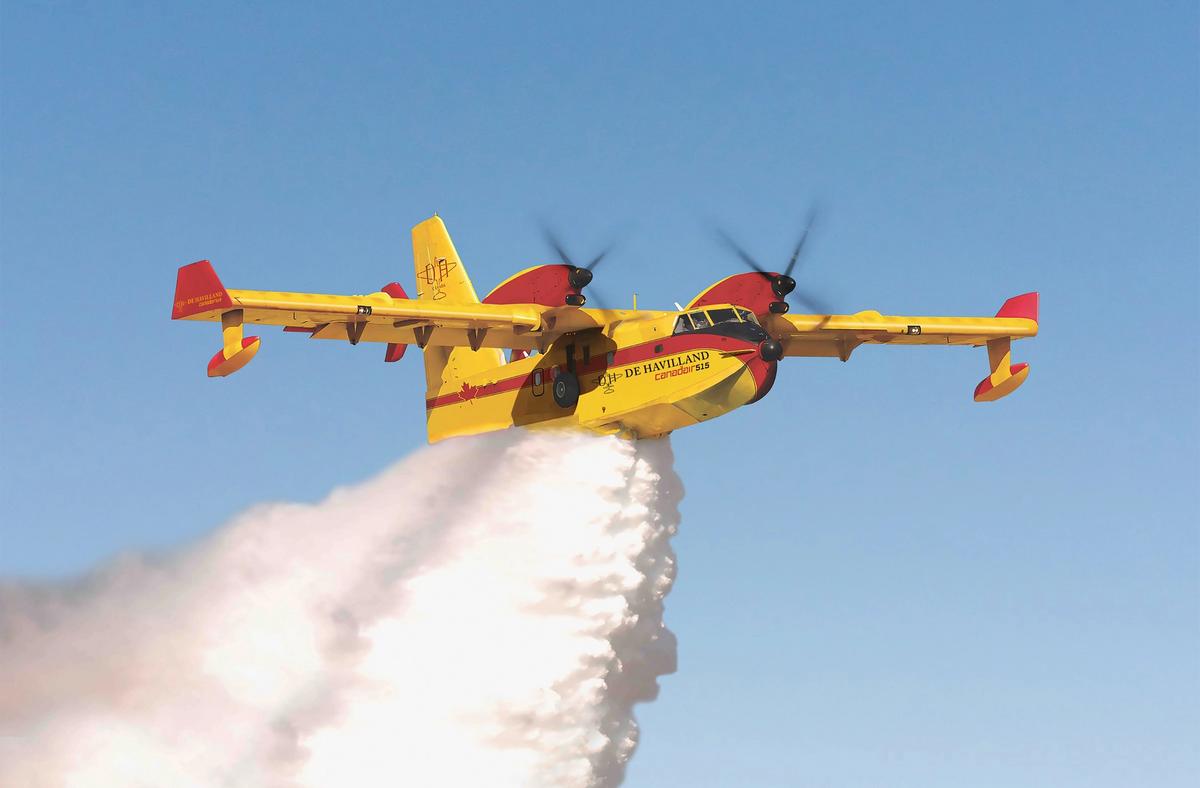
De Havilland’s banana-yellow Super Scooper looks like something drawn from the cover of a 1960s Beatles album. But the deceptively retro airplane is actually the only purpose-built water bomber currently in production. In aerial firefighting, it’s prized for its hulking tank capacity and its remarkable adroitness when scooping: the DHC-515 can lift 6,000 litres of water can lift 6,000 litres of water from a lake or river in 12 seconds. On Oct. 30, at the Canada-EU Summit in Montreal, Prime Minister Mark Carney announced up to $2.5 billion in financing to help De Havilland open a second production line in Wheatland County, Alta.
Given the record-breaking scale of forest fires here and around the world, it’s surprising that the celebrated amphibious scooper fell out of production little more than a decade ago. As De Havilland gears up for the spike in orders, Be Giant explains what exactly makes the water bomber a Canadian marvel – and why competition for it is so intense.

Get our new book for free.
Subscribe to our newsletter and we’ll mail you a printed copy.
Canadian tech from the start
The original Super Scooper was produced by Canadair, who gave the public its first glimpse of the bomber’s design at the Paris Air Show in 1965. A few years later, Quebec became the first Canadian province to score scoopers of its own. That early model, known as the CL-215, is still considered a cornerstone of aerial firefighting, built to carry more than 5,000 litres of water in belly tanks that get filled by rotating aluminum scoops as the plane skims the water.
In the 1980s, the bomber passed from Canadair to Bombardier, whose updated model is still widely in use. The CL-415 travelled faster, carried heavier loads, could mix water with a fire-suppressing foam while in flight and even turn while scooping.
But the customers buying these planes were governments, and during the global slowdown of 2015, orders dried up. Bombardier sent the workers at its North Bay assembly plant home and sold the water bombers to Viking Air, which eventually merged with De Havilland. At the time, De Havilland owner Sherry Brydson – a granddaughter of Roy Thomson and the largest shareholder of Thomson Reuters – said she wanted to keep these well-known Canadian-made airplanes in Canadian hands.
The competitors are coming – but not fast enough
While De Havilland’s scoopers dominate the market, three French aeronautics companies are lining up to challenge them. Two years after launching, Positive Aviation is claiming that its new bombers will carry 8,000 litres of water, 33 percent more than De Havilland’s 515s. The company plans to begin delivery of 12 planes per year in 2030.
Another French startup, called Hynaero, says the water bomber it’s working on – the slender, modern-looking FREGATE-F100 – would fly faster than De Havilland’s 515 and carry 10,000 litres of water. It hopes to have a prototype flying by 2030 and in service by the end of 2031.
The most established contestant going up against De Havilland is the 14-year-old Kepplair Evolution, which is building a water bomber on one of its existing airframes. It unveiled a prototype in August and claims the plane will be in service by 2027, matching De Havilland’s timeline for delivery of France’s new scoopers.
Meanwhile in Italy, 19-01 Holding is partnering with Italdesign on a bomber that could carry 12,500 litres of water if the prototype, due in 2028, flies.
The race to build these machines is becoming an international necessity, as Emily Hope, a researcher studying the economics of aerial firefighting at the University of Toronto’s Fire Management Systems Laboratory, sees it. She lists longer fire seasons that put pressure on existing fleets, more intense fires and public concern about bad air quality caused by smoke as factors that are drawing new manufacturers to the market. She also notes that European nations are currently relying on aging Canadair water bombers.
“Countries that didn’t necessarily have a demand before are interested in expanding their fleets,” she says, and that in turn is putting pressure on international governments to start investing.
What’s the price tag on a Super Scooper?
One DHC-515 costs roughly $80 million – but “it’s not as simple as signing a contract for a new $80-million aircraft,” says Hope. There’s the additional expense of “the many pieces in the support systems that need to be functioning seamlessly to get these machines off the ground” and to keep them operating safely. “The cost of an air tanker,” she says, “is not the cost of an air tanker.”
Mike Flannigan, director of the Institute for Wildfire Science, Adaptation and Resiliency at Thompson Rivers University in Kamloops, B.C., estimates that each Super Scooper costs about $40,000 per hour to operate.
At least they put out fires
In fact, they don’t. Super Scoopers help slow fires and limit damage. Their job is actually to cool a fire, often working in tandem with large air tankers that drop a red-hued fire suppressant to corral whatever is burning. These large aircraft are managed by a Bird Dog, a smaller plane that carries a so-called air attack officer who directs the bombers and tankers, telling them where and when to air drop their fire-suppressing cargos.
“What Super Scoopers do is buy you time,” says Flannigan, explaining that all fires start small, which is when aerial firefighting is the most effective. “Sometimes that window is narrow – 30 minutes, sometimes even less.”
Why the provinces need help from above
Land management is a provincial responsibility, which leaves the provinces and territories in charge of fighting their own wildfires – and purchasing their own bombers. Quebec has the largest fleet (14), followed by Ontario (9), Manitoba (7), Saskatchewan (6), Newfoundland and Labrador (5), and Alberta (4). British Columbia leases its water bombers from companies such as Conair, though B.C. Premier Lorne Doerkson pledged to purchase a fleet during last month’s election. New Brunswick and Nova Scotia mostly use smaller, American-made Fire Bosses. In P.E.I., fire-fighting is ground-based because of its size, and Nunavut doesn’t need bombers because it’s largely tundra.
It’s the job of the Canadian Interagency Forest Fire Centre (CIFFC) to move these resources around when needed; but, according to Flannigan, the system remains strained for two reasons. First, governments only call for help once a fire is already raging, and sometimes it can take a few days for lenders to get equipment and crews ready and dispatched. The second is that provinces hold back resources in case they need the planes and crews to fight their own fires. “Often it takes three days for firefighters from Ontario or Quebec to get to B.C. and that’s three days too late,” Flannigan said.
But the federal government’s announcement is a shift in the wind. Investment in a second production line for De Havilland, Carney, said, will “significantly increase” the number of these “world-class aircraft” in circulation – not only for the provinces but for Canada’s partners.