Robert Weatherbe loves a creative solution. Almost four decades ago that meant driving around Vancouver in an old hatchback with his longtime business partner, Louise Schwarz, collecting used office paper for recycling.
As they expanded their sustainable waste management company, Recycling Alternative, it meant producing their own biodiesel for a fleet of trucks, then developing software to track waste-diversion metrics for their commercial and institutional clients, monitoring how much recycling they kept out of the garbage.
So, when Recycle BC, the non-profit that manages British Columbia’s residential recycling system, put out a request for proposal for a new contractor to collect from apartments and condos in downtown Vancouver, Weatherbe was intrigued. The catch? The contractor would need to pick up four separate streams of recycling from each building, one more than previously collected. Alongside glass, paper and cardboard, and metal and hard plastic containers, the new contractor would also need to collect flexible plastics.
Get our weekly newsletter – the people, places, and ideas revealing where Canada is headed.
B.C. is seen as a recycling leader in North America. Its residential recycling system operates under an extended producer responsibility model, where companies that supply packaging to residents are responsible for it over its full life cycle. They fund the Recycle BC program, largely by charging consumers an added fee to cover its collection and end-of-life management.
Between 2008 and 2022, the city cut the amount of waste that ends up in the landfill or incinerator by 36 per cent, from 476,000 tonnes to 305,000 tonnes annually. But materials that could be composted or recycled are still ending up at the dump, says Jonathan McDermott, the City of Vancouver’s director of solid waste management, in a statement to Be Giant.
In 2025, Recycle BC collected 218,405 tonnes of material across the province, sending roughly 95 per cent to end markets for recycling, according to its annual report. About 92 per cent of paper products, 74 per cent of metal and more than 100 per cent of glass supplied by producers last year were collected for recycling. But the rate for plastics is much lower – just 45 per cent.
To improve this, Recycle BC launched a pilot project in West Vancouver in 2021 to collect flexible plastics from the curb: things like the plastic wrapping around toilet paper, produce bags and the pouches that carry frozen fruit.
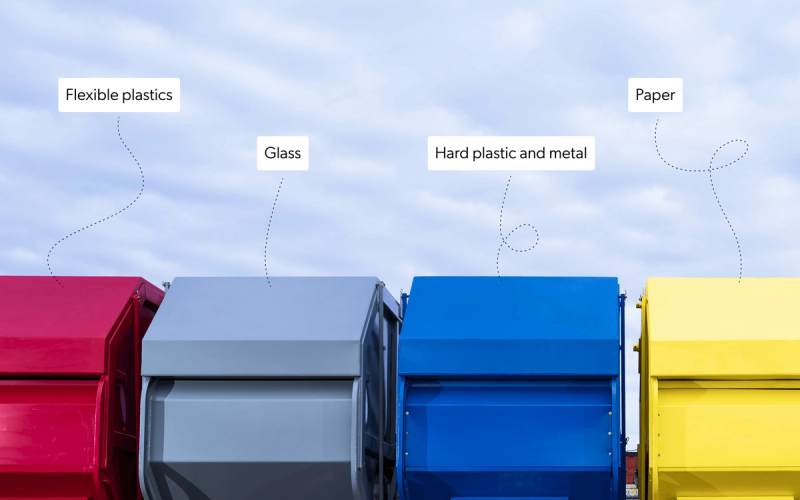
West Vancouver residents sort their recycling into different bins. Hard plastic and metal in a blue box, paper in a yellow box, glass in a grey box. The new flexible plastic stream came with a pink box – and a new logistical challenge for collection.
In West Vancouver, Recycle BC ran a second truck to pick up flexible plastics as an interim solution, says Sam Baker, the non-profit’s executive director. But when the organization set out to expand flexible plastics collection to other communities, it wanted to deploy a more efficient solution – a four-stream truck.
Weatherbe describes Recycling Alternative’s first iteration as a Lego truck. It’s got a white cab with four large compartments lined up behind it, each one colour-coded to a different stream of recycling. The second iteration sports the same overall layout but is electric, with a fully digital system. Soon all the trucks will also carry on-board cameras to monitor for contamination. The company will be able to help offending buildings improve their recycling systems by sharing details about the contamination and providing educational videos building managers can distribute to residents.
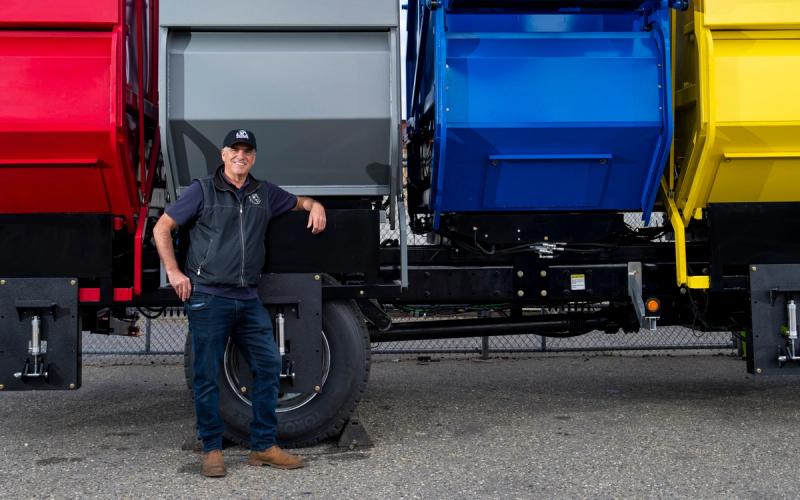
But the company’s trucks weren’t ready by the time it took over recycling collection for the 2,400 condo and apartment buildings in downtown Vancouver in February. While the company knew the electric four-stream trucks wouldn’t be ready by the contract’s start date, it hadn’t planned for manufacturing delays in the delivery of the Lego trucks, too. It also ran into trouble with the rental trucks it had arranged to bridge the gap before its EVs were ready – they kept breaking down. There were more delays getting the key fobs it needed to access some of the buildings downtown.
Some buildings wound up with overflowing recycling bins for weeks. The mess made headlines. “This is not an acceptable situation,” one resident told CTV in June.
“People are passionate; I mean, they’re passionate about their recycling, and we certainly heard it on the phone lines,” Weatherbe says.
“You need to take a certain amount of risk to push innovation forward, and sometimes that comes with challenges,” Baker says. He notes U.S. tariffs disrupted supply chains, which likely played a role in the delayed delivery of some of the four-stream trucks. Recycling Alternative’s Lego trucks were finally delivered at the end of March, and by late July, the collection process was in a much better place. The company’s first EV truck will be delivered in September, with four more on the way.
After the success of the West Vancouver pilot, which saw a threefold improvement in flexible plastics recovery, Recycle BC is working to expand collection to more communities. And those frozen fruit pouches and empty cereal bags can be turned into plastic pellets at a facility in B.C. and used to make new products like plant pots, garbage cans – or even more packaging.