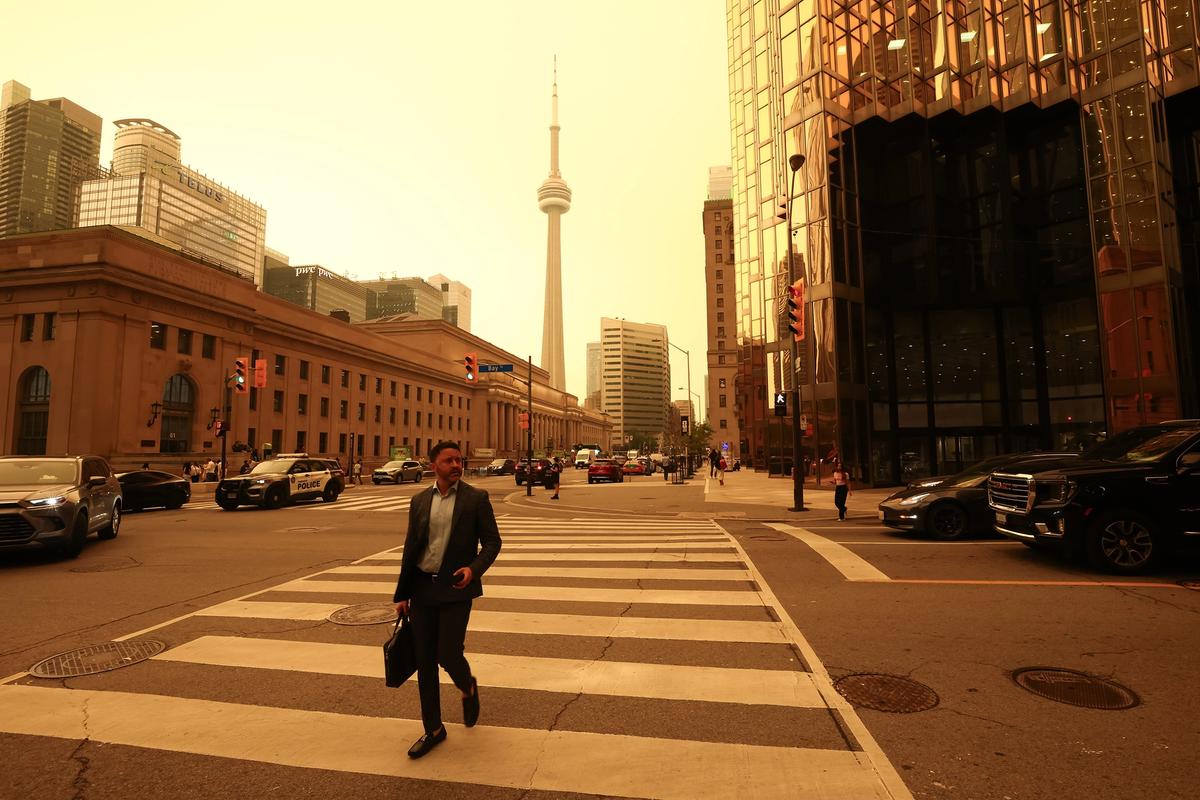
On Wednesday, July 15, Torontonians looked to the sky and found the sun obscured by haze. It wasn’t smog or fog – it was smoke drifting down from 185 active wildfires in northern Ontario.
As the day waned, social media feeds filled with photos of apocalyptic scenes the smoke had produced, captioned with descriptions of dystopian feelings of déjà vu. It was only three years ago, in the summer of 2023, that wildfires in Quebec and Ontario similarly shrouded Toronto in smoke for multiple days-long stretches. At first, many people continued about their day. But after some time spent outside, some found they were struggling to catch their breath. Others noticed they felt a bit fuzzy, a bit slower than usual. People made more mistakes – maybe even umpires calling Jays games.
Forest fires release immense amounts of fine particulate matter called PM 2.5. Out-of-control blazes burn through all sorts of fuel: different types of wood, plants and animal life but also human-made creations such as houses and cars. The fine matter in the resulting smoke is a cocktail of things that are terrible for mammals to breathe in. The particles irritate our throats, airways and lungs, causing inflammation. Gases that travel with the smoke cause further irritation. The smoke is especially risky for people with lung conditions such as asthma since it increases inflammation.
But that’s not the end of the ill effects. The very smallest particles, less than 0.1 microns of aerodynamic diameter, can pass through the lungs into the bloodstream, pumping foreign matter through the whole body – even to the brain.
Air quality reporting in Toronto didn’t reflect that risk. In 2023, Ontario still used an Air Quality Health Index (AQHI) system that evenly weighted PM 2.5, ozone and nitrogen, a holdover from when pollution was the most pressing air quality concern. As a result, Ontario was reporting moderate air quality on days when the amount of PM 2.5 in the air was very high.
Worse still, it appeared very few Canadians bothered to explore their own personal risk. An Impact Canada study to be released this year found that fewer than half of those surveyed had looked up information about wildfire preparedness during the 2023 wildfire season, even though more than half had experienced wildfire smoke. As climate change worsens forest fires, the number of people who find their summers interrupted by smoky skies will only increase – and, as we’ve seen this week, it is rural and Indigenous communities who feel the worst of the effects.
What Canadians need to learn – and fast – is the very specific risk wildfires pose to their health. Luckily, some solutions are underway.
In 2017, the government of British Columbia approached Sarah Henderson and her team at the BC Centre for Disease Control with a request. Wildfires were worsening. And the government was receiving angry letters and calls from constituents who were rightly pointing out that provincial AQHI wasn’t giving them the information they needed. The government wanted a solution.
Henderson tested three different models against different acute health outcomes. In one, if the total level of PM 2.5 was higher than the average of all three pollutants measured in the traditional AQHI, then only the level of PM 2.5 was used to report air quality.
“It was the best model at predicting acute outcomes among people with asthma,” says Henderson of the system that would soon be named AQHI-Plus.
Putting a number to the air quality actually helps people better understand risk, according to Cathy Slavik, the Legacy for Airway Health chair in health communications at Simon Fraser University. “It’s not enough to just tell people there’s a lot of smoke in the air or a high level of air pollutants in the air,” she says. “The numbers on the scale do really serve as a reference point for people to understand how bad the air is.”
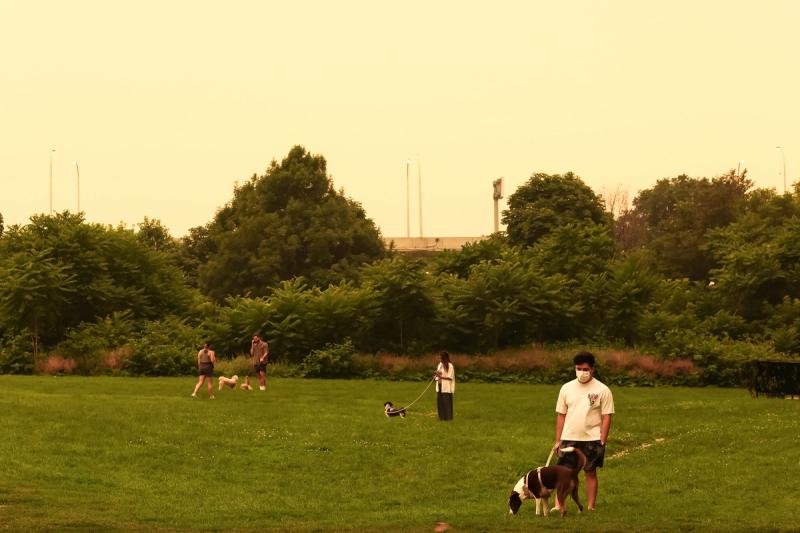
The goal is to get people to change their behaviour to mitigate smoke exposure. Instead of going for a run outside, go to the gym and use the treadmill. Instead of taking your kids to the playground, go to a community centre. Instead of cracking the windows open, think about putting an air purifier on. While it may be impossible to prevent smoke exposure completely, those actions can prevent individual acute medical crises that add up to a huge public health problem.
The Canadian Climate Institute estimates that just one week of wildfire-smoke exposure in Ontario in 2023 cost the province $1.28 billion in health-care costs. Then there’s the long-term health effects, which include increased risk of lung disease, cancer and dementia.
AQHI-Plus rolled out as a pilot project in British Columbia in 2018. It was then adopted slowly across Canada. In 2024, Ontario started using it too. Now almost every province uses it from May to October, if not year-round. (Quebec uses AQHI-Plus for wildfire smoke only.)
It seems like this should solve the problem, no? But that take assumes the monitoring itself is equal across the country. In reality, there are approximately 200 air-quality-monitoring stations across Canada (the number can vary due to stations periodically going offline), most of them located near larger population centres. Compare that to more than 2,000 in the United States. Part of the issue is that monitoring stations that can measure all three factors in air quality are large and expensive. But an insufficient number of stations leaves many communities, particularly those in rural areas or the Far North, without accurate air quality information.
The results can be deadly. In 2023, during the same brutal wildfire season that saw smoke arrive in Toronto, more than 360 wildfires were burning across British Columbia – sending air quality plummeting across central and northern parts of the province. Carter Vigh, a nine-year-old boy from 100 Mile House, B.C., died from an asthma attack that July. His parents told the CBC they had checked the air quality that day. The risk was low. What they didn’t know was that the closest sensor to them was 100 kilometres away.
This is part of the challenge of monitoring air quality when wildfires are at play. Wind and rain can shift smoke’s path, so that one community has low risk while others are at very high risk of breathing in fine particulate matter – yet if they all rely on the same sensor, they will all have the same reported air quality.
Soodeh Saberian, the Canada research chair in economics of climate change, disasters and inequality at Thompson Rivers University, notes that in less-populated provinces, a handful of monitoring stations are often expected to stand in for an entire region. ”When the government issues AQHI-Plus warnings, they assume that the rest of the province has exactly the same level of air quality, which is wrong,” she says.
However, many provinces are piloting lower-cost solutions. The Vigh family and the BC Lung Foundation have partnered to install smaller sensors in rural communities. These outdoor air quality monitors, made by American company PurpleAir, measure only PM 2.5. They are about the size of a coffee cup and need a power source and Wi-Fi or cellular network to run. PurpleAir sells them at retail for US$289 (C$406).
The monitors also publicly report their data, which reaches into Far Northern Canadian communities. Other provinces are piloting similar projects. In Alberta, for example, Aeroqual AQY Sensors are being installed in places where there are gaps in monitoring. The province also has mobile PM 2.5 sensors that can be set up in the event of a wildfire emergency. In turn, meteorologists working for Environment and Climate Change Canada can tap into these networks of smaller censors to issue more accurate air quality alerts. And Henderson is working on a new model called the Canada Optimized Statistical Smoke Exposure Model – or CanOSSEM – which integrates censor reporting with satellite data to measure PM 2.5 in the atmosphere. It can help meteorologists make better forecasts and identify areas that need better on-the-ground air quality monitoring.
Smaller monitors, as helpful as they are for filling gaps, are not a fix. Wi-Fi and electrical power are not a given in the North, particularly in First Nations and Inuit communities, which are often most at risk of wildfires. Geography is one reason these populations are more vulnerable – the further north you are, the closer you are likely to be to wildfire smoke. But, according to Jessica Buckley, president and CEO of the Lung Health Foundation, First Nations people are also disproportionately impacted by lung disease.
“If there are wildfires impacting and triggering lung conditions, then it would be especially difficult for them under those circumstances,” she says.
In the late 2010s, Saberian ran a study on Major League Baseball umpires. She was interested in how accurate their strike calls were, though not for the reason most sports fans are. Saberian was specifically looking at the calls made by umpires when there were increased levels of PM 2.5 and other pollutants in the air. The results were a demonstration of how myriad the effects of fine particulate matter on the human body are.
“They make more errors in response to PM 2.5 on polluted days,” Saberian says. “Their cognitive performance is lower.” To extrapolate: even in the short term, breathing in wildfire smoke makes us less sharp.
But the umpires have some advantages other outdoor professions don’t. They are paid well and enjoy health benefits, and their employer will postpone games rather than expose players and staff to dangerous conditions. Not everyone has those supports. That’s why Saberian says the response to wildfire information remains uneven, even with AQHI-Plus reporting.
“Lower income people and workers, specifically those that are outdoors or have manual jobs, often can’t afford to adjust their behaviour,” she says. And while inside may be safer during wildfire events, there’s no perfect air quality fortress. PM 2.5 can be high inside buildings that have poor ventilation.
In 2022, Slavik published a comparative study on how British Columbians responded to AQHI numbers compared to people living in California, Oregon and Washington state. Overall, Canadians were far less aware of it as a tool. “That did highlight for us that we had a little bit more work to do around the promotion of it,” she says.
While air quality reporting continues to improve and expand, the next step is finding new ways to communicate the risks and to protect people. “What we do not have in Canada, and it actually doesn’t exist in many places in the world, is some sort of indoor air quality standard,” says Henderson. Much like the municipalities that have now legislated a maximum temperature for residential units, a maximum rate of PM 2.5 could be in Canadians’ future.
As far as getting the word out about air quality, there are all the usual channels, like TV, radio and social media. But Buckley says there are other ways to reach people who may be entirely logged off. “We’re not certain that the AQHI is being spoken about in primary doctor visits. That could really help people as well,” she says.
Another option could be displaying air quality levels on public transit screens in subway stations or on buses. The Lung Health Foundation also offers My Lung Health Coach, a free service to help people with lung conditions make safety plans during wildfire season.
One way or another, Canadians need to learn to adjust to this new, fiery reality. “We can’t live without wildfire in Canada. It’s a naturally flammable landscape,” says Henderson. “So we need to learn to live better with wildfire.”
Get our weekly newsletter – the people, places, and ideas revealing where Canada is headed.