On June 9, a storm moving north through the Red River Valley hammered Winnipeg with almost 120 millimetres of rain and hail the size of billiard balls. In Oakbank, kids swam in streets flooded with waist-high water, and in North Kildonan, drivers abandoned their sunken cars; for a time, the city was under a tornado warning. Stonewall, north of Winnipeg, saw 255 millimetres of rain overnight, five times more than what the Government of Canada considers “heavy”; one Stonewall homeowner told CityNews of a neighbour whose eight-foot-high basement was flooded to within a foot of the ceiling. “ ‘Horrific amounts of rain’ is probably the best way to put it,” says Brian Proctor, a meteorologist with Environment and Climate Change Canada.
There’s a reason this is happening, and will continue to happen, and not just on the Prairies: the Clausius–Clapeyron equation, first published in 1824, which says that the water-holding capacity of the atmosphere rises exponentially with temperature – in other words, the hotter it gets, the more it rains, and not in a straight line but rapidly. When scientists say that climate change means more severe storms and more flash floods, they’re talking about Clausius–Clapeyron.
Two days after the storm, I sat with Brian Mayes, a Winnipeg city councillor, in a downtown parkette near the Royal Manitoba Theatre Centre. We talked about street flooding and basement flooding, both top of mind for his constituents. Mayes has been an evangelist on council for green strategies to manage urban flooding, including what’s called “sponge city.”
“The word bioswale comes up a lot,” he says. “I’m not entirely sure what it means, but it’s like green retention, not just big pipes and pavement.” The idea, he says, is to have more parks and more rain gardens “where you’re keeping the water, not dumping it into the sewer system. This [John Hirsch Place parkette] is a little test case. Other cities are way ahead of us.”
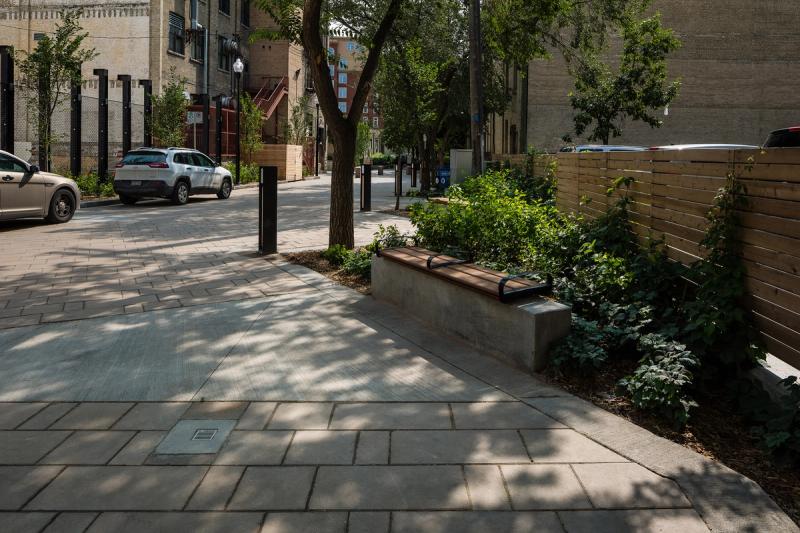
In short, “sponge city” is a nickname for deliberately designed green urban infrastructure, including parks, gardens, grassy medians on highways and even roads made of permeable asphalt with an engineered underground system to absorb runoff. John Hirsch Place is one of Winnipeg’s first sponge initiatives: railway-tie planters of white lilac shrubs, mature elm trees and a wall of climbing vines in a hidden laneway behind what used to be warehouses, now gentrified as commercial and business space. For the record, John Hirsch Place is described as a woonerf, a Dutch term meaning “living street” intended for pedestrians and cyclists more so than cars.
Underneath the bricked pavement is a system of octagonal cells made of recycled polymer that supports tree roots and keeps the soil from compacting. The cells, along with a series of catch basins, the soil and the greenery add up to the laneway’s sponginess; at scale, sponge city is meant to take the pressure off existing city drainage systems. Winnipeg has a combined sewage system in which rainwater, snowmelt and wastewater all end up in the same pre-1960s-vintage overloaded network of pipes, which have been known to spill filthy overflow into the Red River. Nearly nine million litres of untreated sewage wound up in the city’s rivers after the June storm.

Usman Khan teaches engineering at York University in Toronto. The problem with cities, he says, is that they inhibit the absorption of water. He’s interested in urban design that mimics the natural cycle of water that would exist if a city had never been built in the first place. Most areas would have been grassland or forest, he says, “and 90 per cent of the rainfall would go into the subsurface. But once you cover that up with concrete and parking lots and rooftops, we’ve prevented that from happening.”
Sponge technology mimics the conditions that once allowed the infiltration of water directly into the ground, the subsurface layer of soil and rocks that eventually leads to aquifers, instead of forcing water to find its way there through whatever means gravity and physics allow: gutters, roads and basements.
It’s not enough, however, just to build a park or plant a tree. A rain garden, like the one in John Hirsch Place, is built like a layer cake. There’s the top layer of mulch that captures sediment in the runoff, like a filter. Beneath the mulch is what Khan calls “a specifically designed growing medium. We tend not to use the word soil, but it’s similar to soil. The water flows through it fast – but not too fast.”
Clay soil drains slowly, whereas sandy soil drains quickly. Winnipeg sits on Red River clay, so urban rain gardens need a mixture that won’t cause water to pool on the surface. Among other problems, pooling water is where mosquitoes breed, and Winnipeg has enough mosquitoes.
The growing medium used in urban rain gardens is often a sand-silt mixture produced commercially; for Khan, that layer should run about a metre deep. Next is the underdrain, often made of a woven geotextile or permeable fabric – or, in the case of John Hirsch Place, the octagonal cells that also support the weight of the laneway so it doesn’t sink.
Beneath the fabric is gravel, which is even more freely permeable than the faux soil above it. The gravel holds the water until it seeps into the subsurface naturally; if it needs help (as determined by the engineers who’ve studied the topology), the water may be fed into a perforated pipe and redirected.
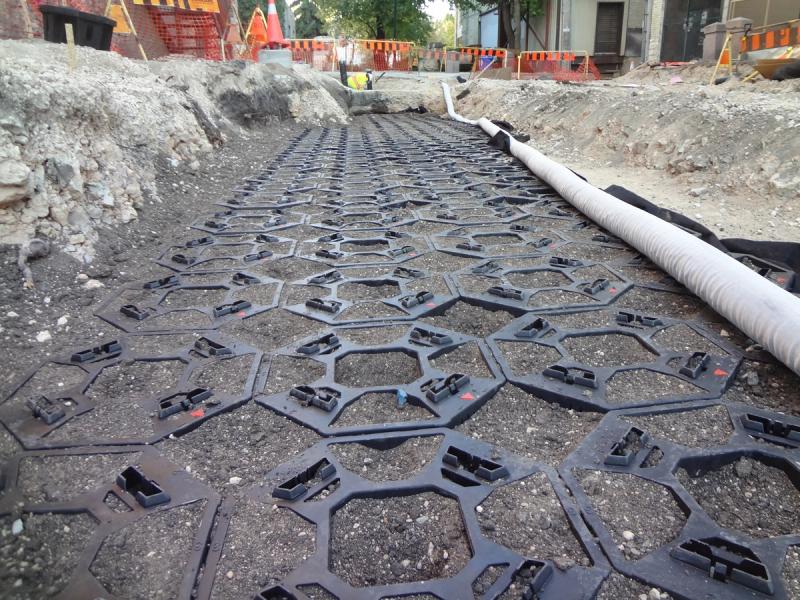
The rain garden, then, is a temporary reservoir that releases water gradually, on nature’s schedule. “You're filtering it,” says Khan, with some enthusiasm, “then you’re slowly releasing it. And if you don’t have that pipe, it’ll just sit in the underdrain layer and move out of that cell into the natural subsoil, going back to the groundwater.” After a heavy rainstorm, there’s still a flood: it’s just been moved underground where it belongs. Build enough rain gardens, or parks with the same prescribed layers underneath, and your city is a sponge.
“Sponge city” was coined by the late Kongjian Yu, a landscape architect from China who believed that man-made disruption of the natural water cycle had led to more natural disasters and to the exacerbation of climate change. His idea was to give water more space, not just more “grey infrastructure,” such as pipes and culverts and conventionally paved roads, which have no resilience and no ability to adapt to changing conditions like historic storms (and, in Asia, monsoons).
Yu’s company, Turenscape, has brought the sponge concept to 250 cities worldwide, including Haikou’s Jiangdong Beach Park, where a four-metre-tall seawall was replaced with a system of vegetated planters and platforms, like rice terraces. Native plants hold it in place. Yu called it the breathing seawall. His philosophy, he said in a 2025 interview, was to follow the “wisdom of the peasantry … growing food, managing floods, living in rhythm with nature.” Tragically, Yu was killed in a small-plane crash last year while working in the Brazilian wetlands on a film about sponge cities.
In Berlin, a residential complex near Checkpoint Charlie, called Charlie Living, has built water-retention infrastructure into its 4,000-square-metre roofing and topped it with vegetation. The claim is that green roofs not only mimic rain gardens but they also help keep buildings cool in the summer. They have the necessary layers of growing medium and drainage material, with added waterproofing and insulation to keep stored water from leaking into the building. Rainwater either evaporates or is absorbed by the plants. Toronto introduced a green roof bylaw in 2009, making them mandatory in new builds that are more than 2,000 square metres at floor level. The provincial government repealed the bylaw in 2025; the Ontario Housing Ministry said the move was part of the government’s “bold action to get infrastructure and homes built faster.”
After a massive flood in 2011, Copenhagen announced a “Cloudburst Management Plan,” which would combine green and grey infrastructure as a large-scale compromise: Enghave Park, designed in the 1920s, has been retrofitted with a 22,600-cubic-metre reservoir. The park is surrounded by a wall. Rain collects underground in an engineered rain garden of the kind Usman Khan describes. In the event of a catastrophic deluge, the wall will open and the whole park will act as a temporary reservoir, letting water drain naturally over time instead of running through the streets of the city.
Canada’s efforts have been slower to develop. The St. George Rainway in Vancouver cost $6.2 million and runs for four blocks, although plans call for extending it to nine. The rainway is a vegetated depression along the side of a residential street (note to Brian Mayes: also called a bioswale) that follows the path of an underground stream and absorbs rainwater – 17,000 cubic metres a year, according to the city’s green infrastructure implementation branch, which has set a target of capturing 90 per cent of Vancouver’s rainfall using green roofs and rain gardens.
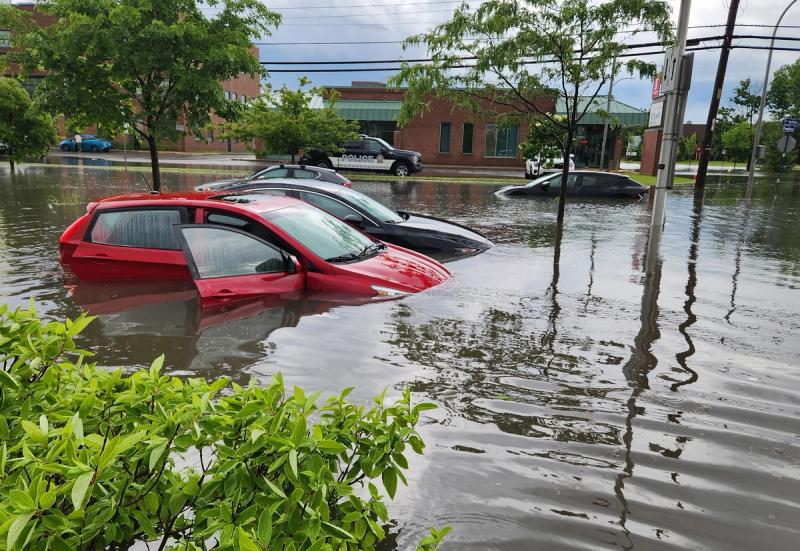
In Montreal, Mayor Soraya Martinez Ferrada has said that the city’s sewage system is “insufficient” to respond to heavy storms and flooding that seem to plague neighbourhoods like St-Leonard and Notre-Dame-de-Grâce. “We also need to consider how the city itself can become a giant sponge in every possible way,” she told reporters in June. So far, there are 30 sponge parks in the city. Larivière Street in Ville-Marie has been designated the first sponge street in Quebec; according to the landscape architecture firm Provencher Roy, the street will be able to hold 900 cubic metres of water thanks to “highly vegetated, programmatically fun and functional retention wells.” A skate park in Parc des Royaux on the north side of the street is presumed to be the programmatically fun part.
Building materials are keeping pace. In our Zoom chat, Khan showed me the chunk of porous concrete he keeps in his office and demonstrated how it holds water by pouring a 500-millilitre bottle of drinking water into it as if performing a magic trick. The stone held the water. “It’s less strong than traditional concrete,” he told me, “but for specific applications, it can be quite effective.” Specific applications include roads: it’s tough enough to support traffic.
A city with a bottomless budget can, of course, get as spongy as it wants. But there is no such city with a bottomless budget. A 2024 study by Burnaby, B.C.’s Simon Fraser University found that, despite Vancouver’s commitment to absorb 90 per cent of its rainfall, the city “struggles to adopt green infrastructure … due to political, organizational, educational, funding, ownership and engagement barriers,” meaning that politicians and residents alike don’t understand it and don’t want to pay for it.
In Winnipeg, it’s amusing to imagine repaving roads with absorbent concrete when most go without pothole repair for years. But, as Mayes says, Winnipeg can’t live with its ancient infrastructure and has committed a billion dollars to sewer upgrades over the next 25 years, with 10 per cent of that going to green infrastructure, according to provincial legislation that will insist on it. As for John Hirsch Place, it was budgeted at $540,000 (before construction) and covers about 3,000 square metres of back laneway. The City of Winnipeg is 475 square kilometres, meaning that the parkette makes up 0.0006 per cent of it, a drop in the clichéd bucket. The city has a long way to go.
“I think we’ll get it done,” says Mayes. “I mean, we had been saying 70 [years] and I’ve been giving these theatrical speeches about how it’s a good thing Councillor Allard has that young son, so he can represent us when that last spike gets hammered because we’ll all be dead. I’ll be dead. You’ll be dead. I think that landed a bit.”
“Slow water,” sponge city guru Kongjian Yu said in an interview last year, not long before he died, “is a poetic but powerful concept. It is the antithesis of modern engineering’s obsession with speed and control. When we slow water down, we create time and space. For life to flourish, for the ground to absorb, for beauty to emerge.”
Get our weekly newsletter – the people, places, and ideas revealing where Canada is headed.