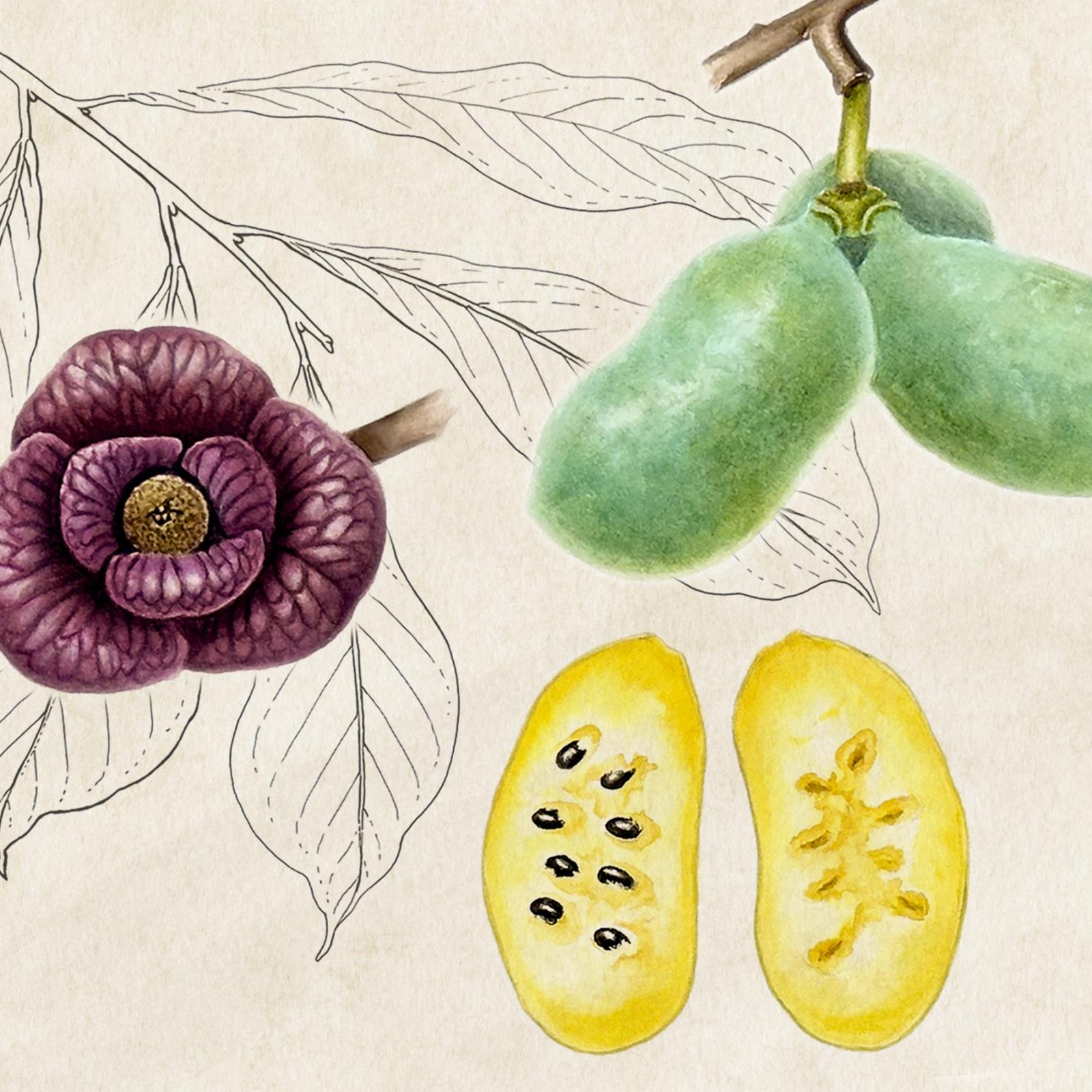
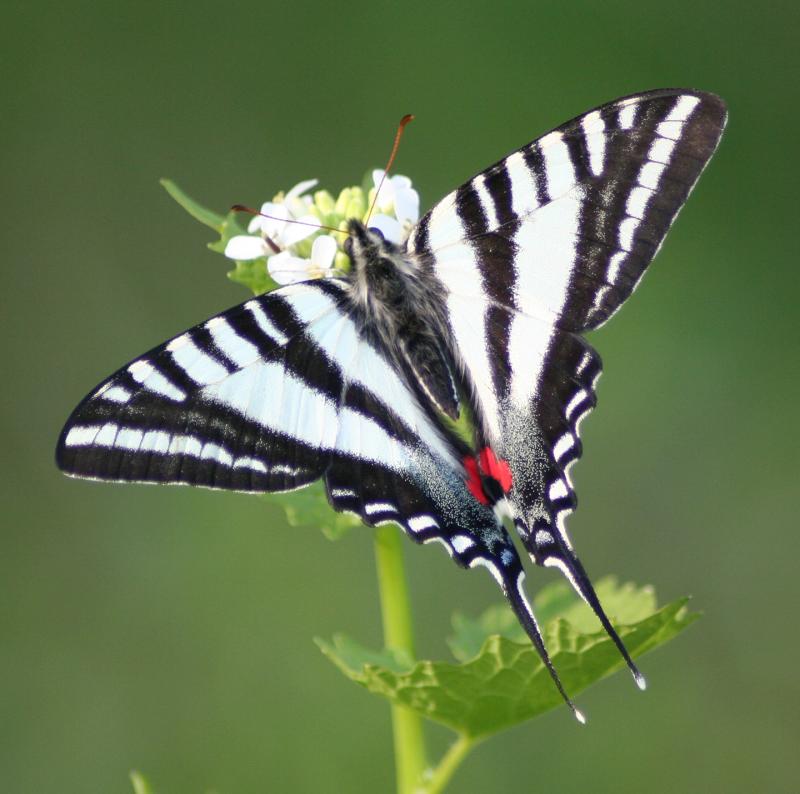
At the edge of the woods at the Forest Valley Outdoor Education Centre, in the north end of Toronto, there’s a grove of 13 rare saplings growing in the shade. In early spring, the smattering of maroon petals on their branches stinks of rotting meat, attracting carrion beetles and flies while repelling honeybees. Most insects that eat the tree’s toxic leaves will die, except for the zebra swallowtail caterpillar, which absorbs the leaves’ poisonous properties like a Mario Kart power-up, gilding itself into a lethal weapon against predators.
The fruit that this tree will one day bear – a pawpaw – is a different story. The palm-sized oblong green pods encase a creamy yellow-orange flesh that tastes far more tropical than you’d expect from a North American fruit, like a delicious cross between a banana and a mango. Most grocery stores don’t stock them; they spoil too fast, in just two or three days, to be reasonably commercialized. Yet there’s good reason to grow them.
“There are very few of these trees left in this part of the world, but they’re ancient to the land,” says Johl Whiteduck Ringuette, one of the people responsible for the pawpaw patch at Forest Valley and others across the Greater Toronto Area. He tends to them as part of his mission to restore native plant species to Canada’s biosphere, in the name of rebuilding local food systems.
Get our weekly newsletter – the people, places, and ideas revealing where Canada is headed.
Whiteduck Ringuette is a chef, educator and founder of Miinikaan Innovation & Design, an Ontario-based Indigenous garden and landscaping firm dedicated to protecting local plant species and Indigenous foodways. He co-founded the business with his partner, the rooftop gardening expert Lara Mrosovsky, who, he brags affectionately, “was growing 500 kilos of food each season” when he met her.
Miinikaan is staffed by gardeners, consultants and Indigenous food sovereigntists who specialize in agricultural species that thrive in harsh urban microclimates. As part of a recent partnership with the Toronto District School Board, they taught city kids how to grow traditional medicines, healing herbs, pollinator plants and foods that were formerly staples of First Nations diets, such as wild rice, sunchokes, squash and, of course, pawpaws.
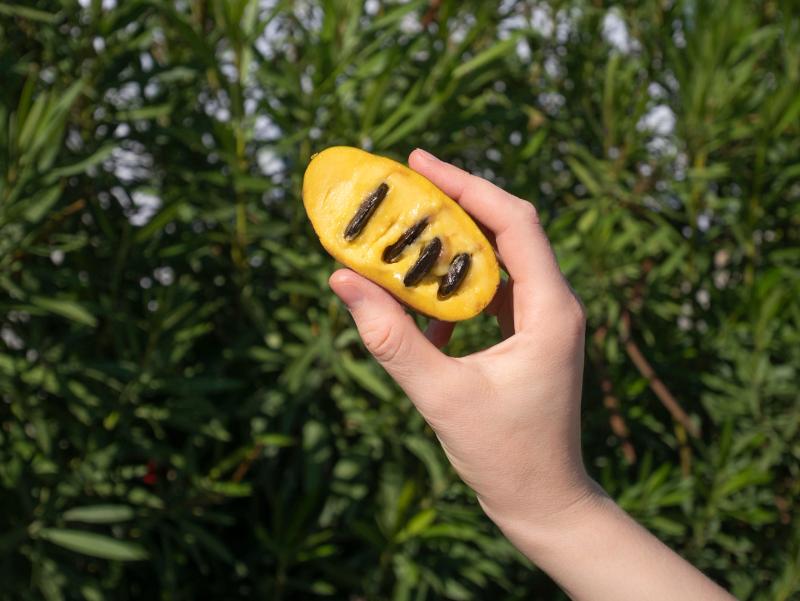
The pawpaw tree used to grow in abundance in southwestern Ontario. According to the Carolinian Canada Coalition (CCC), a charity devoted to protecting and restoring the Carolinian zone, the dung of ancient megafauna like mastodons and giant ground sloths used to spread the fruit’s large, shiny pit-like seeds across the landscape, from Grand Bend to Toronto. It was Indigenous communities that later stewarded the tree and shared it across travel routes and settlements for thousands of years. Because the fruit spoils so quickly, the Haudenosaunee would often mash it into cakes, then dry it in the sun to preserve it for later.
When the colonists arrived, some deemed these trees to be tropical misfits, less desirable than the European species they planned to import. The stinking deciduous trees that grew in such abundance also posed a risk for the European logic of urbanization; they require the shady protection of a forest’s overstory trees. So the patches were cleared and, 200 years later, the residential school system nearly eradicated the memory of them, along with the knowledge of ceremonies used to plant them, which Miinikaan has worked with elders to revive.
The introduction of non-native crops like wheat, wild parsnip and the common reed “pushed the pawpaw to the edge of disappearance in Canada,” says Jennifer Nantais, the healthy habitat manager at CCC. That’s because colonial farming “brought widespread deforestation, wetland drainage, fire suppression, habitat fragmentation and the displacement of Indigenous land-stewardship practices,” she explains. And because they lacked natural predators, European crops spread across the newly cleared land to heavily degrade native forest understories and wetland habitats.
Pawpaws, on the other hand, have deep root systems that prevent soil erosion and stabilize stream banks, provide food and habitat for native insects and birds and don’t require the heavy chemical inputs demanded by other, more commercial fruits. “Planting a pawpaw today represents not just ecological restoration but also cultural repair and reconciliation with the land,” says Nantais.
Whiteduck Ringuette’s efforts are part of a broader push in North America to bring back native plant species. In Canada, this network includes several other Indigenous-led conservation initiatives, like Sovereign Seeds in Burnaby, B.C., and Yukon Seed & Restoration in Whitehorse. The charitable flank is held up by groups like CCC and the North American Native Plant Society, which is run by volunteers. Local educators often act as the face of the movement; there’s the world-renowned botanist Diana Beresford-Kroeger, who advocates for the planting of native trees as a bastion against climate change, and the community activist and prolific gardening-book author Lorraine Johnson, who grows pawpaws in her Toronto backyard.
Not surprisingly, a wave of public interest is growing, too. The internet personality Alexis Nikole Nelson – whose high-energy videos as @blackforager explore Indigenous foraging history and modern ways to cook with native plants – has more than seven million followers on TikTok and Instagram combined, along with a James Beard Award. All of which suggests this isn’t a fringe hobbyist project. The campaign for ecological repair is concerted and hopeful. The results can even, occasionally, be miraculous: last summer, a zebra swallowtail butterfly, whose only host plant is the pawpaw, was spotted in Toronto’s High Park, the first time the insect has been recorded in Ontario since 1896.
Whiteduck Ringuette was born in the 1960s and raised by an Anishinaabe, Ojibwa and Algonquin mother and a Mohawk father in North Bay, Ont., where he learned to ice-fish, snare rabbits and cook over open fire from a young age. But Whiteduck Ringuette didn’t taste a pawpaw until 2018, when he and Mrosovsky procured one from Torrie Warner’s stall in the underpass farmers market at the Bentway in Toronto. They ate the fruits and kept the seeds. Then, after some research, they began the long process of growing them.
After the seeds have been cleaned, they have to undergo a “cold stratification” process, whereby winter conditions are simulated in chilled, moist soil. And because the flowers have female and male reproductive organs that mature asynchronously, they must be planted together so they can grow in clonal groves, linked by a single root system.
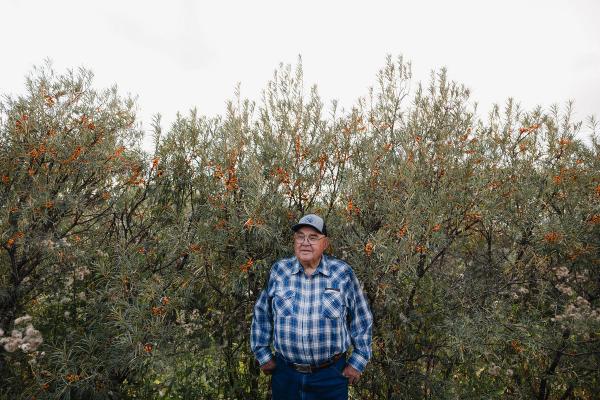
![“There are very few [pawpaws] left in this part of the world, but they’re ancient to the land,” says Johl Whiteduck Ringuette. He is a chef, educator and founder of Miinikaan Innovation & Design, an Ontario-based Indigenous garden and landscaping firm.](https://cdn.sanity.io/images/l3tzmu37/production/45fbc98fb5ddb1cd72a6e553d119ba22dd86eade-1440x1571.webp?auto=format&fit=max&q=75&w=800)
Once the patch has been established, however, the trees don’t need much to thrive: they require little to no tillage; they’re naturally pest-repellent; and they don’t need much sunlight. They also survive freezing temperatures and have adapted to the warming climate to grow much farther north than they once did; Whiteduck Ringuette is able to grow his own all the way up in Kawartha Lakes, near Lindsay, Ont. Johnson, who considers herself a “cultivation activist” and often blogs about nature, says on her website that the pawpaws she planted in her backyard aren’t fussy at all; they thrive, she says, amid drought, squirrels, neglect and “every other hardship thrown their way.”
“It can take seven to eight years for the trees to bear fruit once the seedlings have been planted,” says Whiteduck Ringuette, noting that the carrion beetles and flies it lures are its pollinators, “but some people have better luck.”
Paul Decampo, a municipal food-policy leader and advocate of the Slow Food movement who lives in Toronto’s Oakwood Village, started growing them so long ago (1994) that his front yard now blooms with thickets of trees up to six metres tall. “The advantage of pawpaws over all of our other fruit crops, which aren’t actually domestic, is that they don’t need any sprays, support or protection from mildew or pests the way our other crops do because they co-evolved with the insects and fungus here and they’re so climate-resilient,” says Decampo, who refers to himself as a “pawpaw-gandist.” He says he’s fortunate that his neighbour has also naturalized their front yard because the pawpaw-root shoots have started to spread. “The yard is all pawpaws, snowberry, cedar and other native bushes and wildflowers that used to grow here.” The fruits of his labour get parcelled out, first to the raccoons and squirrels, who knock half of the pawpaws to the ground before they ripen, and the rest to friends and family – or donated to public events in an abundant year.
Although the pawpaw’s rarity makes some people protective about sharing where they source their seeds, there are highly active Facebook groups, such as “Ontario Pawpaw growers,” that boast thousands of members who post photographs of their seedlings, offer growing tips and give away pollen from grafted trees. There aren’t really any large-scale commercial pawpaw farms in Ontario, but you can find the fruit at small specialty orchards in southern Ontario.
In early May, “urban orchardist” Matt Soltys, who organizes an annual pawpaw festival between Guelph and Hamilton, used the Facebook group to announce his plans to start “Canada’s first pawpaw breeding program,” in an effort to support future orchards as the species’ range adapts to climate change and shifts northward. The program has emerged from his master’s research project at the University of Waterloo and will be partially supported by a scholarship from the Social Sciences and Humanities Research Council. Soltys says he’ll spend the summer interviewing as many Ontario-based farmers of bearing-age pawpaws as he can “to begin collecting data on varieties being grown and their performance, and to co-develop a breeding strategy with growers.” Next year, he’ll start propagating the standout varieties in a breeding orchard and genetic repository he has planned for a nearby farm.
The future of the pawpaw patch at Forest Valley, however, is uncertain. In mid-May, the Toronto District School Board announced it would terminate outdoor education programs at five centres, including the one at Forest Valley. But Whiteduck Ringuette is determined to continue his efforts at ecological restoration. In his dreams, he sees food forests stretching across the city and thousands of kids learning to cultivate a more reciprocal relationship with the land that houses them. Just a week after we spoke, Miinikaan was called out to Whitby to plant a brand-new patch at Durham College. Perhaps, some decades down the line, a cluster of bright-green chrysalises might split open on the underside of those pawpaw leaves, releasing a kaleidoscope of once-rare black-and-white butterflies, beautiful and deadly, into the fresh summer air.