When Wallace and Harrison McCain decided in the 1960s to export french fries from tiny Florenceville, N.B., they opted to skip the relatively close American market, a mere 17 kilometres away. Instead they looked east, 5,400 kilometres to the United Kingdom, which became their beachhead into Europe and eventual global expansion.
Today, McCain Foods is the world’s largest french fry producer, and J. Scott McCain, Wallace’s son and board chair of the family-owned firm, says his father and uncle saw a competitive advantage in going to the U.K. over the U.S.
“My uncle and my father said, ‘Look, we’re going to come up against some really strong, tough American players in our sector, and it looks like it’s a lot more convenient and easier for us to go to Europe.’”
With the future of the Canada-United States-Mexico Agreement (CUSMA) uncertain and European NATO members interested in deepening defence sector ties, some Canadian firms are looking with new eyes at the U.K. and Europe, particularly in Atlantic Canada, where a new report by the Atlantic Economic Panel suggests the region could be Canada’s gateway to Europe for trade, defence and energy.
Get our weekly newsletter - the people, places, and ideas revealing where Canada is headed.
McCain, a member of the federally appointed panel, says that will require Canadian businesses, on the East Coast or elsewhere in the country, to embrace the elimination of interprovincial trade barriers – the patchwork of provincial regulations, licensing requirements, product standards and restrictions on labour that hamper trade across the country. Businesses also need to wean themselves off the benefits of a low Canadian dollar, in service to strengthening homegrown firms’ global competitiveness.
“There are only two things that matter in business: what’s the cost of whatever you do and what can [you] sell it for,” McCain says. “At the end of the day, you can’t hide behind a tariff or trade barrier in your own region, because if P.E.I. can’t compete with New Brunswick, Nova Scotia or Newfoundland making sausages or tissue paper or whatever it happens to be, how the hell do you think you can compete in Europe?”
Panel chair Don Mills has studied the Atlantic Canadian economy for more than four decades, first as co-founder and CEO of the polling firm Corporate Research Associates (now Narrative Research), and more recently as a podcast host and author. He says the argument in favour of a Euro-focused trade strategy begins with the most obvious reason: geography.
“If you start looking at the natural resources we have and [our] proximity to the European market,” he says, “we have ice-free ports available, major ports, and that’s why we can be the gateway.”
In 2025, 18 per cent of Atlantic Canadian exports, about $7 billion, went to the European Union, according to a report from 2025, up from 11 per cent in 2016. But the United States still takes about two-thirds of the region’s exports, a dependence the panel noted when recommending diversification.
Meanwhile, the private sector is gearing up for what the report describes as a generational public investment in national defence infrastructure in Nova Scotia, New Brunswick and Newfoundland and Labrador across land, naval, air, space and cyber sectors, all touted as Canada’s more robust NATO contribution. (In June, Prime Minister Mark Carney pledged to boost defence spending to five per cent of GDP by 2035.)
Mills says the domestic supply chain built to support all this activity, which includes a new submarine base in Halifax and a spaceport in Canso, N.S. – both of which are partnered with European-based defence and space companies – is positioned to quickly scale into a European-centred trade corridor.
“It becomes a really big opportunity to sell to our NATO allies on the other side of the Atlantic,” Mills says.
The region is also hoping to woo international investors and Canadian pension funds to invest in large-scale infrastructure projects, about 41 of which were listed in the Canada Investment Summit’s pitch book, with energy and ports topping the list.
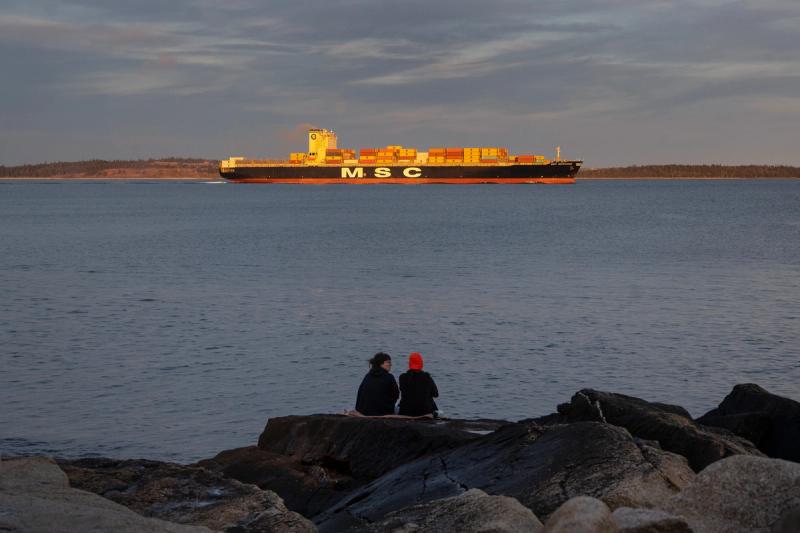
“There were 167 projects on that list and almost 25 per cent of them were in Atlantic Canada,” says Mills. “We’re six per cent of the population. Look at us now.”
On energy, Mills highlights Nova Scotia’s offshore wind proposals, and Newfoundland and Labrador’s offshore hopes, including the proposed Equinor-led Bay du Nord project, a major offshore oil development project about 500 kilometres east of St. John’s. A final investment decision is expected in early 2027.
“We need to get our energy resources to an export state. Of course, we can sell to other parts of Canada or the northeastern United States, but the demand for energy in Europe is a big opportunity,” says Mills. “No pipeline needed.”
To convert these openings into a real transatlantic gateway, the panel recommends a regional market access strategy, supported by an integrated port system with each of the region’s ports serving a defined role, led by existing deep-water ports in Halifax and Saint John and supported by stronger rail and air links.
For instance, the Port of Belledune in northeastern New Brunswick, which once exported iron ore from nearby mines, has repositioned itself as a green energy hub, with a growing biomass export business in wood pellets as well as planned exports of green hydrogen. Port Hawkesbury, on Cape Breton Island, can provide support services, including laydown yards, for Nova Scotia’s nascent offshore wind industry.
While geography makes Atlantic Canada a natural gateway to Europe, it also holds one of the region’s chronic challenges: a lack of economic connectivity.
The regional population is highly dispersed, with East Coast residents twice as likely as other Canadians to live in rural communities.
That means dependable cell coverage, high-speed internet and regular flights between the four provincial capitals are all needed, according to Mills.
It’s why the panel framed its final report around a One Atlantic Canada economic rallying cry. While it stops short of advocating for political union, the panelists recommend the four provinces reduce trade barriers, align regulations and integrate planning to create what Mills describes as a regional free-trade zone.
In addition to Mills and McCain, the panel included Sandpiper Ventures co-founder and former Newfoundland and Labrador finance minister Cathy Bennett; Halifax International Airport Authority president and CEO Joyce Carter; Cassidy Group CEO Michael F. Cassidy; Pabineau First Nation Chief Terry Richardson; and Seafair Capital CEO Anne Whelan.
“One of the things we heard consistently across the region and across sectors was that we need to be able to collaborate with each other and work together on common challenges and opportunities. There is a pent-up desire to have that actually happen,” Mills says.
“I took that to mean it’s time to get out of our own way.”