The South African visitor has come ashore on this blustery morning in Saint John, N.B., to replenish supplies. “It’s OK, we sometimes get snow where I live,” he says with a smile and a shrug as he sets off down Water Street, hands stuffed in the pockets of his red puffer jacket, headed toward the city’s Uptown district to shop for snacks and other necessities.
He and his fellow passengers aboard Virgin Voyages’ 17-deck Valiant Lady aren’t supposed to be experiencing the brisk winds and drizzle that mark early spring on the Bay of Fundy. They’re supposed to be sunning themselves in Bermuda, but gale-force winds and six-metre ocean swells have diverted the 2,000 passengers northward to Saint John, where shopkeepers, wait staff and locals are accustomed to providing directions, lunch recommendations and local history tidbits to visitors “off the boats.”
For much of the 21st century, this has been life in Canada’s historic “Port City” – a cruise ship or two anchored at wharves abutting the city’s Uptown and tourists buying dried Grand Manan dulse and lighthouse magnets in Canada’s oldest city market (established in 1785), and going on walking tours of the city’s ornate 19th-century buildings, which once housed transatlantic merchants and adventurers and are now home to law offices, design studios and loft apartments. In pre-Confederation Canada, Saint John was the place to be, the largest shipbuilding centre in British North America.
By the turn of this century, the port that had built Saint John and 19th-century Canada had seen its influence fade as markets changed, business slowed and locals openly mused about converting underused port lands to parkland. But just as it has learned to live with its famous high tides, Port Saint John has also weathered the economic lows. And now, thanks to a recently completed $247-million modernization effort and a splash of good fortune courtesy of American tariff policy, Saint John is ready to rise again.
“This isn’t just about infrastructure and bricks and mortar,” says Craig Bell Estabrooks, Port Saint John’s president and CEO. “This is about more people making a living again on the waterfront.”

For Saint John, American tariffs are a good news/bad news story. While they are helping to drive business growth at the port, the city’s economy has been hit hard. New Brunswick’s economy is deeply tied to the United States, where about 90 per cent of its international trade goes, leaving it heavily reliant on what is now an unpredictable market. The city is home to J.D. Irving Limited, one of Canada’s biggest forestry companies, which is currently being battered by American softwood lumber tariffs. It is also home to Irving Oil, Canada's largest oil refinery, which can process over 320,000 barrels per day, with more than 80 per cent of it bound for the U.S. Eastern Seaboard.
Beyond the Irving Group of Companies, the Bay of Fundy is home to a multi-million-dollar seafood industry that sends lobster, scallops and other catches to Maine and beyond.
All this American-directed activity led the Canadian Chamber of Commerce in early 2025 to rank Saint John as the Canadian city most vulnerable to U.S. tariffs, with a trade exposure index of 131.1 per cent – nearly double that of oil- and gas-dependent Calgary at 81.6 per cent, and more than twice that of auto sector hub Windsor at 61.7 per cent.
“We’re trying to put this port on the national scale,” says Estabrooks. “We’ve got to make sure the country, North America and the world know we’re a gateway that could matter to them.”
Ontario shippers have been the first to respond, with a 153 per cent increase in trade traffic through Port Saint John between 2024 and 2025 as the Toronto-centred Golden Horseshoe, which generates about two-thirds of Ontario’s and one-fifth of Canada’s GDP, begins to shift some of its trade east, toward Europe, and south into the Americas.
A combination of geography and logistics helps place Saint John in the mix with the larger Eastern Canadian ports in Montreal and Halifax. Saint John is a deep ocean port, so it can handle heavier vessels than Montreal, and it is closer to North American markets than its Maritimes neighbour. It’s also an hour’s drive from the land border with the United States.
That combination of factors is fuelling interest in Saint John, and Estabrooks now spends a good deal of his time travelling to, and talking with, Canadian shippers.
“What we try to pitch to exporters is ’You’ve set your supply chain up to trade north-south, and you’re always going to do that, but if you want to take some of your goods and see if there are opportunities elsewhere, we’ll help you.‘”
Estabrooks believes in Saint John with the fervour of a hometown fan. “I went to high school right here,” he says, pointing out his office window to Saint John High School, Canada’s first public high school (1805), which dominates his view and where he and generations before him stood on the front steps, smiling out toward the harbour on graduation day. He and his wife were married a block over at Trinity Church, had their wedding reception downstairs from his office in the cruise terminal, and today they and their toddler live in a 19th-century brownstone a few blocks up from the harbour.
“I travel a lot for my job, but when I’m here, there’s not much movement,” Estabrooks says with a laugh. “I walk everywhere. This is my neighbourhood.”
Doug Smith is a more recent convert. As CEO of DP World Canada, the Canadian arm of the Dubai-based shipping giant that moves about 10 per cent of the globe’s container traffic, Smith is pulling for Saint John not because he’s sentimental but because projected trade flows keep pointing his attention to New Brunswick’s Port City.
When DP World became the port’s terminal operator in 2017, Saint John was annually shipping about 57,000 TEUs (short for 20-foot equivalent unit, the standard measurement for shipping container capacity). By 2023, the city’s traffic had almost tripled to about 153,000 TEUs. Smith, the newly arrived head of DP World’s Canadian operations, looked at the numbers and challenged the team in Saint John to be more ambitious, suggesting the port set its sights on one million TEUs.
“When I said that big dream, everyone looked at me like I had four heads,” he says. “We’re now literally talking about reaching 400-450,000 TEUs in the next year and a half. That’s halfway there.”
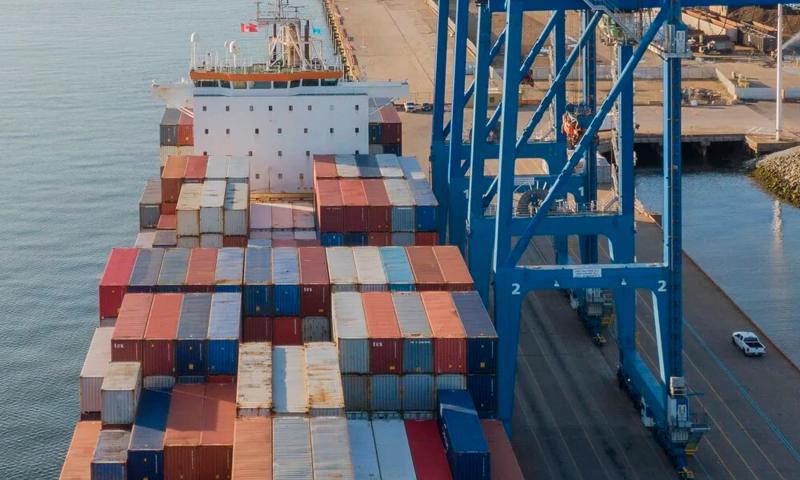
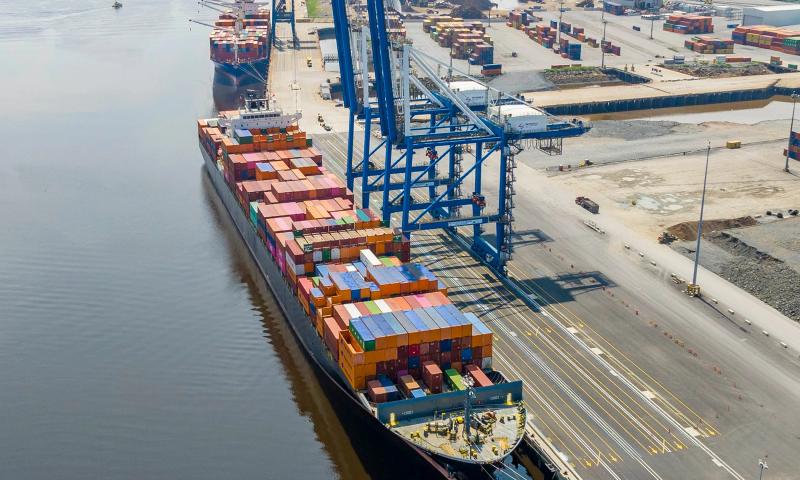
DP World’s role in Saint John is to help drive cargo growth by managing the port’s container terminal. In Canada, marine ports – like airports – operate on federally owned land that is managed by arm’s-length federal port authorities. Within these large marine transportation hubs, terminals stage and move cargo among trucks, trains and ships using large cranes. DP World operates under lease from the Saint John Port Authority, which included a $75-million investment from DP World toward the port’s $247-million modernization project.
Smith says DP World is applying a three-part strategy to solidify Saint John’s role in Canada’s economic value chain. First, it increased the port’s capacity by deepening and widening the channel, adding an additional berth and installing new, larger cranes. It also attracted Canadian Pacific Kansas City (CPKC) back to Saint John in 2020 after a 25-year absence. Along with CN Rail, it provides shippers access to two national rail lines, connected by the Irving-owned short line New Brunswick Southern Railway.
Second, DP World is working to raise Port Saint John’s brand profile with global shipping lines, attracting giants Maersk, CMA CGM and Hapag-Lloyd to commit to weekly sailings into Saint John, connecting it to more than 500 ports around the world.
Third, it brought in partners that could offer specialized services to, as Smith describes it, “lock in customers.”
In 2025, Gemini Cooperation, a new vessel-sharing alliance created by Maersk and Hapag-Lloyd, added Saint John to its transatlantic hub-and-spoke network, and later that year Atlanta-based Americold began construction of a local cold storage facility.
“From what I hear, [Americold is] already fully booked,” says Smith. “We’re already talking ‘should we expand?’ because there’s that much interest.”
Smith’s strategy has helped turn Saint John into Canada’s fastest-growing port. “That bright-eyed eagerness, willing to do, is incredibly refreshing,” says Smith, who has worked in global shipping for more than three decades, with both shippers and ports in North America, Europe and Asia. “[Saint John] is the only place I’ve ever been where I saw so many people come out to see the cranes arrive and [be] so happy to see the port grow. The general social approval and support are astounding.”
Smith oversees a Canadian portfolio that stretches from the Pacific to the Atlantic with terminals in Vancouver, Prince Rupert, Fraser Surrey, Nanaimo and Saint John, soon to be joined by Contrecoeur, the Port of Montreal’s new terminal, which will add just over one million TEUs of annual capacity when it opens in 2030.

Following the mid-April ground-breaking ceremony on the Montreal waterfront, Smith pauses to consider how he’d describe Saint John within DP World’s family of holdings. “It’s the high schooler who’s probably ready to go get a scholarship somewhere and go pro real soon, who’s just saying, ‘Give me a chance, coach, let me get in there,’” he says with a smile. “It’s willing to do anything it takes to be on that winning team.”
That mix of ambition and commitment to do the work is exactly how Andrew Dixon, Port Saint John’s now-retired longtime head of business development and operations (he still serves as a part-time special adviser), describes how the port rebuilt its fortunes, with a low-ego, get ’er done conviction that Saint John has a significant role to play in Canada’s third century.
Dixon, like a lot of Saint Johners, was raised on family stories about the port.
His grandfather worked there in the winter, and his father spent his whole working life at Irving-owned Saint John Shipbuilding, starting out in 1942 constructing warships for the Second World War, and ending in the 1990s, building frigates for the Royal Canadian Navy, at the time the largest shipbuilding contract in Canadian history.
Dixon’s own path to the port started out at MacMillan Rothesay, now Irving Paper, tarping giant newspaper rolls bound for the Miami Herald. By the time he came to work at the port in 2004, the decade of decline had begun. It was accelerated by the 2005 bankruptcy of St. Anne-Nackawic, a major pulp producer in the province’s interior that was the base cargo for two of the port’s biggest shippers.
The tide began to turn when Port Saint John partnered with DP World, a company with global connections to match its global ambition. DP World was huge worldwide and on Canada’s West Coast, but with no foothold on North America’s Atlantic coast.
“We knew this was going to be a tough, challenging go... and we did not want somebody that had alternatives all over the place. We didn’t want them to say, ‘Oh well, this isn’t working’ and shift it to other operations,” says Dixon. “We got all these people together [who] had to make the impossible happen or die – and it worked.”
Dixon’s final act before retiring earlier this year was to help cut the ribbon and toast the new container terminal he helped create.
The New Brunswick government, DP World and the port are now exploring where to expand logistics capabilities, looking at communities with rail corridors and available land that could serve as inland staging points, connecting the port’s growing container business to the region's manufacturers, exporters and cold chain operators. The village of McAdam, a historic railway junction town 100 kilometres north of Saint John, is positioning itself as a potential inland port, its century-old rail infrastructure suddenly relevant again in an era when Canadian trade needs new routes and new hubs.
In November 2025, the federal government chose Port Saint John as the location to announce its new $5-billion Trade Diversification Corridors Fund. It’s a major part of a broader $6-billion infrastructure commitment designed to build and upgrade transportation corridors, including ports, that help Canadian businesses reach global markets beyond the United States.
The Saint John Trade Corridor project, which would upgrade road, rail and logistics links connecting the port to inland markets, has been identified as a priority project by all three levels of government. The project has three concrete components: a rail upgrade, a port expansion and the long-discussed overhaul of Simms Corner, a notorious crossing where New Brunswick Southern Railway lines cross a busy intersection, carrying all rail traffic in and out of the port through residential neighbourhoods that were originally built to house port workers and their families.
As Estabrooks walks the familiar streets of his Uptown neighbourhood, he thinks a lot about the relationship the port has with Saint John residents. It isn’t just a part of the city; the port and the city are entwined, built around each other, setting the pace and rhythm of life in this coastal city.
"The port’s not some abstract entity to people here,” he says. “It's their port."