On a clear day, you can see Nova Scotia while standing among mountains of “red gold” from Saskatchewan.
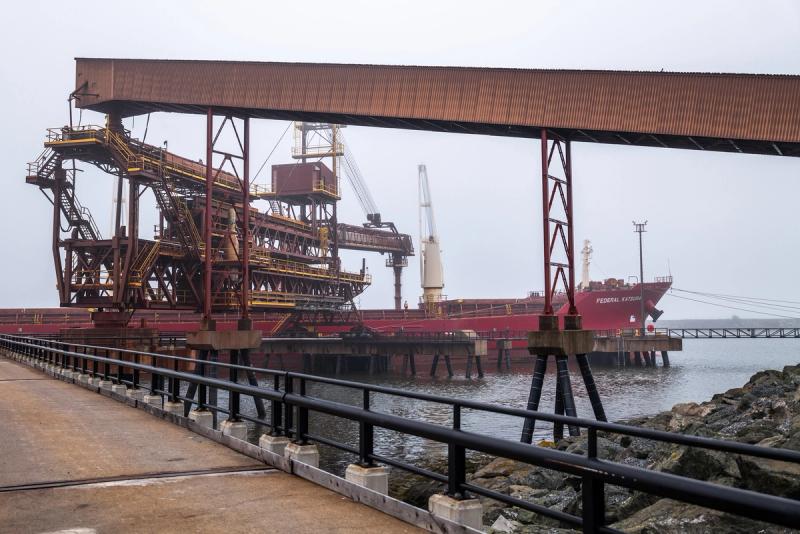
Here on the rocky coastline of Saint John, N.B. sit two massive storage sheds filled with huge piles of potash, the heavy pink-hued mineral crucial to the global food supply – and your morning cup of coffee. From here, the fertilizer is loaded onto cargo vessels and shipped to markets in Brazil and Europe.
Canada is the world’s largest potash producer and exporter, typically shipping more than 22 million tonnes a year. The U.S. accounts for about half of that, but Saskatchewan potash ships to more than 40 countries in total and the vast majority of it – 70 per cent – goes through the Port of Vancouver, with another 20 per cent leaving through Portland, Ore., each a journey of about 2,000 kilometres.
The rest travels more than double that distance – 4,300 kilometres – snaking through five provinces and four time zones over eight days on specially designed railcars before arriving in Saint John. This journey began as a kind of circuitous cross-country detour to avoid labour slowdowns in Vancouver and extreme weather on the West Coast. It’s now an example of how the need to diversify markets in the face of new geopolitical realities can lead to opportunity.

“As we’re talking about major projects, trade diversification and nation-building, this is a great example of something already working,” says Port Saint John CEO Craig Bell Estabrooks. “It’s Saskatchewan going all the way east to New Brunswick for a solution on how to get their goods very far abroad, get the right price and keep workers employed in Saskatchewan while employing workers in Saint John.” And it’s proof, Estabrooks insists, that more western resources should be moving eastward.
Canada got a reminder of the need for trade diversification last month, when U.S. President Donald Trump threatened to replace Canadian potash with lower-priced product from Belarus, only to walk back parts of the plan a few days later. While the U.S. government lifted its sanctions on Belarusian potash in March, the European Union continues to maintain sanctions against Russia and Belarus over the war in Ukraine. It was Europe’s push for new suppliers, and Canada’s reputation as an attractive and stable alternative, that initially sparked the renewal of shipments through Saint John.
Get our weekly newsletter – the people, places, and ideas revealing where Canada is headed.
For much of their 80-year history, Canadian producers shipped potash bound for non-U.S. markets through ports on the Pacific coast. It made logistical sense: Vancouver and Portland are closer to both the mines in Saskatchewan and to China, Indonesia, India and Malaysia, four of the largest non-U.S. customers for Canpotex, the overseas marketer for potash giants Nutrien and the Mosaic Company. Brazil, too – Canada’s largest non-U.S. market – got its potash from ships going through the Panama Canal.
That started to change in 1983, when the Potash Corporation of America opened a mine outside Sussex, N.B., a farming community about 45 minutes east of Saint John. To get its product to market, the company opened a potash terminal on the southeastern tip of Port Saint John, across Courtenay Bay from Irving Oil’s docks.

The Potash Corporation of Saskatchewan (PCS) acquired the mine in 1993 and shipped more than 600,000 tonnes of potash each year, mostly to Brazil. Then, in 2017, Sussex and Saint John got the type of news that guts resource towns: Nutrien, created by the merger of PCS and Agrium, was closing its New Brunswick mines.
“We were sitting there as a port authority trying to figure out what we’re going to do with an export bulk facility and no potash,” says Estabrooks. Canpotex, which saw value in having the option of an Atlantic terminal, took over operations and started, with Canadian National Railway, to test an overland cross-country route.
For the first few years, it used the Saint John terminal mainly when labour strikes slowed work in Vancouver or extreme weather, such as wildfires or torrential rain known as atmospheric rivers, made rail lines trickier to navigate through British Columbia.
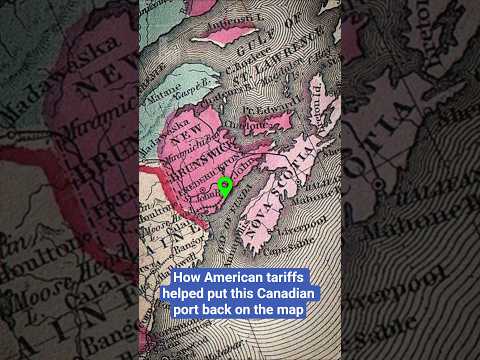
The turning point came when the EU imposed sanctions against Belarus in 2021, and then much of the democratic world followed with sanctions against Russia after its invasion of Ukraine in early 2022. Canadian potash shipments to Europe through the Port of Antwerp-Bruges in Belgium tripled in 2022, virtually all of it from Saint John, and Belgium is now Canada’s fourth-largest non-U.S. destination, slightly ahead of India. Port Saint John shipped a record high of 2.3 million tonnes of potash that year, mainly to Brazil and Antwerp.
“This year is tracking toward 1.6 to 1.8 million tonnes despite the fact it has to come all the way across the country,” says Estabrooks of Atlantic potash exports. “We are moving more potash now than when there was a mine up the street.”
The seasonal nature of potash use – the fact that farmers don’t need it every day of the year – means “speed isn’t always the most important piece,” says Sandra Ellis, CN’s vice-president of bulk and business development. “It’s about [whether] the supply chain that’s planned [is] going to be executed in a reliable and consistent way.”
CN sees potential for Canadian potash to reach more Atlantic markets, according to Ellis, including western Africa, and for increased trade along the Eastern Seaboard in the U.S. and with Europe. “Saint John is an incredible port because it’s on the east coast, so it’s just a straight shot down or over,” she says.
Not that the future is guaranteed. Nutrien is building a new $1-billion export terminal on the Pacific coast – the announcement last year that its preferred site was in Washington state got considerable political push-back in this elbows-up moment – and Canpotex recently said it would invest $500 million at the Port of Vancouver. Still, Estabrooks expects potash will continue to traverse the country for the Atlantic coast. Growing global demand will increase the need for “multiple exports gateways,” he says, and Saint John’s connections to Brazil and to other South American and cross-Atlantic markets make it a vital link in a reliable supply chain. “Canpotex and its producers have long relied on a diversified transportation network, and we expect that approach will continue,” he adds. These developments complement, rather than diminish, Saint John’s role as part of a flexible and resilient national export network.”
And geopolitics are likely to remain unpredictable. The day after Trump walked back his threat to cut off Canadian supplies, he said he still figured he could get a better deal from Belarus.