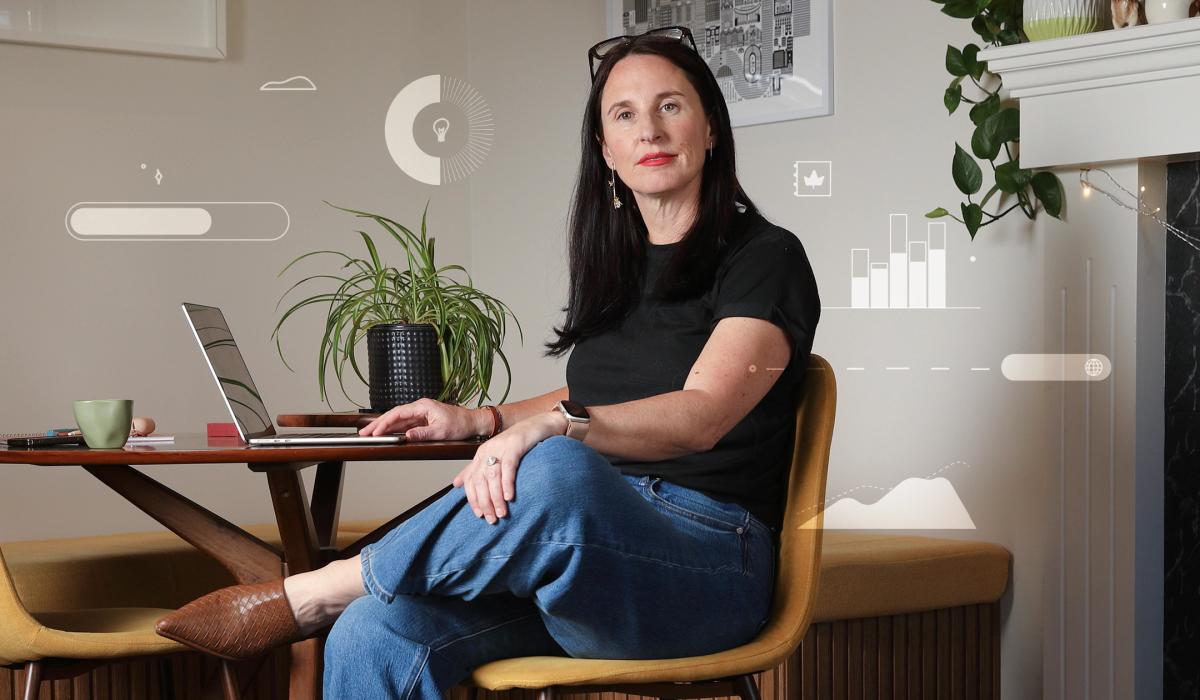
Jill Dewes is a Calgary-based creative entrepreneur who spends her days helping emerging organizations develop branding and content. While her work leads her to partner with a constellation of other founders, she operates alone. Her company, Nice One, is a one-woman shop – proudly and deliberately.
Dewes started her career at one of the world’s biggest ad agencies and later became an early partner at Daughter Creative, which she helped grow into a 24-person operation. But along the way – between client meetings, employee check-ins and the endless to-dos of a chief growth officer at an expanding agency – she realized she was spending almost no time on the creative work that had got her into the game in the first place. “I really missed getting my hands dirty,” she said. So, last summer, she amicably exited Daughter and hung out her own shingle. So far, she has zero regrets: “I love being self-sufficient. It’s the best thing I’ve ever done.”
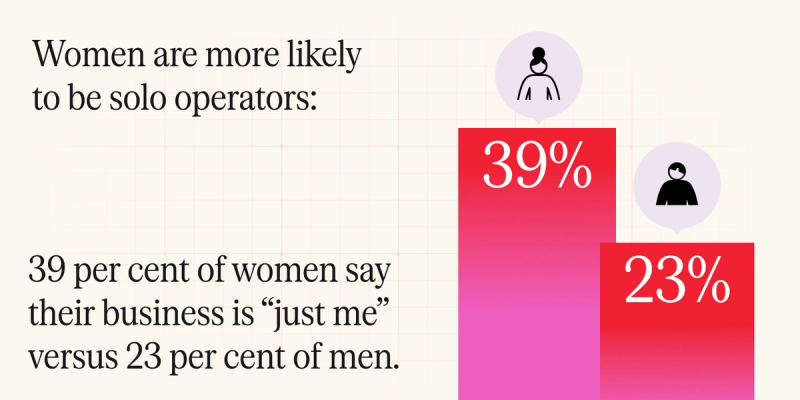
Dewes is one of many entrepreneurial Canadians choosing to go it alone: to run a business by themselves, doing work they love on their own terms. According to Be Giant’s Upstart Index – a new annual measure of Canadian entrepreneurial sentiment, drawn from a proprietary Ipsos poll of more than 3,000 aspiring and early-stage entrepreneurs – 29 per cent of emerging founders in the country are solopreneurs. And there’s a notable gendered trend among them: 39 per cent of women founders in the country are operating without any co-founders or employees, nearly twice the share of men doing the same.
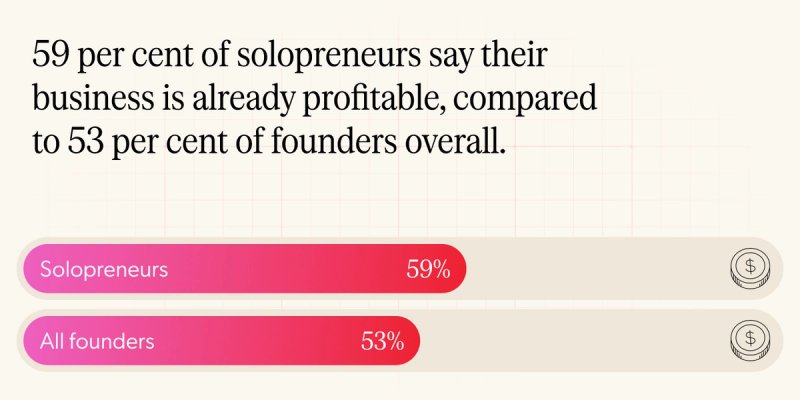
According to Dr. Wendy Cukier, a researcher, professor and founder and academic director of the Women Entrepreneurship Knowledge Hub (WEKH) at Toronto Metropolitan University, the decision to operate alone is often intentional – expansive growth is not a primary goal for many entrepreneurial women. Her research shows that women are more inclined to “ease in” to entrepreneurship, often via a single-person side hustle, and are more likely to focus on business sustainability over growth. The Upstart Index data suggests that approach is working on its own terms: 59 per cent of solopreneurs say their business is already profitable, compared to 53 per cent of founders overall. And these paths have multiplying economic effects, Dr. Cukier said – even if they don’t fit the typical startup stereotype of a venture-backed founder racing toward an exit. “A lot of the discussion surrounding entrepreneurship in Canada is still based on models from the past that don’t necessarily take into account the unique contributions of women or the structural differences in their businesses,” she said, noting that women entrepreneurs are more likely to reinvest in communities, support social impact and mentor others. “The preoccupation with growth can distort our understanding of what else is important.”
For many women, solopreneurship can also offer more stability. As evidence mounts about the ways in which women can be disadvantaged by conventional career paths (including limited opportunities for promotion, inadequate accommodations for health and life needs and stubborn gender pay gaps), solopreneurship presents a compelling alternative. And the data supports its many lifestyle benefits: according to the Upstart Index, solopreneurs are notably less likely to say the stress of entrepreneurship has impacted their health. And, despite reporting less access to mentors and peer support than other founders, they are no more inclined to feel lonely in their entrepreneurial journey.
Still, women face very real obstacles when starting and scaling businesses. Be Giant’s poll found that only 41 per cent of women entrepreneurs have access to investors and funding networks, compared to 50 per cent of men. Where 64 per cent of men have informal financial support, 56 per cent of women entrepreneurs have the same. And just 33 per cent of women have participated in incubator or accelerator programs, compared to 41 per cent of men. “We need to better support women who want to grow their businesses,” Dr. Cukier said. WEKH research recommends applying a gender and diversity lens to government business programs to improve women’s access to customers, financing and skills development. “Slow or no growth is not due to lack of ambition, risk aversion or a confidence gap.”
Beyond structural barriers, the lingering effects of the “great resignation” prompted by COVID-19 also help explain why women are disproportionately drawn to solopreneurship, some experts say. Vera Ilnyckyj, the Calgary-based founder of a career coaching business, Create Your Best Chapter, sees this firsthand. In her experience, once women start probing, they often find a disconnect between what they are capable of and what they have traditionally done to pay the bills. “The question of purpose is a big one,” she said. “Women are asking, ‘What am I meant to be doing here? What is next for me? Where am I going to pour my energy?’” The answers lead many to strike out on their own: “Women are looking for the flexibility to support what’s important to them, and solopreneurship offers that.” She counts herself among them: Ilnyckyj opted into solopreneurship in early 2023 after years in the corporate world.
But for all its benefits for women, the trend toward solopreneurship is not without tradeoffs. Solopreneurs may be more likely to turn a profit, but fewer are creating jobs: according to the Upstart Index, only 30 per cent of solopreneurs plan to hire within the next year, compared to 49 per cent of business owners on average. And more women gravitating toward operating alone will do little to address the systemic barriers faced by women in the workplace. Dr. Cukier recognizes this tension: “It is a challenging conversation to have without making it seem like women are not pulling their weight in terms of economic contributions,” she said. “But there’s no question that, for a lot of women, solopreneurship is a deliberate choice.”
Going it alone isn’t for everyone. It tends to benefit self-motivated individuals with well-established professional networks: and it can be a tougher slog for those just starting out. But for many women, including Jill Dewes, it’s an option that deserves more attention as a valid form of entrepreneurship. “My business model isn’t right for every woman entrepreneur, nor is running a fast-growing business in general,” Dewes said. “It’s a ‘yes, and’ situation. There’s a role for women-run businesses of all types.”