Inside the Richmond, B.C., headquarters of General Fusion, just beyond a security checkpoint, there’s a motto inscribed on a wall: Clean energy. Everywhere. Forever.
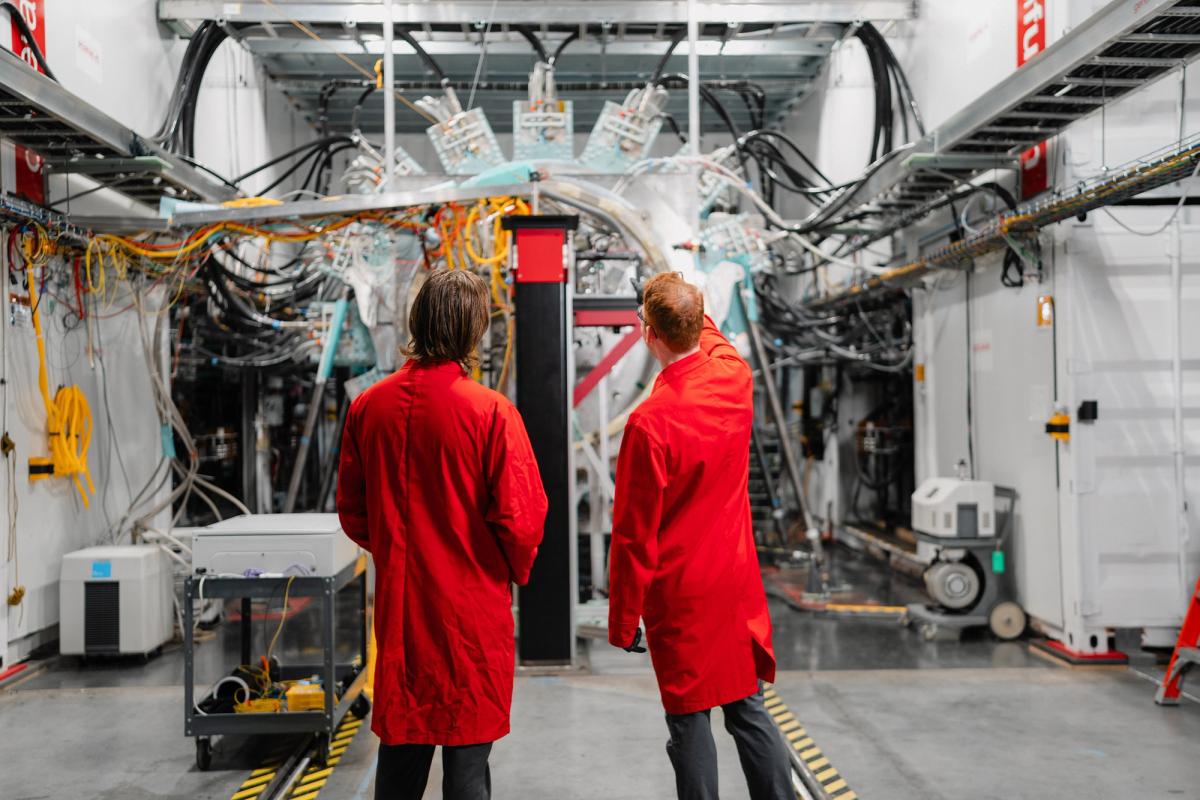
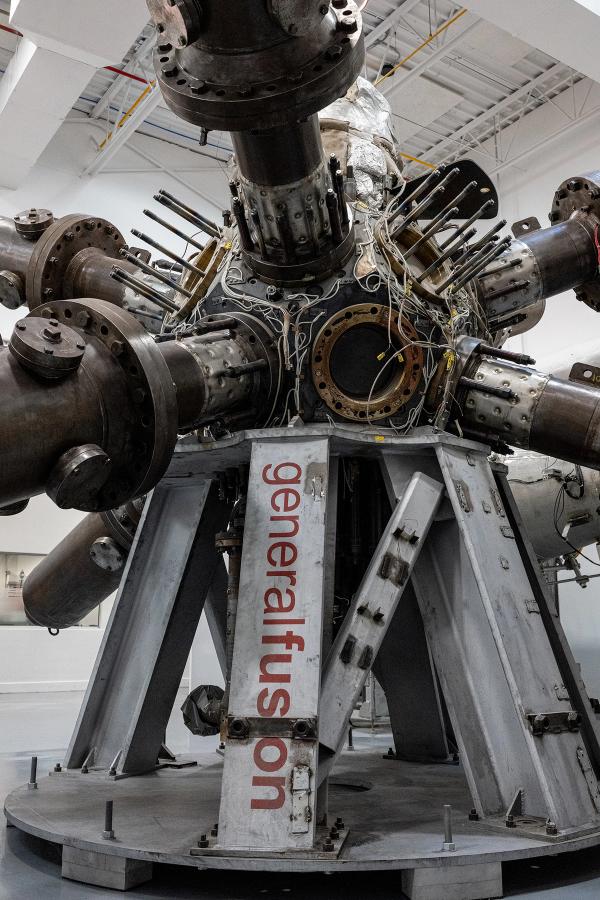
Behind the wall is a large, high-ceilinged room filled with giant machines. One of them looks like a spaceship cradled on its side, while another, a spherical assemblage of wires and tubes with thick steel shafts pointing outward in all directions, bears no resemblance to anything you’ve ever seen.
This is General Fusion’s “museum,” a Back to the Future landscape of old experiments. Each artifact represents a point along the company’s journey to achieve what would rank among humankind’s greatest accomplishments, if not the greatest: recreating conditions that power the stars, including our sun.
Get our new book for free.
Subscribe to our newsletter and we’ll mail you a printed copy.
Unlike nuclear fission, which creates chain-reactive energy by splitting heavy atoms from radioactive metals such as uranium and plutonium, fusion is a process in which two lighter atoms fuse to form a single, heavier atom, creating intense energy that converts into heat.
Ever since it was identified by astrophysicists in the early 20th century, people have tried to develop a technology that can replicate fusion here on Earth. Why? Because it could provide a new source of abundant zero-carbon energy for electricity generation and other industrial applications. It would not produce long-lived radioactive waste. It could not be used to produce materials for the manufacture of weapons of mass destruction. The process could not experience a runaway chain reaction or “meltdown” if something went wrong. In other words, it would be safer, cleaner and friendlier than fission.
Demand for fusion energy could be practically insatiable. And that, says General Fusion CEO Greg Twinney, represents a massive business opportunity, to the tune of at least $1 trillion.
Twinney joined General Fusion as its chief financial officer nearly seven years ago after holding similar roles at Rakuten Kobo, the Toronto-based digital bookseller, and Hootsuite, the social media management platform. In 2022, he became the boss. While he’s fluent in fusion energy and can describe his company’s technical endeavours with practised ease, he’s not a science guy. “When I first jumped into this, what I saw was a lot of really important work going on, led by scientists and physicists,” he recalls. “But their goals are different than mine, as an entrepreneur.” His goal: transform General Fusion from a highly advanced science project into a highly profitable enterprise.
It’s already come a long way, from humble beginnings inside an old service station on one of B.C.’s Gulf Islands more than two decades ago to an acknowledged leader in what’s often called the “race to fusion.” Over the years, it has received $100 million through grants and partnerships in Canada, the United States and the United Kingdom as well as some half a billion dollars from other sources, including individual angel investors, venture capital firms and sovereign wealth funds.
But until recently, despite all the cash that has kept General Fusion going and the billions more spent elsewhere on the pursuit – in the United States, Europe and Asia – the so-called race has seemed more like a crawl, as the company’s chamber of relics starkly demonstrates. Framed press clippings tell a story of possibility, promise and potential pay dirt. A 2011 cover of BCBusiness magazine features a photo of an early General Fusion device, a tangle of pipes and rods and engineered whatnot. “Is this the answer to our energy problems?” reads the hopeful cover line. Turns out it was not.
A Fortune magazine story from 2012 has General Fusion’s then chief executive promising that the company would achieve “net energy” – creating more energy than it used during experiments – by 2017. That would have been an enormous accomplishment, had it happened. It didn’t. What followed was a decade of incremental, unspectacular progress.
But this year, the pace quickened. General Fusion has found some momentum. In June, TIME magazine ranked it the world’s “Top GreenTech Company” on a list of 250, based on a study that considered “positive environmental impact, innovation and financial strength.” A month later, in a first for the fusion industry, the company went public with a listing on the NASDAQ, allowing it to raise another US$150 million in cash.
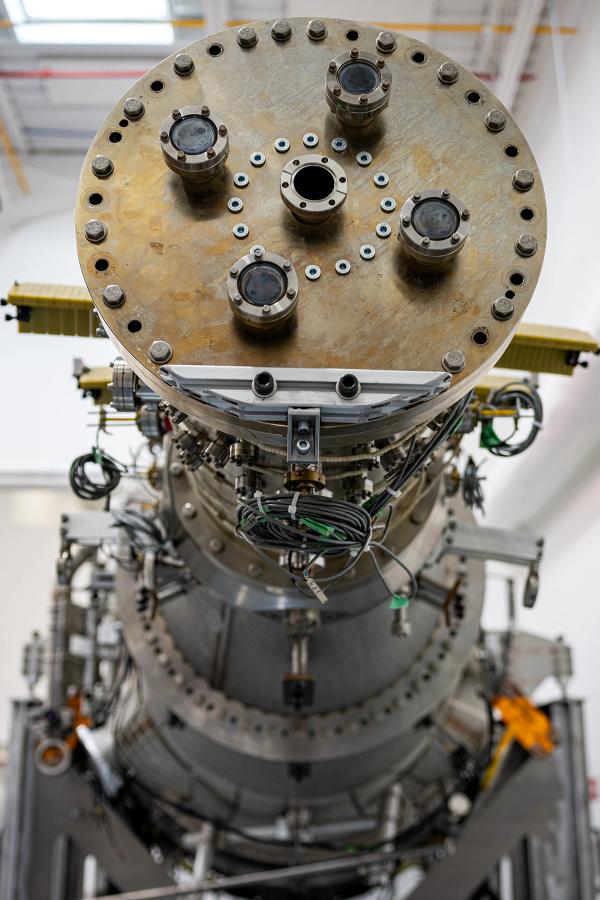
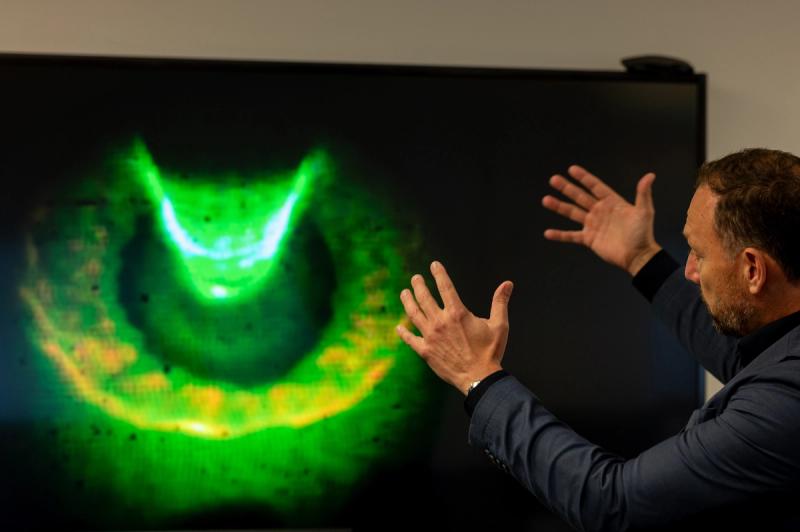
Then, in October, General Fusion announced what’s arguably its biggest technical achievement to date. Working in collaboration with the U.K. Atomic Energy Authority, the company deployed a hulking mechanical beast it has developed, a demonstration machine it calls Lawson Machine 26 (LM26), to achieve an electron temperature of approximately 12 million degrees Celsius – equivalent to more than 1 kiloelectron volts (keV), or something approaching the sun’s core temperature of 15 million degrees Celsius.
Needless to say, that’s incredibly, unimaginably hot. Hot enough to instantly vaporize just about anything on our planet had it not been confined inside LM26’s protective metal walls. Enough heat to generate more headlines and raise eyebrows in scientific communities. Not nearly enough heat to create fusion, but another measurable step along the way.
A successful system of human-made fusion would generate more energy than it would consume; it would manufacture an energy gain, or “net energy.” In most fusion designs being developed today, that thermal heat would be used to drive steam turbines, generating electricity.
The majority of General Fusion’s competitors are based in the United States and Europe. Many have deeper pockets, as well as backing from big-name individuals and companies such as Bill Gates, Jeff Bezos and Google. Most are using complicated arrays of high-temperature superconducting magnets or high-powered lasers to try to create the conditions needed to make those massive amounts of heat.
General Fusion uses a less exotic system, a “differentiated approach” conceived by its founder, Michel Laberge, back in the early days. It relies on mechanical pistons to repeatedly compress magnetized plasma at low speeds, a process called magnetized target fusion (MTF), which it claims is less expensive than others and more durable. There’s still no telling if Laberge’s approach to compression using MTF is the right path to fusion, but then again, no one else has managed to reach 1 keV using such a structurally simple system. (While still a presence at the Richmond facility, which is now staffed by 139 people, Laberge is transitioning to a part-time advisory position.)
LM26 is big, about the size of a Greyhound bus. But it wasn’t on view at General Fusion’s headquarters a few weeks after the 1 keV announcement. It was having some work done, a company spokesperson explained. Upgrades are required for it to advance to 10 keV, about 100 million degrees Celsius, a temperature considered necessary for commercial fusion.
Reaching 10 keV would be – will be – General Fusion’s next big achievement, Twinney states flatly. He speaks of targets, not hopes, and of years, not decades. He’s introduced a highly structured approach to the company’s development, with clearly defined phases. How does he land on a timeline? “Lots of Gantt charts,” he says with a laugh, referring to the classic time-management tool. “It’s not about raising many billions up front, crossing your fingers and hoping that in 10 years you flick a switch and everything works. We’ve taken a milestone approach that has some flexibility and that also works for the public markets because it allows us to demonstrate real progress.”
Building up the LM26 demonstration program and using it to hit 1 keV checked one box. Taking General Fusion public checked another. Twinney wants 10 keV by around 2028. By about 2030, he sees the company advancing work on plant-scale components, including liquid-metal pumps and pistons. And he has his sights set on working with third parties to fully outfit a fusion-fuelled, dual-machine power plant that’s spinning turbines and delivering 300 megawatts of electricity to grids – about a third of the output of a typical nuclear reactor – by 2035.
That’s an ambitious target, but “not unreasonable,” says Axel Meisen, former dean of applied science at the University of British Columbia and former president of Memorial University in Newfoundland. Meisen has an abiding interest in fusion; he currently serves as president of the Fusion Energy Council of Canada, a non-profit that promotes the advancement and regulation of fusion energy in this country.
While he believes that fusion can be achieved, and its energy harnessed and used in some sort of commercial application, he says it won’t happen at scale inside of 10 years. General Fusion’s mechanical approach has some inherent advantages and disadvantages, but so do the others. “All current approaches to fusion-energy production are challenged by complexity,” he notes. “This will change as learning progresses.”
The challenges go beyond physics. Will the public accept that fusion – often confused with nuclear fission – is fundamentally safe? Will governments finally start thinking about how fusion energy might best be used and where, and develop regulatory policies around it? Canada especially is behind in that space, Meisen says.
If all that weren’t enough to ponder, there’s “another very general, very real problem,” he says. It takes power to make power, and the cost of the electricity required just to run a fusion project is considerable. “Will the economics work? Could a fusion-energy plant produce electricity at a price that’s affordable? I’m not lacking confidence, but it’s not an easy task.”
That’s an understatement. Twinney doesn’t disagree. But the prize is too big to ignore, the possibilities for a cleaner form of energy too great. “There’s just such massive potential here, you know, for leaving the world in a better place for everyone, including my four kids,” he says. It’s his soft sell. Then the businessman takes over. “If we can’t create fusion conditions in a way that can ultimately be turned into a power plant that runs 24 hours a day, seven days a week, I’m not interested. I want to build lots and lots of power plants, all over the world.”