If drivers in Burnaby, B.C., last summer had X-ray vision, they might have spotted something curious inside a couple of yellow school buses cruising around town: 5,000 pounds of sandbags, meant to stand in for the weight of a load of rambunctious kids.
The electric buses, being put through the paces of an ordinary school run, were part of a pilot study by B.C. Hydro and Lynch Bus Lines to see how much charge was left in their batteries at the end of the day. And, crucially, whether that juice might help the utility even out its supply and demand.
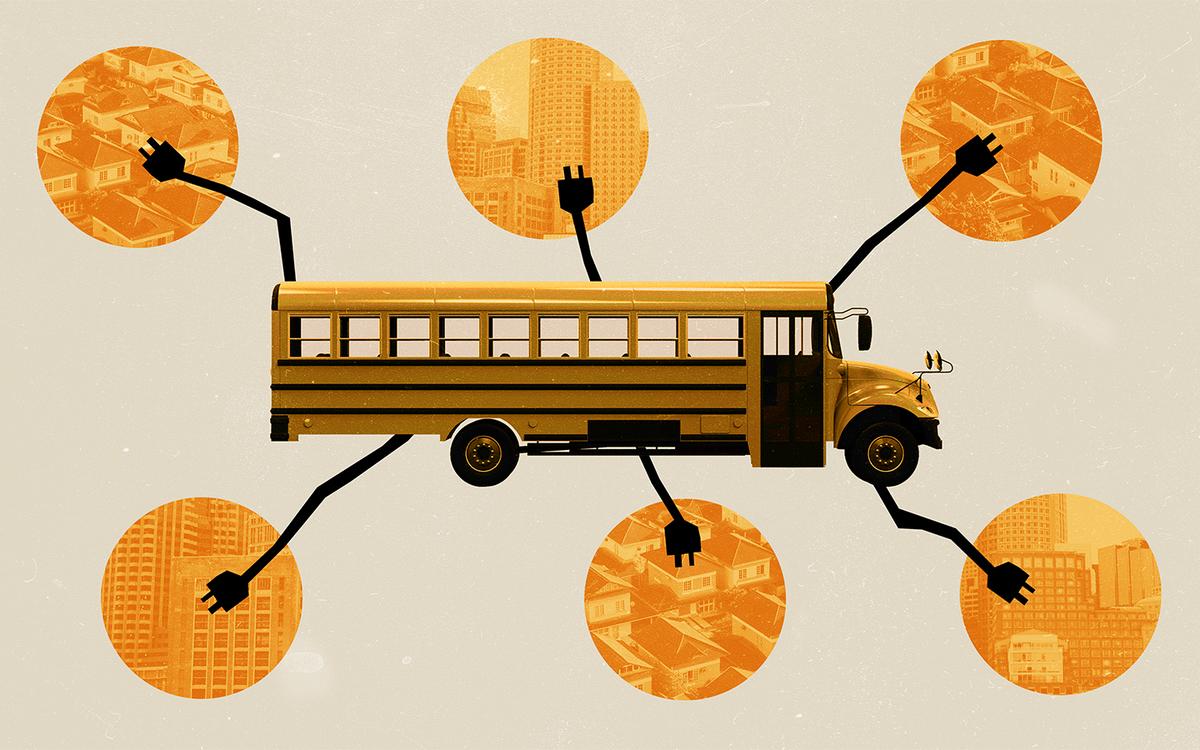
The idea is called V2G, or vehicle-to-grid, and it works like this: electric vehicles are connected to the power grid so their batteries can supply power to the grid when it’s most needed. In turn, the vehicles recharge when demand on the grid is lower.
“Batteries are ways to manage our electricity grid when there are periods of high demand,” says Kari Montrichard, senior manager for capacity products at B.C. Hydro. “They’re a tool in our toolbox of how we manage the grid and serve our customers based on the demands that they have and the supply that we have available.”
These batteries can come in a number of flavours. A property owner, for example, might install a backup battery to provide electricity to their home when the power goes out, or to store excess power from rooftop solar to use after the sun goes down. Utilities might set up big battery stations to even out electricity supply when sources are intermittent – in Australia, for instance, where solar panels often create much more power than is needed during the day, batteries can store the excess, then release it in the evening.
Electric vehicles could become another big piece of this puzzle. Last year in the Netherlands, for example, a car-sharing service connected 50 bidirectional chargers to the local grid so their fleet could help the city of Utrecht manage its renewable-heavy electricity system. California already has school buses and chargers set up for V2G. And oceangoing vessels – another kind of V – have the potential to participate, too. A recent joint project between the U.K. and the province of Nova Scotia ran successful tests of vessel-to-grid charging and is working to bring V2G technology to life in Halifax and Plymouth, U.K.
And that’s where the big yellow buses come in. “School buses are very highly scheduled,” says Cory Lynch, operations manager at Burnaby-based Lynch Bus Lines. “You know that every morning you take the kids to school, every day you take the kids home, and within reason, you’ve got a 10- to 15-minute window of when all the buses are getting back to home base.” They also do a predictable amount of driving each day, which means it’s possible to have a good idea in advance of how much power they’ll use. That’s perfect from the point of view of B.C. Hydro operators, for whom having an amount of battery capacity ready to go at the end of the school day is perfectly placed to cover the province’s peak electricity demand: 5 p.m. to 9 p.m. on cold winter days, when people crank the heat. After that, says B.C. Hydro’s Montrichard, “there’s still time for the bus to be able to recharge and then go back out on its route the next day.”
The pilot in Burnaby took place from July through November of 2025, using a pair of electric buses borrowed from the manufacturer, RIDE Mobility. (Perhaps fittingly, the model they used is called the Dreamer.) Lynch’s buses are currently all diesel-fuelled, with tanks filled overnight in the yard by a mobile service. But he is eager to electrify the fleet – doing so would significantly cut emissions and fuel costs while being healthier for kids, drivers and the environment. The catch is that electric models currently cost “close to triple” what you’d pay for diesel buses, which is a large barrier to entry. Participating in a V2G program with incentives from the hydro utility could help bridge that gap, as could government support for bus electrification. (Lynch is still waiting on government grant applications the company began four years ago and is hoping for an answer soon so it can buy some electric buses.)
To conduct the pilot test, Lynch’s building needed an electrical update and V2G-capable chargers installed, then the company sent drivers out on the road with their sandbag passengers. “We tested it on a number of school runs,” Lynch says, to make sure everything worked as it should: charging and discharging, covering specific routes, even a mock field trip up to Cypress Mountain and back. “We were trying to see if we’d have enough at the end of the day to actually give back to the grid.”
The answer was yes. The Dreamer’s capacity is 255 kWh, and the test buses used about 75 to 100 kWh per day. Maintaining a minimum charge level of 20 per cent still left a solid 100 to 125 kWh per bus for B.C. Hydro to use during the 5-to-9-p.m. window. That’s about enough electricity per bus to heat a single-family home for almost three full days.
Get our weekly newsletter – the people, places, and ideas revealing where Canada is headed.
Now, the utility is planning to take the concept further, with aims to test a larger number of vehicles, including residential cars and trucks, within the next couple of years. There are a few hurdles to cross, Montrichard says: vehicles, chargers, software and the utility all have to be able to communicate, and at the moment the systems are far from standardized. There’s also the matter of what makes it worth it for drivers themselves to participate: a business like Lynch Bus Lines might see the value as an investment, but the average car owner might hesitate over potential wear on their battery, or letting a utility manage when and how their battery gets used. As well, many EVs aren’t even capable of being used for V2G. “This industry is still developing,” Montrichard says. “It’s starting to become more mainstream, but we still have things to figure out.”
That said, she anticipates large-scale V2G will be a reality in B.C. in about five years, and notes that utilities, governments and industry stakeholders across Canada are working to co-ordinate efforts, which will help develop standardized protocols and build a more attractive market for charger and vehicle manufacturers. “In B.C. we have 235,000 light-duty EVs on the road,” Montrichard says. “People aren’t charging every day because they don’t need to, and the range of vehicles has increased so much that there’s this potential sitting in a driveway or garage. We want to take advantage of that when we need it.”