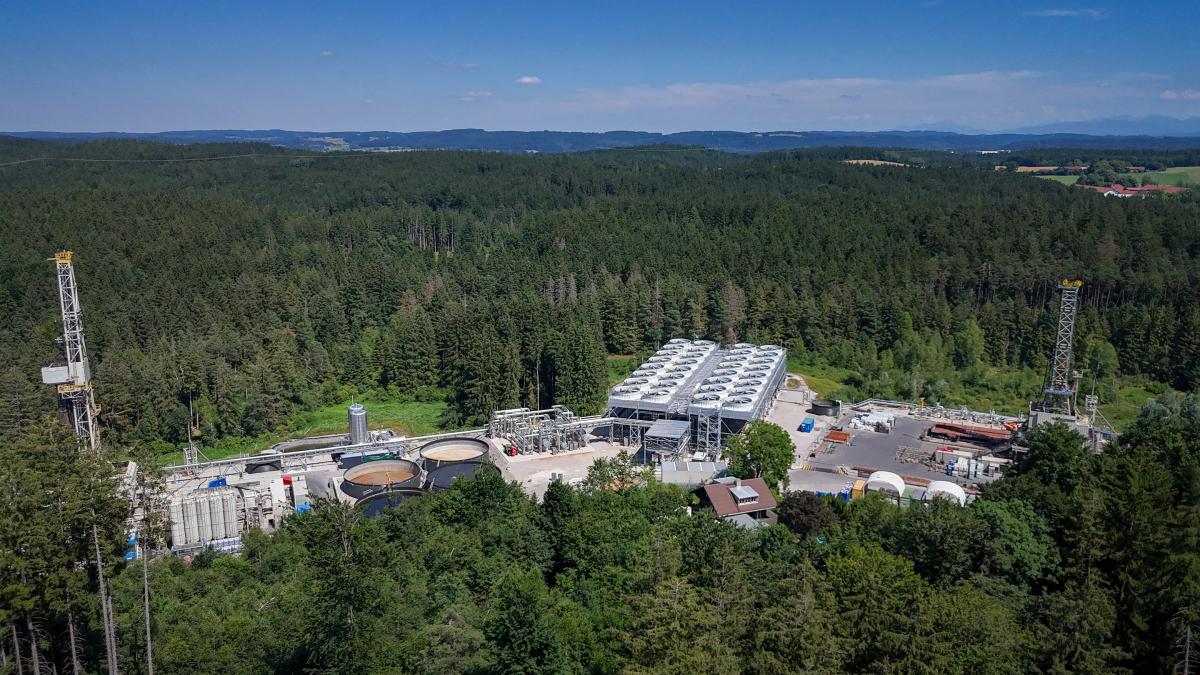
Late last year, Calgary-based Eavor Technologies announced it was sending power to the electrical grid in Germany using a ”closed-loop” geothermal system, which taps into the Earth’s natural heat underground – the first commercial project of its kind in the world. Eavor (pronounced “Ever”), which recently ranked second on Time’s list of the “World’s Top GreenTech Companies of 2026,” has set its sights on going deeper and hotter, with an eye to unlocking renewable geothermal energy almost anywhere.
Be Giant spoke to Eavor president and CEO Mark Fitzgerald at the World Geothermal Congress in Calgary about the company’s installation in Geretsried, Germany – what worked, what didn’t, what comes next – and what it would take to get a project like this going in Canada.
You were CEO of Petronas Canada, the Canadian arm of the Malaysian oil and gas multinational, then you made the switch to geothermal energy. How did that come about?
I have 37 years in the oil and gas industry. I saw different energy systems around the world. I saw economies that were developed, that wanted energy security and were trying to create that. I saw economies that were in abject poverty that had no access to energy. It was very impactful in terms of thinking about how we evolve energy systems to provide prosperity, energy security and energy equality around the world.
I chose to retire at the end of 2025, and my retirement lasted 19 days. I had the opportunity to join Eavor, [which] took all of that passion I had for providing Canadian energy and know-how on the global stage, just in a different way.
What makes you excited about geothermal?
Fossil fuels exist in sedimentary basins – deposits that aren’t consistent around the globe. Wind and solar work in some areas [and] are accepted in some, but not in others. Nuclear, either as an existing or emerging energy system, again is accepted in some areas – or not.
The closed-loop geothermal system is unique. We can go to regions of the world that don’t have the energy infrastructure to deliver fossil fuels, or we can go to regions, such as Japan, that are concerned about the long-term impacts of nuclear development. The [geothermal heat] resource is everywhere – it’s beneath our feet. It’s just [a matter of] optimizing the manner in which we extract that to deliver cost-effective, environmentally sound heat and power.
![The progression of the development in Germany. ’The first loop of four planned loops came on stream in December 2025, [and] we generated first power. We partied like crazy when we did that.’](https://cdn.sanity.io/images/l3tzmu37/production/6c759443afd5c34a549a437b99f4473dae5f2ec8-571x677.png?auto=format&fit=max&q=75&w=571)
Tell me about the Eavor-Loop system. I’ve seen it compared to a radiator.
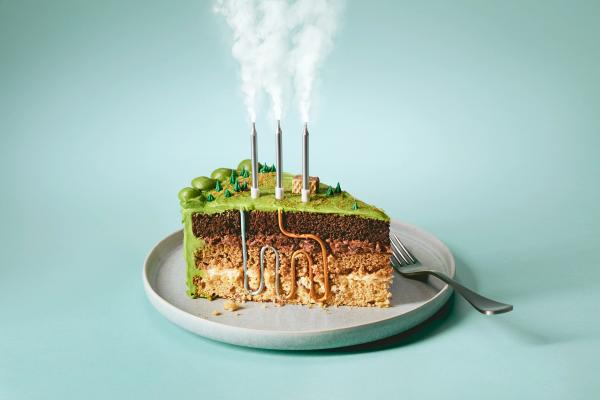
That’s exactly the right comparison. I describe it often as a fork. So we take a fork and we bend the ends of the fork. We essentially go down one vertical well, and then we branch into up to 12 horizontals from that single vertical well. Then we do it again, and we connect the toes [of the forks]. We seal that loop. We fill the entire loop with water.
Cold water comes down one vertical. It circulates through and comes back up the second, creating that closed loop. Because cold water is heavier than hot water, it rotates on its own, so there’s no pumping. As that heat is brought to the surface, we either use it to generate heat — [for] district heating systems, for example — or we can drive a turbine to generate power. As the water is cooled, it falls back down by its weight and continues that cycle.
The most significant benefit for us is we don’t have to input energy. Because we don’t have pumping equipment and big machinery at the surface, we don’t have the emissions associated with that. And because we don’t have to put all that energy in, our cost structure is much different long-term. We can go into areas that [other] geothermal systems cannot compete in.
How did Eavor end up in Germany for this project?
We are a proud Alberta company. We started in Alberta because of the overlap between the talent, technology and knowledge that exist in the oil and gas space. Our first test was the Eavor-Lite. That was the first test of, can we connect these wells? Does the system work? As we advanced, it was very clear we needed to build at scale. We needed to show we could develop a closed-loop system commercially, to deliver heat and power.
Germany was a natural fit. They have what’s called a feed-in tariff; it defines the price received for heat and power at the end, and it was a strong price. We were given significant support by the European Union Innovation Fund [for low-carbon technologies]. Two of our major shareholders are European: BP and OMV. And the site was already prepared.
It was an existing site that was originally designed for traditional geothermal. It didn’t work. It was hot, dry rock. For us, it was perfect. The first loop of four planned loops came on stream in December 2025, [and] we generated first power. We partied like crazy when we did that. We’re currently working to determine the best way forward for loops two, three and four. We remain committed to seeing Geretsried completed as planned.
How much power is it generating?
We were originally designed for 8.2 megawatts per hour of power and 64 megawatts of heat. We’re currently at 1 [megawatt]. The first loop wasn’t fully completed. We’ve released all the technical details. Our view is that we’ll be transparent; it’s the very first one, here’s what we learned, here’s how we’ve corrected and here’s where we’re going. That’s not something I’m concerned about in terms of the ability to execute. In terms of [heat generation], it’s 36,000 houses. We’re competitive in terms of cost of heat supply in Europe right now.
I understand you had some challenges with drilling.
That’s not unexpected. The challenges were primarily related to the manner in which the cement was designed. So, as we go down with drilling and install steel pipe, we add cement to ensure a seal between the outside of the pipe and the [rock] formation, and that ensures that no fluids move between. That cement job wasn’t designed properly, and as a result, we had all kinds of challenges ensuring that each lateral was independent, that there was no fluid flow between. We spent a lot of time learning through that. We’ve since redesigned the cement system, so we’re very confident where we are now. We continue to evolve materials and systems and how we drill. Our objective is between 12 and 15 kilometres.
That’s quite deep.
It would be unique not only in the geothermal space but also in the oil and gas space.
Isn’t the deepest [human-made] hole in the world about 12 kilometres deep?
Yep. The attraction of a company like Eavor, and what pulled me out of retirement, is the innovative mindset. I’m highly confident that we’ll achieve that. The combination of drilling efficiency and eliminating the mistakes will bring us very quickly to a levelized cost of energy that’s below where the competition is at right now.
Any other lessons that’ll be taken forward?
The system worked. Delivery of heat to the surface was as we expected. The ability to drive power generation was as expected. If those didn’t work, there [would have to be] a major problem.
It caused us to think about what’s the most effective way to scale. We went into Geretsried as the driller, as the operator. We did everything. And that creates great learnings for us. The challenge is, you do one project, it takes a long time, and then you do another. And it also requires us to build organizational capacity to rival a BP or a Chevron or an Exxon, because we’re a global company.
We stepped back and said that our strength is in innovation, creativity [and] the application of that to deliver underground heat to derive heat and power at the surface. There are companies that are really good at execution. And so our focus now is to create partnerships. We don’t have to drill all the wells anymore. We will build and innovate around the closed-loop geothermal system to make sure we can scale that rapidly around the world.
Would Eavor install something like this here?
I would love to do a big project in Canada. I said that the first day I started. But Canada is difficult because we’re behind in terms of acceptance of geothermal. As an energy superpower, we have very low-cost energy relative to other regions of the world, and part of the reason we’re in Germany is [that] we have to go where the business is profitable for us.
We can be an important part of a balanced, sustainable energy mix as [geothermal] technology and innovation continue to grow and develop in Canada, through these made-in-Canada solutions. Then we can export that globally. With the support of regulators and policymakers, we’ll be able to make that happen.
This interview has been edited for length and clarity.