Benjamin Hatton spends a lot of time contemplating the perfect window.
In the summer, it would keep out the sun’s heat while letting in light. In winter, it would let in both light and heat. It would scatter and evenly distribute light on overly bright days to keep a building naturally lit.
In short, the perfect window would act a little like a squid.
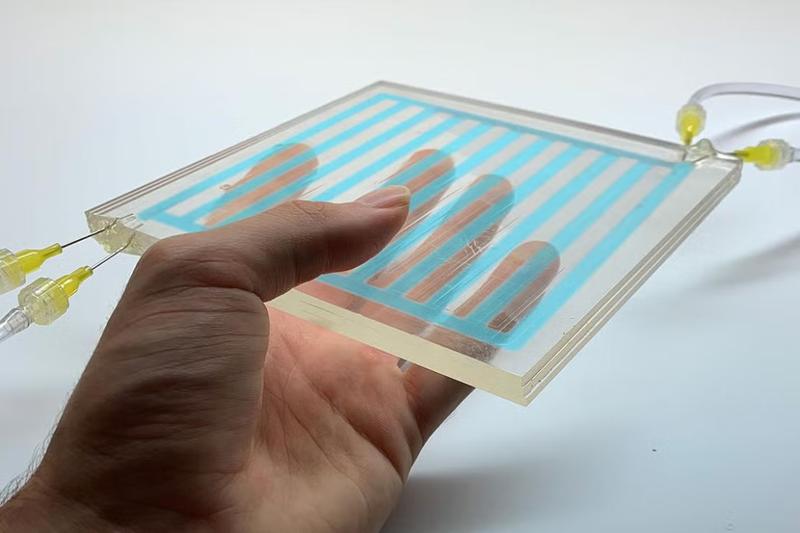
Hatton is a University of Toronto materials science and engineering professor who leads the Hatton Lab for bio-inspired materials and design. A few years ago, he and a team of researchers created panels that dynamically shade in response to the sun’s rays, mimicking the way squids, octopuses, krill and other sea creatures move pigments within their cell structures to change their coloration. The panels move liquids containing additives such as carbon black (to absorb light) and titanium dioxide (to scatter it) through channels carved into thin plastic sheets.
Get our weekly newsletter – the people, places, and ideas revealing where Canada is headed.
Hatton says the next challenge is to scale that idea by turning it into a tool that can be used to retrofit old buildings.
“We can improve the performance of a window without having to replace the entire [thing],” says Raphael Kay, who began working with Hatton’s research group while doing his master’s degree in mechanical engineering at U of T; he’s currently working on his PhD at Harvard. Kay was the lead author on two papers about the team’s panel system, released in 2023 and May of this year.
In the 2023 paper, the researchers’ simulations estimated that one version of their dynamic windows with three fluid layers could help buildings slash their heating energy use by 75 per cent, electric lighting use by 20 per cent and total operational energy use by 43 per cent compared to the best available electrochromic technology of the sort used in airplanes.
About 80 per cent of the world’s buildings will still be in use by 2050. And those structures are energy hogs. Currently, buildings consume about one-third of the world’s energy supply, and that’s projected to double by mid-century.
The reason? “The buildings we design today are kind of dumb,” Hatton says. More than a quarter of a typical building’s energy is used to offset the heat that enters or escapes through its windows: the ramped-up air conditioning in the summer to combat greenhouse-effect warming from the sun and the blasting of heat in winter to counter the chill let in through glass panes.
Research attention to windows is overdue, despite their outsized role in a building’s energy use.
In the 1970s and ’80s, researchers collaborated with industry in the U.S. and Germany to develop coatings that limited the amount of thermal radiation that entered through windowpanes on buildings. Today, most commercial buildings have windows manufactured with these films in them, but their light-blocking properties are fixed, meaning they aren’t well suited to a country with a variable climate. Electrochromic windows, first developed in the 1980s, have advanced the concept of dynamic facades – if you’ve been on a newer airplane with windows that can brighten or darken with digital control, you’ve seen them. But, at the moment, they’re “way too expensive” for a whole building to adopt, Hatton says.
Then there’s good old-fashioned roller shades, he adds: “More or less, that’s all we have.”
Hatton and Kay are currently testing separate prototypes to fill the gap. At Harvard, Kay and fellow researchers have installed a commercial-scale prototype window in a historic house on campus that students can conduct experiments on. The two-foot-square window has a reservoir for liquids that can be pumped into an air gap between two glass panes. The solutions can variously make the window change from clear to blurry, control heating and cooling, and filter light.
Kay sees the path to market running through commercial real estate, given that cities are implementing higher benchmarks for energy efficiency in commercial buildings. Kay says he’s envisioning a thin application for existing windows that basically acts like a giant sticker with fluids inside. That would allow building owners to retrofit their windows rather than replace them entirely. Such a sticker system, he says, could be controlled by artificial intelligence to respond to weather conditions outside.
At U of T, Hatton is in the midst of setting up a lab with a dedicated simulation room where tests will determine whether two-metre-tall prototypes can regulate the room’s temperature as sunlight shines through them.
“If you can make a layer two metres tall, it means it’s suitable for a big storey-height window,” he says. “It’s the height of these things that’s most difficult because of the gravitational effects on the fluid.” Depending on how the prototypes perform in the lab, the next step will be to test them across the university campus.
Hatton envisions a final product that can be targeted at the retrofit market. But “how that ends up technologically, we’re still working on,” he says. “Where we’re at right now is just trying to figure out how to best fabricate these layers to be large scale and inexpensive but also reliable, and to test their performance in different conditions.”