In downtown Vancouver, it takes a lot for new towers to stand out. Since the turn of the millennium, a landscape of highrise construction cranes has become an enduring complement to the majestic mountains and waterways that frame the city. Yet, even amid the thicket of soaring condominiums and sublime natural surroundings, Sen̓áḵw is a showstopper.
Immediately distinguished by its sinuously expressive forms, vivid orange striations and bursts of highrise greenery, the rising cluster of sculpted towers draws the eye against a skyline of generic blue boxes, asserting a proud yet elegant presence even before construction of the first phase is completed later this year. Led by the Squamish Nation (Sḵwx̱wú7mesh Úxwumixw), the landmark development in False Creek will eventually comprise some 6,000 apartments spread across 11 towers, including affordable housing earmarked for Squamish Nation citizens and other Indigenous communities.
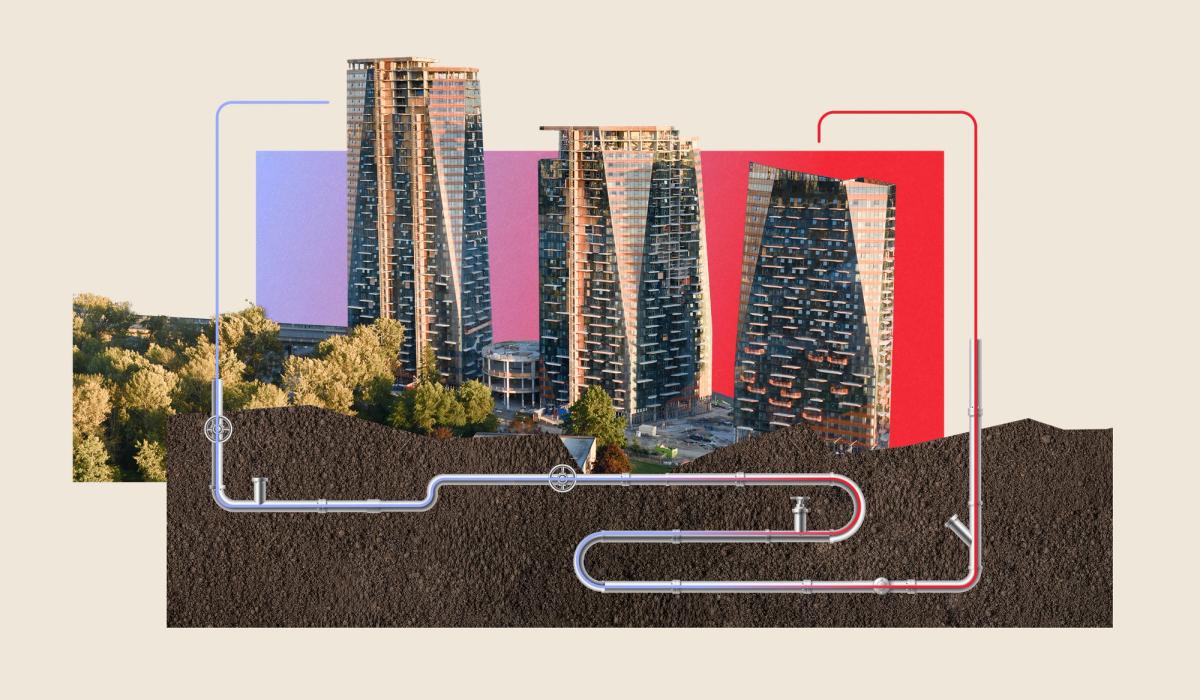
Beyond dramatic thickets of futuristic towers and generous new green spaces, however, one of Sen̓áḵw’s most radical technological innovations is easy to miss. In fact, it’s almost entirely buried underground.
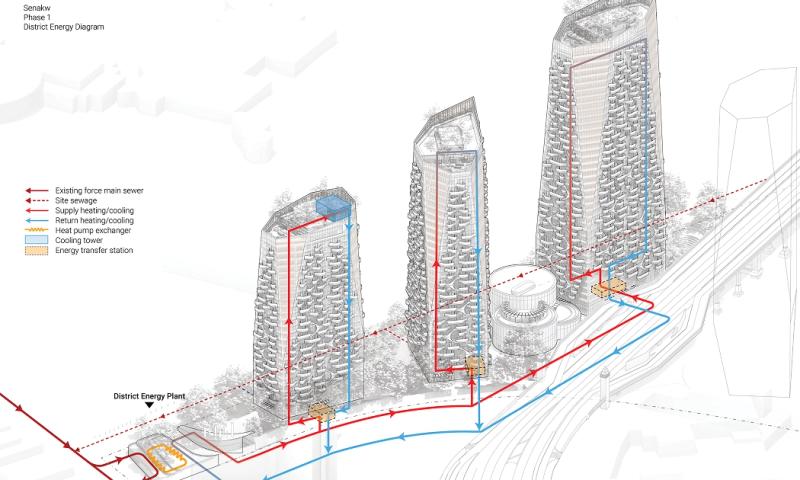
A novel energy system is taking shape below the 4.3-hectare construction site, one that will harness the heat generated by Vancouver’s sewage system as a carbon-free source of residential heating. The developers are building a district energy system – so called because a single system will serve multiple buildings – and it will tap into the city’s main sewage line to harvest heat and pump it into the towers during the winter months.
Get our weekly newsletter – the people, places, and ideas revealing where Canada is headed.
The scale and ingenuity of Sen̓áḵw’s system represent the next step in an energy revolution that’s shaping development across the country. Although district energy systems have been around for decades, they are increasingly using advanced energy-recovery loops and geothermal systems. Otherwise unremarkable condo or apartment buildings are sinking 250-metre-deep boreholes to harvest geothermal energy. More and more Toronto office towers are using a system that taps cold water from deep in Lake Ontario to provide air conditioning. Residential developers are building neighbourhood-scale geothermal systems. Tapping sewage systems is another step in pursuit of clean energy – every shower or flush of the toilet becomes a potential source of sustainable heat.

At False Creek, Sen̓áḵw’s system was developed by the local firm Creative Energy, working in collaboration with designers Revery Architecture and the Squamish Nation. Keith Bate, Creative Energy’s director of engineering, says the scale and location of the site, at the foot of the Burrard Street Bridge, allowed two emerging strategies to be combined: a district energy plant that consolidates heating and cooling operations for the whole neighbourhood; and the sewage heat-recovery system.
“There’s a major sewer main, with about a four-foot diameter, which handles about half of all the sewage from downtown Vancouver, and it’s right next to our site,” says Bate.
While the heat generated by sewage is a simple byproduct of waste, the process was anything but straightforward. It required drilling into an active, highly pressurized main, all without interrupting municipal services.
“We hot-tapped into the sewer main with a pair of pipes, which we then connected to heat pumps that move energy into Sen̓áḵw’s district hub, which distributes heat through the buildings,” he explains. (Electrical boilers will help handle peak loads and natural gas boilers will be available for backup if needed, but the system will meet the vast majority of Sen̓áḵw’s heating needs, and save an estimated 4,000 tonnes of greenhouse gas emissions every year, compared to conventional gas boilers.)
Such systems are not cheap: Sen̓áḵw’s $30-million district energy system represents a substantial investment, but it’s designed to yield long-term benefits.
“The sheer size of the project also helped us justify the cost,” says Bate, adding that the 11-building site invited economies of scale, making the sophisticated central energy hub financially viable. The fact that it’s a purpose-built rental development helps, too. Unlike condominium projects – where developers sell units and then flip responsibility to condo boards after occupancy – rental building owners have an economic incentive to think longer term, and be more willing to make upfront investments that pay dividends decades later.
Amirali Javidan, a director at Revery Architecture, says the benefits add up. “Passive measures of carbon reduction through sewer heat recovery allow for long-term cost stability, which also reduces energy costs for residents.”
While Sen̓áḵw is poised to become Canada’s first private-sector project to harness sewage as a major energy source, it builds on an innovative local precedent. The False Creek Neighbourhood Energy Utility (NEU), operated by the City of Vancouver, has gradually expanded to supply heat and hot water to buildings across Southeast False Creek.
“We began operation in 2010 and are the first application of large-scale raw sewage waste heat recovery in North America,” says Ashley St. Clair, a former senior green building planner at the City of Vancouver. The plant “provides space heating and hot water to over five million square feet of development in the False Creek area.”
Similar to nearby Sen̓áḵw, the process uses heat pumps to capture heat from wastewater, significantly reducing greenhouse gas emissions by harnessing the heat from daily water use as a community energy resource.
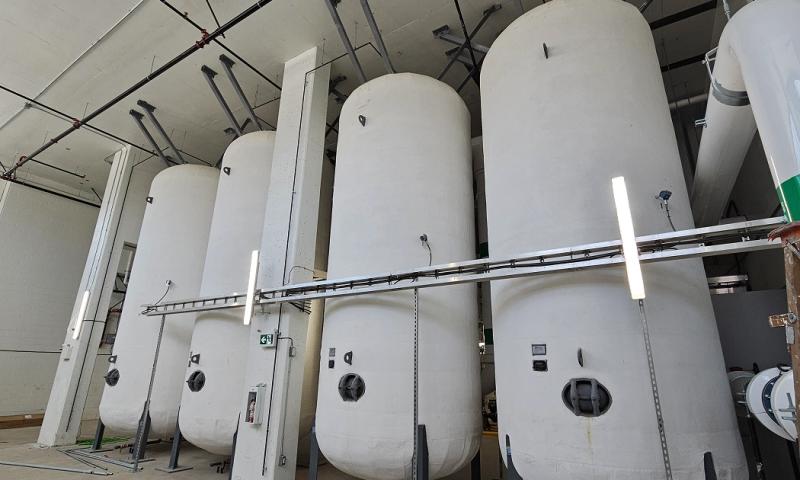
“Wastewater is warm because we use domestic hot water for things like taking a hot shower, doing the laundry and doing the dishes,” says NEU branch manager Derek Pope. Before wastewater is sent into a treatment plant, the NEU plant diverts a portion of the flow to a sewage heat recovery plant. Here, a “heat pump extracts the heat from the sewage and puts it into our system water, boosting it to a high temperature – as high as 80 degrees Celsius.”
The ingenuity of the NEU’s heat pumps is their efficiency. For every unit of electricity they consume to operate, the heat pumps generate three units of thermal energy. Following a major expansion in late 2025, the NEU now serves over 10,000 area residents in nearly 50 buildings, as well as nearby Emily Carr University.
Similar principles are spreading nationwide. In Edmonton, for example, the upcoming Blatchford Sewer Heat Exchange (SHX) Energy Centre is poised to sit at the gateway to one of the most sustainable neighbourhoods in North America. The sprawling 217-hectare site of the decommissioned City Centre Airport is being redeveloped as a dense urban district with a mix of residential, commercial and recreational uses, and a planned population of 30,000 people. Located just two kilometres north of downtown Edmonton, the master-planned development aims to become the first carbon-neutral community in Canada.
Heating and cooling are key to realizing Blatchford’s sustainable aspiration. To that end, the nascent community already features a district energy plant with a geo-exchange system: 570 boreholes were drilled to reach stable underground temperatures at a depth of 150 metres, deploying the earth’s relatively consistent temperature as a sort of giant battery. Used in conjunction with heat pumps, water-filled boreholes reach underground to swap cool and warm air. In winter months, the warmer underground air is used as a source of heat. During the summer, the same temperate air is used to cool buildings, providing a carbon-free energy solution.
The next step? Sewage. At the southeast end of the Blatchford lands, the future SHX Energy Centre is designed to extract thermal energy from the 2.4-metre combined sewer trunk (carrying both wastewater and stormwater) that runs below the site. Here, the flow will be diverted from the main sewer, screened to separate solid particles and then channelled through a heat-exchange system. The energy harnessed will provide both heating and cooling, as well as domestic hot water for Blatchford residents.
And it’ll look good doing it. Designed by Toronto-based architecture firm gh3*, the eye-catching building is a marked contrast to energy facilities – particularly sewage plants – typically kept underground or shunted into nondescript buildings. Instead, the centre will feature two curved expanses of thin white brick, paying poetic homage to the movement of heat and energy, and a dramatic, swooping chimney that will rise above its surroundings with sculptural elan. While the facility’s advanced technologies all but eliminate any lingering odours, the tall chimney also ensures that any trace waste particles are released far above street level.
For Canada’s sustainable energy community, the visibility is about more than showing off. Tim Weber, a co-founder and CEO of Toronto’s Diverso Energy (itself a leading geothermal provider), says technologically advanced energy solutions like those at Sen̓áḵw and Blatchford tend to get short shrift in the public imagination and political arena.
“These systems are all buried underground, which has always been a kind of an Achilles heel for these technologies,” he explains, contrasting geo-exchange and sewage heat recovery with better-known forms of green energy. “You can drive across the country and see wind turbines and solar panels, but almost none of these things are visible, which puts them at a disadvantage.”
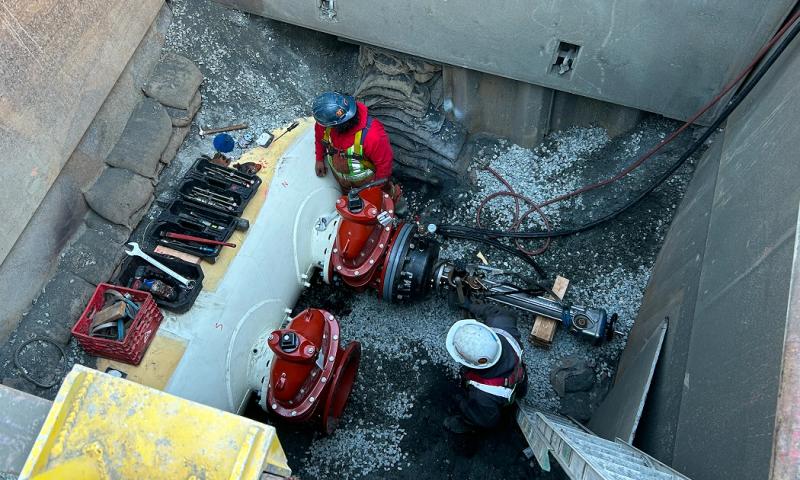
With most of the progress happening out of the public eye, the scale of potential is easy to miss. One of Canada’s biggest wastewater energy-transfer systems, in fact, has quietly taken shape beneath University Health Network’s (UHN) Toronto Western Hospital. UHN’s wastewater energy-recovery system joins Sen̓áḵw and NEU as one of the largest systems of its kind in the world.
The wastewater energy-transfer system complements a high-profile expansion that will be capped by the downtown hospital’s 15-storey surgical tower, expected to open in 2028. Much of the media attention has focused on the project’s clinical sophistication, including the 20 state-of-the-art operating theatres that will broaden access to the hospital’s expertise in neurosurgery and orthopedics.
The municipal sewer line that runs beneath it gets scant mention. All the same, the wastewater energy-transfer system will supply about 90 per cent of the hospital’s heating and cooling needs, greatly reducing reliance on natural gas and electric systems. On an annual basis, it will eliminate 10,000 metric tonnes of greenhouse gas emissions, equivalent to keeping more than 1,800 cars off the road every year. Over a 30-year period, it is expected to save more than 141 million kilowatt-hours of electricity, 130 million cubic metres of natural gas and 1.3 billion litres – or 520 Olympic swimming pools’ worth – of cooling water.
Even though the upfront costs of waste and sewage heat recovery remain substantial, the potential for cheaper energy once installed – and zero-carbon energy at that – creates new economic and ecological paradigms. Green energy developers see it as a reality that reveals the waste and inefficiency of the status quo. As the American physicist and author Amory Lovins put it, in a world where heat and energy are already flowing beneath us, “using gas or electricity for heating is like using a chainsaw to cut butter.”