Trade disruption. Geopolitical tensions. Technological disruption. There were lots of fears to face when Canadian and U.S. business and political leaders gathered this week to discuss how to navigate through extraordinary times.
But there was plenty of optimism too. Dominic Barton, chairman of Rio Tinto, may have caught the mood perfectly when he declared himself a “frightened optimist.”
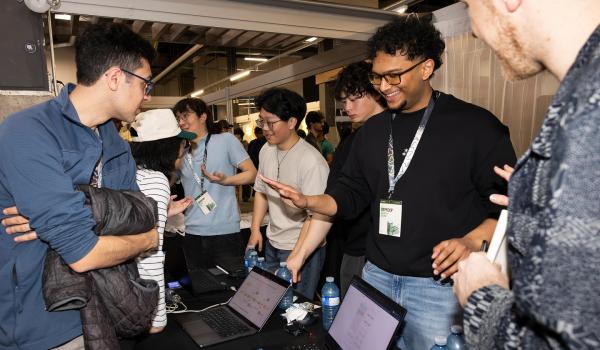
Ambition and urgency were the twin imperatives at the US-Canada Summit, hosted by the Eurasia Group and the Royal Bank of Canada in Toronto. On the stage, in side meetings, and over power coffees, more than 600 leaders traded ideas on how to ensure Canada’s growth and resilience. Here are seven of the ideas that won the day:
1. Listen, let’s be friends again…
A conciliatory U.S. Ambassador Pete Hoekstra said there may be messaging problems on both sides of the border, with Canadians hearing a different message than the U.S. administration is intending, and vice versa.
One example: Just after U.S. President Donald Trump said again the U.S. needs nothing from Canada, Hoekstra gave the opposite message, listing American needs, including potash and oil. He talked up the Ontario auto industry, praised Canada for trying to diversify trade and told Ottawa to put its sales hat on and go into CUSMA pitching ways Canada can partner with the U.S.
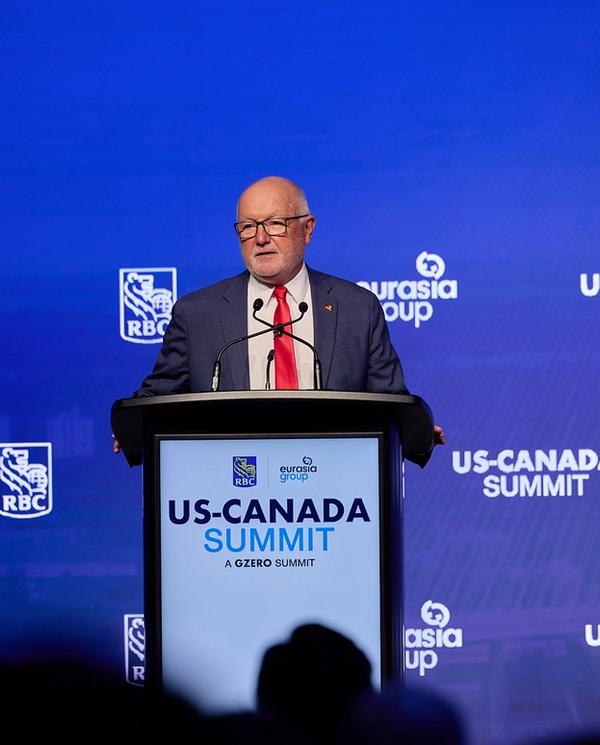
“I think Canada should optimistically look at this, and with all of the resources that you have, and the capabilities that you have, and the talent that you have, go into these negotiations very aggressively and say, ‘We know America has needs across the board, and we’re here to partner with America and fill those needs because we are the best place for America to fill these needs,’” Mr. Hoekstra said.
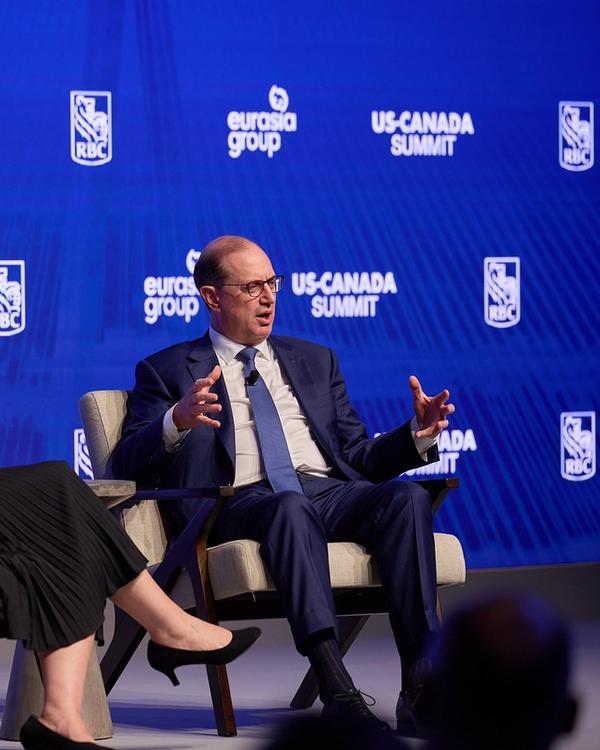
For his part, Mark Wiseman, Canada’s ambassador to Washington, told the audience that in turbulent times we need to look beyond today’s headlines and think long term in this relationship. But he conceded Canada is not always good at explaining our importance to the U.S. “We’re not moving out of the neighbourhood,” Wiseman said.
Wiseman reminded the audience that Canada is the largest trade partner for more than 30 states and more than $3 billion in goods and services cross the border each day.
Get our weekly newsletter – the people, places, and ideas revealing where Canada is headed.
2. …But let’s not forget to make other friends too
It was five months ago that, in a Davos speech heard around the world, Prime Minister Mark Carney urged middle powers to band together to counter the great-power rivalry. The summit seemed a good moment to take stock: “Is there a middle power strategy? Are there a group of countries that are cohering into a stronger collective to ensure that there is a roadmap for what more of a global order would look like?” Ian Bremmer, president and founder of Eurasia Group, asked the room. “No.”
Mark Wiseman, Canada’s ambassador to the U.S., made a case for a strong, resilient, self-sufficient Canada that can partner with the Americans while growing stronger globally. “There is nothing at odds in our relationship with the United States when the prime minister or the government of Canada talks about our need to diversify,” said Wiseman. “Because it's not diversification at the expense of our relationship with the United States of America. It…means we need to grow our markets in the rest of the world, our customer base in the rest of the world with a goal of doubling that in the next 10 years.”
Opening trade to other countries also means translating Canada’s skill at early-stage innovation into strong, at-scale economic growth, said Annesley Wallace, president and CEO at the Healthcare of Ontario Pension Plan (HOOPP). “ The ambition to create opportunity is now abundantly clear, and that's not just for investors who are in Canada – I think we have the attention now of investors globally,” Wallace said. Research from RBC finds that there’s a whopping $1.8 trillion of investment opportunities aligned with our export-oriented industries, including defence and oil and gas.
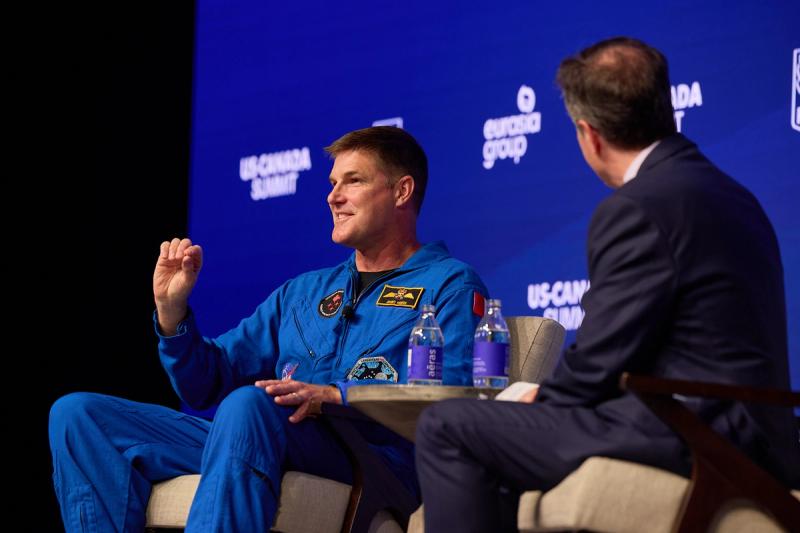
It wasn’t just trade and economic experts who pointed to the importance of Canada developing stronger ties with the rest of the world. It was a realization Canadian astronaut Jeremy Hansen said he came to while flying around the moon during the Artemis II mission earlier this year: “I stopped connecting with a country. I started connecting with a planet,” he told the crowd.
“When I do think about our collaboration, something that really jumps out at me and when I looked at it from space is that for a thriving North America, you have to have a thriving Canada, and you have to have a thriving United States,” Hansen said. “There's just no other way to see it from space.”
3. Don’t rage against the machine
With AI adoption rates in Canada among the lowest in the OECD, both the Eurasia Group’s Ian Bremmer and Evan Solomon, Canada’s minister of AI and digital innovation, pointed to a lack of trust as a major barrier.
Solomon said Canada’s recently announced AI for All Strategy aims to solve part of this problem by combating deepfakes and surveillance pricing, protecting personal information and improving AI transparency. “ If you want mass adoption, you need mass literacy,” said Solomon. To this end, the new strategy will include a free national AI literacy course, access to an AI agent or tool for every post-secondary student for the duration of their education and 90,000 job placements for young people, who are already struggling to land roles in a challenging labour market.
“Our countries succeed when we are entrepreneurial, when we embrace technology, and when we use it for the betterment of ourselves and our neighbours, and our friends,” said Bremmer, noting that Canada and the U.S. are the two countries in the world whose people are most fearful of AI. “Young people especially understand that the governance model we have right now is inadequate, that the leaders are not trusted, and that is the thing that should be setting our hair on fire. That is the thing that should be creating urgency.”
For all the concerns and fears around AI, there was also optimism about the technology’s economic opportunities. “I think it’s going to unleash a lot of businesses that we can’t even imagine,” Rio Tinto’s Dominic Barton told the crowd. “I would not be fighting against it.”
4. Get caught up on data centres
The rapid growth of AI is fuelling a need for more energy-hungry data centres. Canada has about 300 data centres now, and there are plans to build facilities – known as hyperscale data centres – with ten times the capacity of typical data centres.
McKinsey & Company estimates that global spending on data centres could hit $7 trillion by 2030, with much of this investment driven by heavyweights like Oracle, Microsoft and Meta.
“Never in history has there been a wave of CapEx investment to this scale,” said Hamid Moghadam, executive chairman at Prologis, a real estate investment trust that invests in logistics facilities in 20 countries around the world. “Now, whether it all gets built, whether it all can be built, remains to be seen, but certainly the interest appears to be there.”
5. Prioritize capital that sticks
A historic level of global capital is on the move, led by massive investments in tech and energy infrastructure, and several speakers encouraged Canada to move quickly if it wants to bring it home. (Remember that $1.8 trillion in investment opportunities that RBC says is aligned with federal priorities such as energy, critical minerals and AI adoption.)
“I believe the capital will be there because capital will go to where it is treated well, and then it comes down to an ability to execute,” said Wallace of HOOPP.
Laying out the welcome mat in Canada means addressing slow-moving regulatory processes and building investment vehicles that balance out development risk with long-term returns. AI minister Solomon said potential investors “want access to capital, they want access to customers, they want access to compute, they want access to talent, and they want to build trust.”
American companies invest about twice as much in R&D as Canadian firms, a problem that both Solomon and Wallace said the private sector must address. On the government side, regulatory policies continue to be a focus for investors.
For instance, Prologis’s Moghadam cited a 15 per cent withholding tax on foreign capital invested in Canadian real estate, which increases the cost of investing in Canada.
In order to attract major capital investments, a number of speakers suggested Canada should pair the diversity of its energy sources and educated workforce with faster approvals and public-private investment. This could encourage capital, from abroad and from domestic sources, to dig in here.
“There’s a lot of interest from overseas investors in Canada,” said Jo Taylor, president and CEO of the Ontario Teachers’ Pension Plan. As an example, Taylor said Ontario’s expertise and experience with nuclear power makes it attractive because community acceptance will be easier to attain.
6. Fire back with economic policy
Economic policy is becoming a key power lever for assuring national security, with tariffs, export controls and industrial subsidies now tools for managing geopolitical rivalries, and supply chains for strategic resources, such as energy, critical minerals, pharmaceuticals, and advanced computing being rerouted to favour trusted partners. That means investors and businesses must be as knowledgeable of geo-political fault lines as they are of balance sheets.
HOOPP’s Wallace signaled an interest in diversifying its Canadian-based investments into infrastructure projects, a federal government priority. AI Minister Solomon described Canada’s cybersecurity relationship with American counterparts as robust and vital. For instance, through the Americans, Canada has access to Mythos, Anthropic’s large language model designed to find software vulnerabilities,
“Sovereignty is not solitude,” he said. “It doesn't mean that we are building a moat. No country can do that on technology. No country can do that in trade.”
7. Lean hard into space
“Space is a big part of defense, and so we're seeing multiple countries now wanting to increase their space assets for defense,” Mike Greenley, CEO of MDA Space, told the crowd. “It's a strong economic multiplier, so it's at about a 2.5 times economic multiplier in space manufacturing technology.”
As compute moves into space, MDA is working to maintain space networks by building its own custom computer chips so that satellites can do more of their own thinking and processing. It is also using laser links between satellites to move data securely around the planet while controlling exactly where it touches down on Earth.
In an interview with Be Giant before the conference, Greenley noted that satellite monitoring is also essential to Arctic security: “With that monitoring capability, we can then interject if there are threats in the Arctic. We detect from space, and then vector land, sea, or air assets to intercept anything in the Arctic. It is an important, powerful capability.”
“We really have the opportunity to stand up taller in defense, and especially in space,” Greenley told the conference, listing commercial space stations, living and working on the moon, and materials development in microgravity as business opportunities.
On the opening of an “Earth to moon economic corridor,” he said “getting there, getting the good spots” is an opportunity Canada needs to lean into.