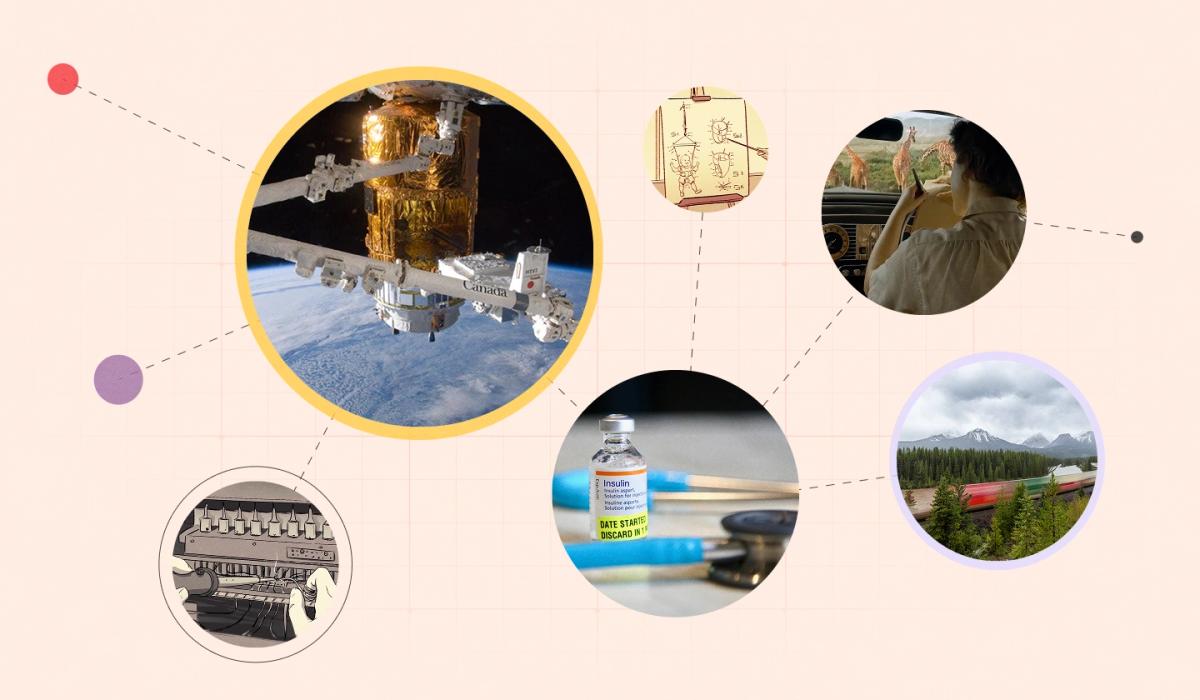
Anne Innis Dagg was three years old when she saw her first giraffe at a zoo. That experience set her life course until she died 88 years later. Travelling from her Toronto home, Dagg visited Africa for the first time in her early 20s in order to see giraffes in their natural habitat. While booking her trip, she signed her correspondence “A. Dagg” to disguise the fact she was a single woman – and thus unlikely to find a place to stay. Over time, she became known internationally as “the giraffe lady,” the leading expert on the species despite widespread sexism that meant she could not get tenure at Canadian universities. By the time of her death in 2024, she was a recipient of the Order of Canada, the subject of an acclaimed documentary and recognized in anthropological circles as a peer of more renowned contemporaries such as Jane Goodall and Dian Fossey, both of whom she was ahead of as the first Western researcher to study the behaviour of any species in its natural habitat. (Last year, she was also featured in a Heritage Minute, which was produced by Historica Canada, the not-for-profit organization for which I serve as president.)
Dagg is one of a long list of Canadians whose ambition and risk-taking in all manner of fields has shaped our view of the world. Sometimes, those efforts have changed the way people here and in other parts of the world live. From the creation of Jolly Jumpers for babies to building an “arm” for satellites in space, the impact of innovative Canadians extends from the most routine daily functions to the far reaches of outer space. (Not to mention putting pineapple on pizza: the concept of a “Hawaiian pizza” first occurred to a Greek immigrant in Chatham, Ont., in 1962 and has been the subject of widespread and sometimes virulent debates ever since.)
Get our weekly newsletter – the people, places, and ideas revealing where Canada is headed.
Often, however, those achievements are more recognized beyond our borders than within them. That collective modesty is a virtue with a downside. Our lack of awareness of our innovators and risk-takers can discourage others from following in their footsteps. It can also mean we focus more on risk than reward. As Michael Sabia, the current Clerk of the Privy Council (the country’s most senior public servant) and a longtime business executive, said last year, “We have an ambition deficit.” The result, he added, has been a long list of government regulations that have piled up “like a stack of pancakes,” inhibiting capital investment in new projects and steps toward their development. The declared goal of Prime Minister Mark Carney’s government is shared by the Opposition Conservatives: to clear away some of that thicket of regulations and provide new funding to encourage innovation and risk-taking. This includes funnelling millions of dollars into higher education institutions and medical research to encourage new ideas.

Those measures should be accompanied by reminders of all the things Canadians have created through our history and into the present. A hat tip here to the non-profit Rideau Hall Foundation, the force behind the annual Governor General’s Innovation Awards, held every year since 2016. Historica Canada has devoted a number of our Heritage Minutes as well as articles in our Canadian Encyclopedia and other programs to celebrating risk-takers.
Some of the more striking stories illustrate the range and effects that a fertile imagination and willingness to dare can have on virtually any aspect of our existence:
- The 1922 discovery of insulin by the team of Frederick Banting, Charles Best, James Collip and J.J.R. Macleod provided a life-saving cure for diabetes and won Banting and Macleod a Nobel Prize. The discovery (the subject of one of our most popular Heritage Minutes) has saved millions of lives since then.
- Olivia Poole, an Ojibwe born in Minnesota, considered her Indigenous roots when she was trying to find a way to soothe her new baby after she had moved to Canada. That led her to invent the Jolly Jumper, inspired by traditional Indigenous cradle boards, which allow babies to dangle from a saddle seat that supports their spine while helping them to learn coordination by moving their legs at the same time. She patented the device in 1957. The Jolly Jumper brand, owned by a company in Mississauga, Ont., sells its product globally.
- Roland Galarneau, from Gatineau, Que., was born with two per cent vision. In the 1960s, he developed the idea for a computerized machine that would convert texts into Braille. His invention has allowed the visually impaired to access textbooks and other written information.
- The Canadarm, also known as the shuttle Remote Manipulator System, was built in the 1970s under the direction of the National Research Council of Canada by Spar Aerospace Ltd. It was a staple on missions in outer space for the next 30 years, used to deploy, capture and repair satellites, position astronauts, move cargo and conduct a variety of other chores. It was retired in July 2011.
- While there are varying opinions as to the origins of artificial intelligence (AI) because of its many components, there is no doubt Canadian universities and other institutions have played key roles in its development. Two figures of particular note are Geoffrey Hinton of the University of Toronto and Yoshua Bengio, a McGill University PhD graduate who was then hired by the Université de Montréal. In fact, Hinton, who later went to work for Google, shared the 2024 Nobel Prize in Physics with John Hopfield of Princeton University for “foundational discoveries and inventions that enable machine learning with artificial neural networks.” (Hinton has since developed great concerns about the potential hazards of AI and left Google to focus his efforts on that.)
That’s a small selection of breakthroughs from Canadians willing to try ideas previously rejected, failed or simply not thought of by others. So why do we remain so self-deprecating about our ability to do bold things? Perhaps our greatest encouragement in looking to the future lies in our past.
Canada has a long history of taking on small and huge projects with challenges that initially seemed insurmountable. One of the most obvious is the building of the national railway in the late 19th century. It made Canada a feasible coast-to-coast country in ways that had not seemed possible before.
But the most dramatic example is the outcome of the Second World War. A country of 11.5 million people in 1939 sent 1.1 million men and women off to the conflict. More than 45,000 died and another 55,000 were wounded. Entire small communities across Canada that saw a generation of their young men go to the battlefield have never been the same since. But by war’s end, we had gone from a military that totalled 4,500 soldiers, six destroyers and fewer than 20 modern aircraft at the start of the conflict to having the world's fourth-largest air force and third-largest navy. In addition, Canada had become a fully industrialized nation, and women had become an important part of the mainstream workforce for the first time – broadening our intellectual scope, perspectives and list of achievements.
The challenge of history is that when we look back, we see the hopes and fears of previous times accompanied by the story of the eventual outcome, so everything seems neatly preordained. The present is messier. We can’t fully understand the evolving challenges and can only guess at the eventual outcomes, so sticking to familiar habits and avoiding risks seems the safe thing to do.
It is too easy to forget that people in those earlier days felt the same uncertainties and fears but pushed past them. We benefit today from their willingness to take chances – and the many, many times they succeeded.