What it is
A transportation network that uses airships – huge inflatables with engines and attached cargo bays – to move goods cheaply and without emissions, aimed at serving remote communities and industry sites that roads can’t or don’t reach.
Who’s behind it
Winnipeg-based Buoyant Aircraft Systems International (BASI), founded in 2011 by pilot and industrial designer Dale George and Barry Prentice, a University of Manitoba professor who specializes in transportation economics. Prentice wrote his master’s thesis on the idea of using airships to bring food from the tropics to Canada.
What problem is it trying to solve?
Many remote communities, primarily in Canada’s North, receive goods in two ways: by airplane, which is expensive and emissions-intensive; and on winter ice roads, which are temporary and face increasingly shorter seasons because of climate change. Prentice remembers ice roads that lasted four to six weeks in the past; now, he says, four weeks “would be a very good year.”
These limited transportation options mean high costs and long delays – issues that contribute to problems such as food insecurity and housing shortages. It takes at least two years to build a house in a remote community, Prentice says, because shipments are always incomplete. “Something’s always missing. There’s no such thing as a one-year house.”
Industries such as mining face similar problems in remote areas. Building roads is expensive and time-consuming and has negative effects on wildlife, like breaking up habitat corridors, while fossil fuel-powered aircraft come with high costs and limitations in scale. In addition, decarbonizing transportation is essential to meeting national and global targets in the fight against climate change.
Get our weekly newsletter – the people, places, and ideas revealing where Canada is headed.
How it works
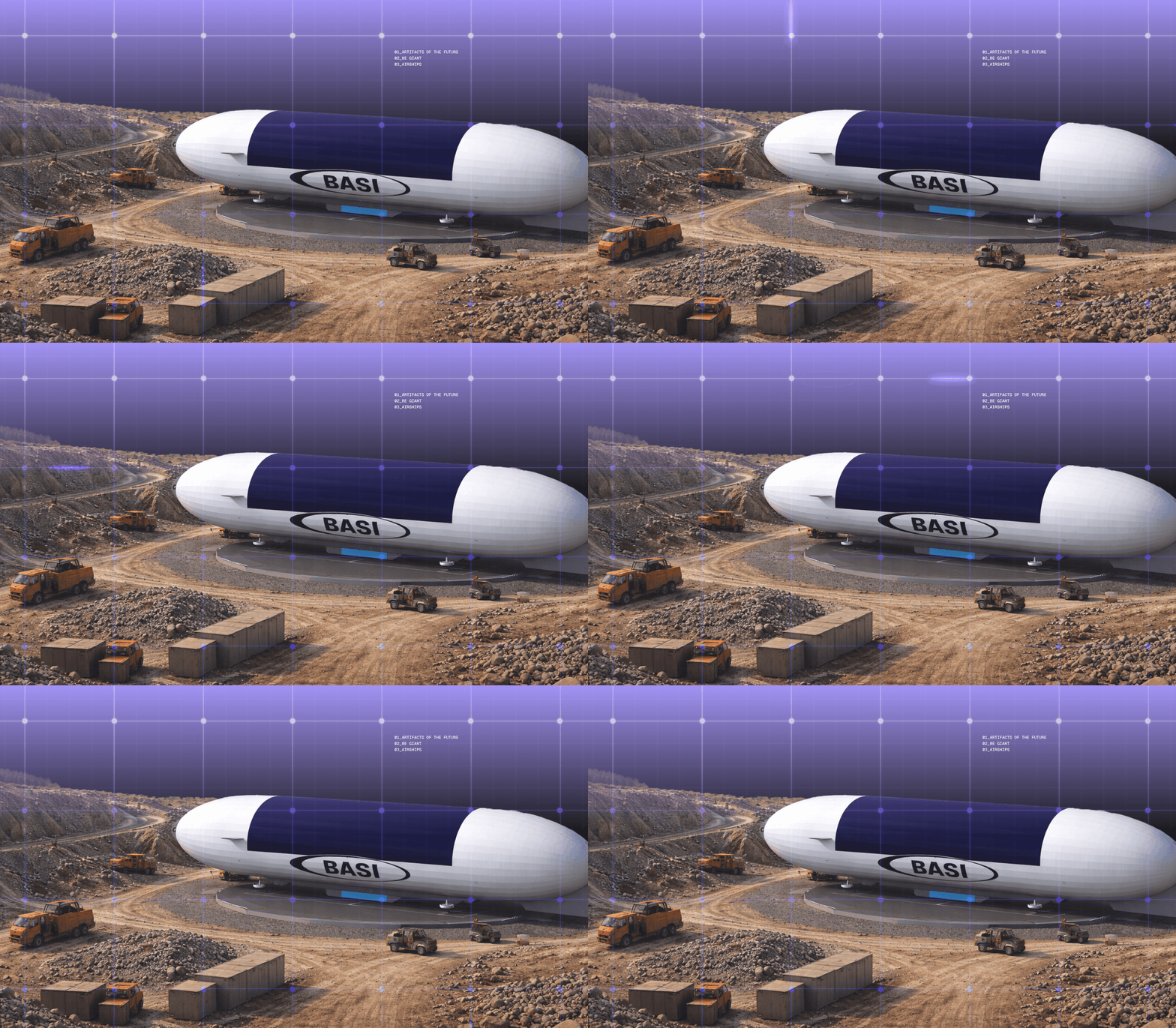
Airships, a.k.a. dirigibles, come in multiple shapes and three main types: rigid, semi-rigid and non-rigid. (The latter, frameless version is commonly known as a blimp.) They get lift from lighter-than-air gases and propulsion from motors – likely electric engines in BASI’s case. Rigid tubular airships with multiple cells for the gas are best suited to handle cold and fluctuating temperatures, Prentice says, and BASI’s models work on this premise. Cells can be filled with hydrogen or helium for lift, though Prentice prefers the former, partly because it is easier to access. While BASI anticipates beginning with standard turbine generators fuelled by diesel to power the ship’s electric engines, the goal is to switch to a zero-emissions hybrid-electric system fuelled by hydrogen, which has the added benefit of creating water that can be used for ballast.
One of BASI’s innovations is a fixed base for landing and takeoff featuring a terminal that rotates so that the airships can stay facing into the wind. These fixed bases include on-ground infrastructure and crews to keep the airship’s systems minimal; for instance, storing water for ballast on the base means ships can be more nimble, and BASI plans for the ships to be flown remotely so there’s no need for an onboard crew space.
BASI’s current designs feature airships that are 170 metres long and can hold 30 tonnes of cargo, though, Prentice says, “we don’t know how big they could get.” While dirigibles of the past maxed out at 135 kilometres an hour, he adds, he anticipates modern versions could reach 200 – not nearly as fast as an airplane, but much faster than a transport truck.
The vision is for a network of airship bases with regular flights so that remote communities could receive shipments of goods year-round. “We’re looking at this as a transportation system, not just an airship,” Prentice says. For initial setup in remote areas, they’ve modelled a base that can be installed as a floating dock on bodies of water.
The challenges it faces
Three technologies that were commercially available in the 1930s all disappeared in the face of cheap fossil fuels, Prentice says: electric cars, windmills and airships. Today, electric cars and windmills “are back, big time,” thanks in part to a relatively low barrier to entry. Dirigibles, on the other hand, are very large and require a substantial investment to get to market – an estimated $250 million for a drone airship, he says.
That sounds like a lot of money, but it’s “peanuts,” he adds, compared to other infrastructure projects like a $40-billion LNG (liquefied natural gas) terminal, a $35-billion oil pipeline or a $4-billion bridge in Montreal. There are no insurmountable technical barriers to building them, he says – it’s just a matter of finding the space and money to get started.
In addition to funding, Prentice adds, an airship industry needs “government encouragement and support,” not least in updating aviation regulations. Transport Canada doesn’t have a policy on airships, he notes. But as asserting sovereignty in the North becomes more of a national priority, he believes airships will come into their own as a technology that can serve both civilian and military interests.
“The amount of money we’re talking about to have an industry that would serve the entire North is really pretty small in the great scheme of things,” he says. “It’s not money that’s lacking, it’s commitment.”
What’s next?
BASI is currently focused on an upcoming demonstration project using an envelope – essentially the inflatable part of a dirigible – that they’ve acquired from a blimp. The intention is to turn it into a drone airship that can lift one or two tonnes of cargo from a base in Thompson, Man., to a landing base in a remote northern community. The project will take about a year to set up – materials for the base need to be transported via ice road, of course – but they hope to make their first voyage in 2027 or 2028.
As for broader support and investment, Prentice is hoping the time has finally come for a new age of airships. Projects elsewhere are helping to kick-start the movement, he says. In October 2025, for example, Google co-founder Sergey Brin’s LTA Research (it stands for “lighter than air”) ran a test flight in the San Francisco Bay Area of its 400-foot (122-metre) Pathfinder 1 rigid airship. And in France, Flying Whales – whose backers include the governments of France and Quebec – is on track to start assembly and flights of its airships equipped to carry 60 tonnes of cargo in 2027, with commercial operations expected to begin in 2029.
“There’s a huge market for this,” Prentice says. “And once the money of the world finally figures this out, there’s going to be a stampede to build airships.”