When Koami Soulemane Hayibo was working on his PhD in electrical and computer engineering, he hit up against a seemingly unsolvable puzzle. A former Fulbright Fellow and an expert in developing renewable energy systems, he was exploring the promising new field of floating photovoltaics (FPV) – installing solar panels on bodies of water.
Around the world, solar power has been mushrooming – its output more than doubled between 2022, when Hayibo started his research, and 2025, according to the International Energy Agency. Last year it generated eight per cent of electricity globally. And when it comes to finding places to install solar panels, bodies of water represent a new frontier.
But Hayibo was keenly aware that almost all the growth in floating solar projects had occurred in warm climates; and so, as a doctoral student at Western University, he was wrestling with a way to make FPV work in the Canadian winter.

Get our new book for free.
Subscribe to our newsletter and we’ll mail you a printed copy.
It’s a struggle engineers have faced for years, because ice and snow get in the way of the panels’ functioning. Attempts to get around that have included heating up the water in a pond, a common method for preventing freezing around docks, but it used too much energy and disrupted wildlife. In other experiments, water was churned with turbines or propellers to prevent the ice from forming in the first place, but that also used more energy than it was worth, while also irritating wildlife and scrambling the water layers critical to life in a pond.
Finally, Hayibo – now a post-doc researcher at Western – found a solution in the form of a common aquarium accessory: a bubbler.
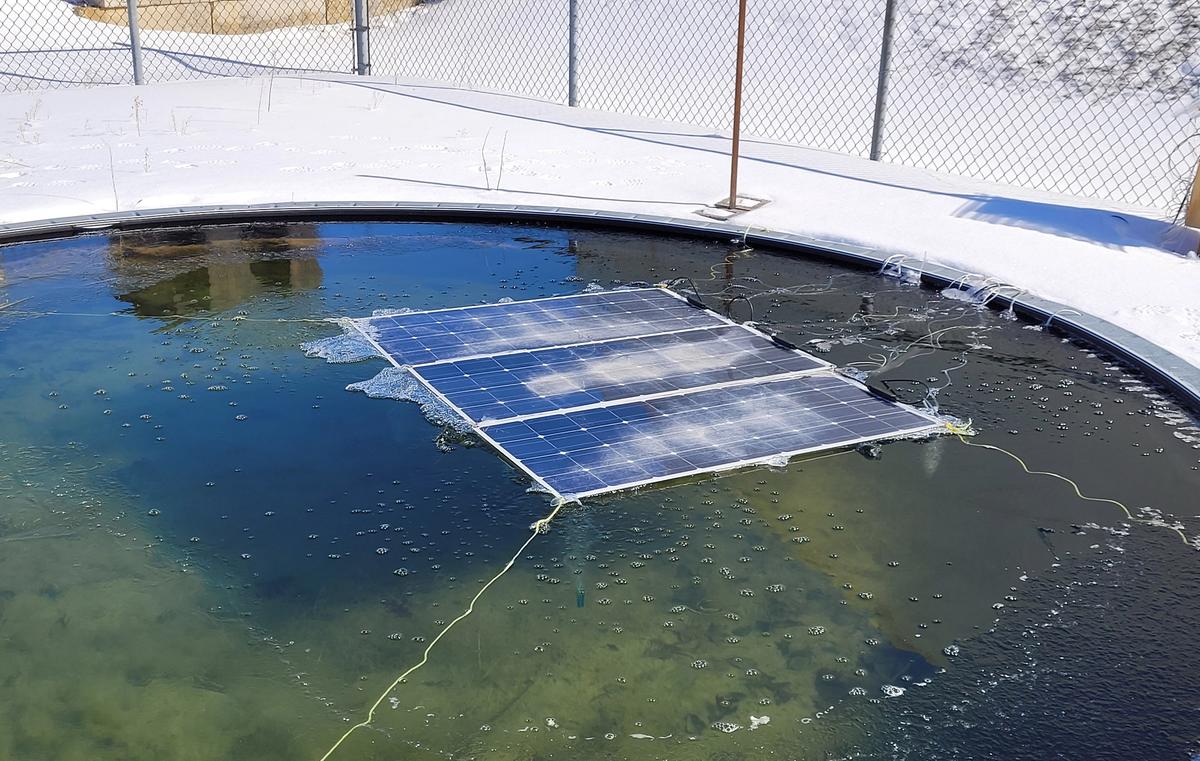
In the world’s first full-scale experiment of its kind, he floated solar panels mounted on foam on a small rainwater drainage pond at a Western field station in Ilderton, Ont., during the particularly harsh winter of 2024-2025.
Tubing in the water pumped air around flexible solar panels, which were fixed to slabs of polyethylene foam floating on the water. The bubbles transported heat from the warmer bottom of the pond to the surface, agitating it at the same time.
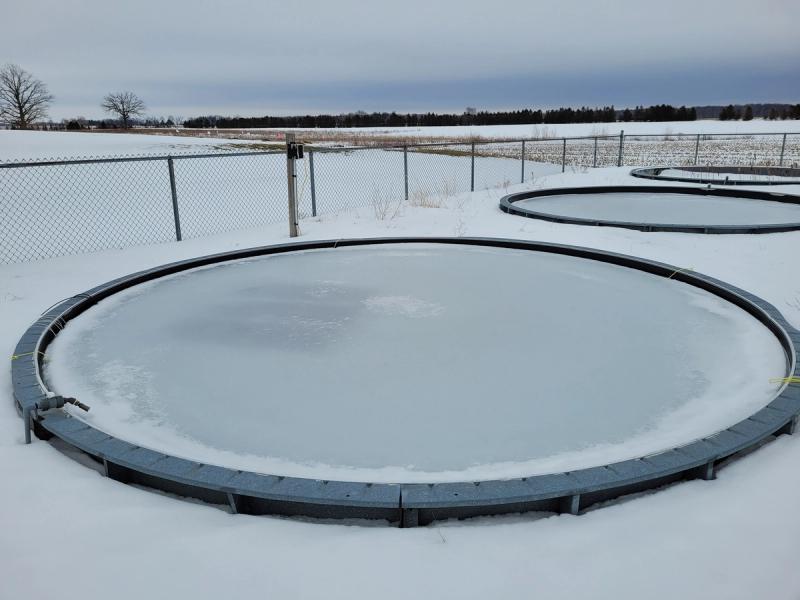
Hayibo and his team – which included Joshua Pearce, a materials engineer who was Hayibo’s PhD adviser and is Western’s John M. Thompson Chair in Information Technology and Innovation, and Md Motakabbir Rahman, who helped design and build the system – tried three configurations, each of which used different amounts of energy: bubbles on demand, continuous bubbling when ice is present and extending the bubblers across the entire surface of the panel array.
It was the eureka moment Hayibo was hoping for: the systems worked – all three of them – interfering with the formation of ice while the panels produced seven kilowatts of energy, enough to power a big Canadian house all year. Hayibo, Pearce and Rahman published the results online in the journal Applied Energy in June.
And while each of the configurations used up some of the electricity the panels produced, from 0.02 to 14.5 per cent, the energy cost was acceptable, according to Hayibo. “The next phase will be to find a controlled environment where we can replicate different types of freezing environments and go gradually until we get to the limit of our technology. And then maybe we’ll try to find other ways to break that limit as well.”
Still, there are drawbacks. Globally, engineers recommend restricting floating panels to no more than half the area of a body of water so that light can still reach the creatures that require it for survival down below. (In Hayibo’s experiment, panels covered about three per cent of the pond, or 45 square meters.) And his floating system can’t be used on water bodies with high waves. Because the panels are flexible, they’re also more expensive than stiff glass mass-market versions, though using foam is “almost free” compared to the metal and concrete racking currently in use for other solar systems, Pearce says, and it takes less energy to produce.
As for larger installations of this kind, a scientific review in 2024 of FPV systems around the world noted that they can alter water circulation patterns, lower oxygen levels in water, disrupt migratory routes for birds and take habitat away from aquatic species that need it.
Hayibo’s team is planning an experiment using underwater cameras and fish mapping to find out precisely how fish are affected. But so far, frogs have enjoyed sitting on the system’s ropes, and fish have sought shade and cooler water beneath the panels on scorching summer days.
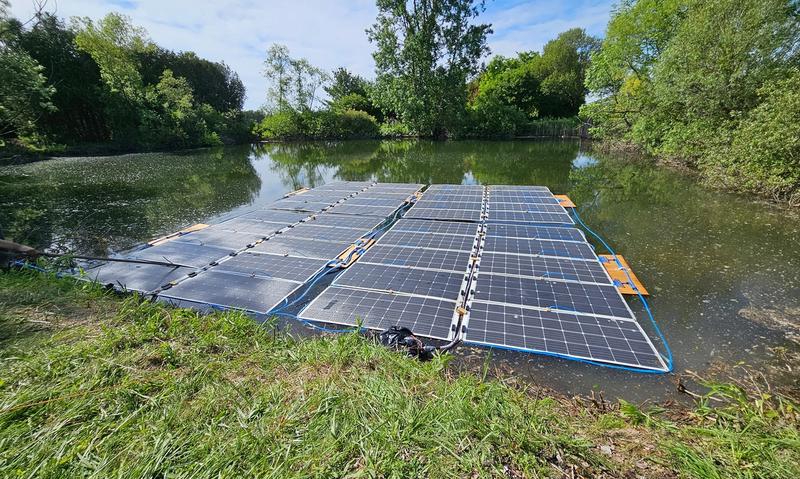
Floating panels can prevent as much as 80 per cent of evaporation, Hayibo says, a win for water conservation, and can help avert algae overruns if installed before the algae bloom. On the other hand, a 2025 review study found little research anywhere in the world on the effects of biofouling and noted that the corrosion of the materials in FPV has been too little studied, though preliminary studies at Hayibo’s field station showed that neither the foam nor the modules were shedding microplastics into the water.
As for what’s next, Hayibo wants to take the idea further and is examining the use of his system in abandoned mines; the panels would generate solar electricity by day on surface reservoirs. Any excess would be used to pump water from the bottom of the mine up to the reservoir, which at night would generate electricity by dropping the water down the mine shaft and passing it through a turbine.
For now, the goal is to test Hayibo’s floating innovation on icy aqueducts, lakes, ponds and other spots that don’t have high waves. “I think we’re just looking at the beginning of a fast-growing industry,” Pearce says. “With this kind of solution for the North, that means the Nordics and Russia and everyone else who finds themselves having to put on long underwear will get a chance to take a look.”