Last July, a clean-up crew at Wembley Stadium in London went viral after they were captured sweeping up empty plastic cups following a rowdy Oasis reunion concert, where an estimated 250,000 pints of beer were consumed.
There’s something undeniably satisfying about the video clip, but the almost balletic quality to the crew’s choreographed movement masks a disturbing truth: most of those cups were destined to end up sitting in a landfill or suffocating our oceans, a quarter-million little cuts to our ailing planet.
But just a couple of weeks before the Wembley concert, Coldplay had performed four shows at Rogers Stadium in Toronto where things went rather differently. In order to comply with the band’s ambitious sustainability goals, the venue partnered with Muuse Canada, a company that provides reusable beverage and food container services, for a pilot project designed to cut back on single-use plastics.
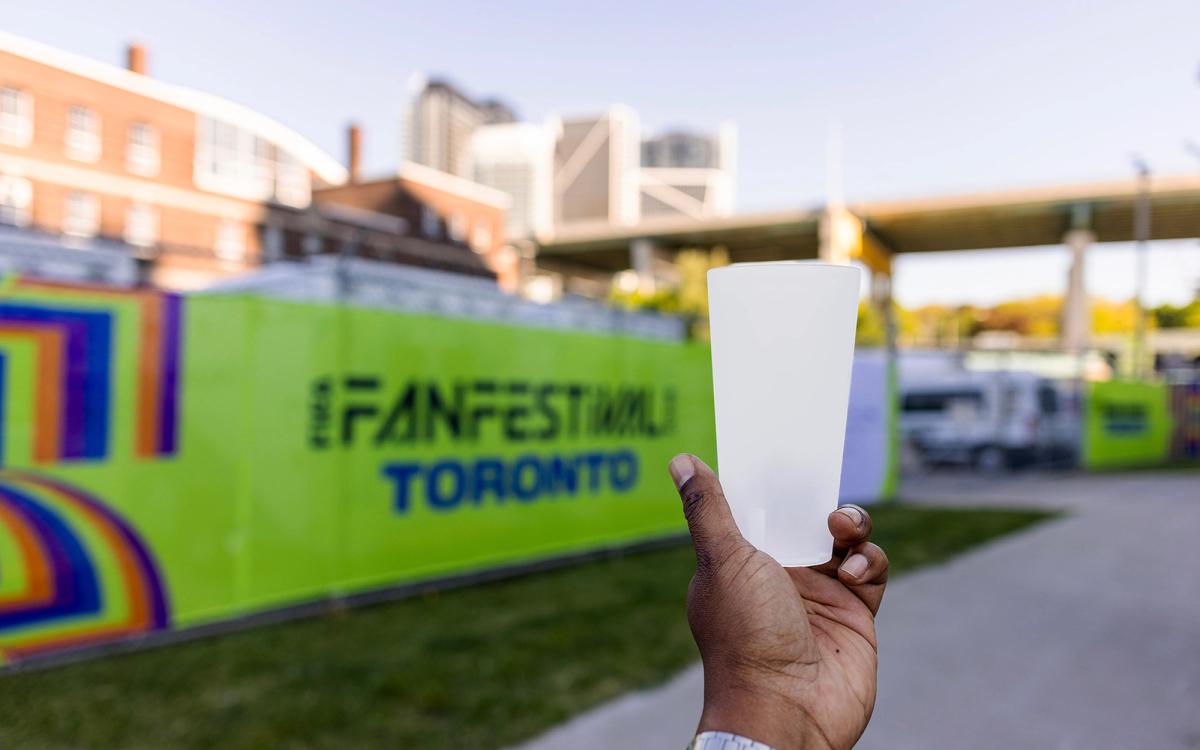
The pilot, which, according to Live Nation, diverted more than 7,000 pounds of plastic waste, led to a partnership for Muuse to provide reusable services for nearly 100 concerts at Rogers Stadium and RBC Amphitheatre. As well, the City of Toronto has called on the company to provide reusable cups for the FIFA Fan Festival zone at Fort York for the duration of the World Cup.

In recent years, large-scale music and sporting events have emerged as important sites for environmental innovation, as well as spaces uniquely suited to normalize new approaches to sustainability. Unlike coffee shops or takeout restaurants, these events are what sustainability experts call a “closed ecosystem” – a discrete space with a single group of people buying from the same set of vendors – which makes it remarkably easy to replace single-use plastics with reusable items that can be continuously recirculated.
“I always tell people to think of Ikea,” says Scott Morrison, the general manager at Muuse Canada. “When you walk into the cafeteria there, you don’t question whether you should leave those plates and utensils and glassware there. It’s designed in a way where it’s obvious that you return the items, and it’s awkward if you don’t.”
Get our weekly newsletter – the people, places, and ideas revealing where Canada is headed.
The company – which is headquartered in Singapore and opened its Canadian branch in 2021 – is built on this same basic principle, which Morrison says can be scaled far beyond a retailer’s cafeteria. The system, he explains, is remarkably straightforward and intuitive: when customers at an event purchase a drink, the beverage is served in a sturdy polypropylene plastic cup. When they’re finished, rather than toss the cup, they simply return it to a clearly marked bin at various sorting stations around the venue.
Morrison pulls up the proposal that won him the contract with the city for the FIFA Fan Festival and rattles off some figures: between June 10 and July 19, the company will provide 532,000 reusable food-service items. “[It’s] expected to prevent up to 237,378 pounds of waste!” he exclaims, reclining in his chair and letting out a big laugh. “That’s crazy, man!”
The accumulation of plastic waste has become a “planetary crisis,” one that’s as severe as climate change or biodiversity loss, says Anthony Merante, the senior plastic campaigner at Oceana Canada, a non-partisan environmental advocacy group.
“The ocean receives, globally, two dump trucks full of plastic every minute,” he says. “Once [that plastic] goes into the ocean, it never disappears. Plastic pollution kills wildlife; it suffocates coral reefs and contaminates seafood. It’s washing up to our shores, and through microplastics and nanoplastics in our food and the air, it’s making its way into the human body.”
Canada discards an estimated 4.3 million tonnes of plastic waste annually, with about half coming from single-use items. There has been some progress on the regulation front. In 2021, the federal government passed legislation banning six categories of single-use plastics, including bags, straws and cutlery. The ban, which was briefly struck down following heavy backlash from the plastics industry, was upheld by the Federal Appeal Court earlier this year.

But Merante says federal regulations must be complemented with what he calls “co-operative and supportive” municipal bylaws, such as those that exist in cities like Edmonton, Victoria and Montreal. In Montreal, for example, organizers hosting large events or festivals, from the Osheaga Music and Arts Festival to the Formula One Grand Prix, must adhere to a bylaw that bans the use of single-use food and beverage containers. In cities that lack this type of regulation, large companies or organizations will often opt for the cheaper, easier-to-implement single-use plastics or other products with high carbon footprints.
According to Morrison, Toronto’s BMO Field will be relying on single-use aluminum cups for the duration of the soccer tournament. This has the potential to create 540,000 disposable items, or 9.7 tonnes of waste, over six games, according to a study by the Toronto Environment Alliance.
When it comes to waste management, Canadians tend to over-prioritize the act of recycling, says Morrison, despite evidence that it’s actually at the bottom of the least effective “three Rs” hierarchy. Data from Oceana Canada suggests that only eight per cent of recycled plastics are recovered, sorted and ultimately recycled. Moreover, recycling is an expensive and energy-intensive process.
Take, for example, single-use aluminum beverage cups, like the ones being used at the World Cup games this summer. As Morrison explains, aluminum is an infinitely recyclable material, but the recycling process involves melting the cups down, then reprocessing and remanufacturing the material into downgraded products. With limited capacity for this type of processing, Canada often ends up shipping used materials across the border.
Muuse’s polypropylene cups, which are manufactured in France, are designed to be used up to 500 times. After each use, the cups are sorted, shipped to one of three nearby commercial washing sites, inspected for quality control and recirculated. This system, says Morrison, not only creates local jobs and reduces shipping costs and distances, but it’s also less vulnerable to the type of supply-chain instability caused by the pandemic and the ongoing trade war between Canada and the U.S. Reusable items never leave the city limits.
The FIFA Fan Festival isn’t Muuse Canada’s biggest event, but, given the involvement of the municipality, it is perhaps the most significant, says Merante. “It’s a highly visible partnership, one that signals a new direction the city might be headed,” he adds. “This is a real opportunity for Toronto, and it could set a new standard in sporting events. I hope that’s the lesson the city takes from it.”
Morrison, too, is hopeful. “In the next five years, you’re going to see this. This should be in every stadium,” he says, proudly holding up a Muuse cup. “There’s absolutely no reason why that won’t be the case.”