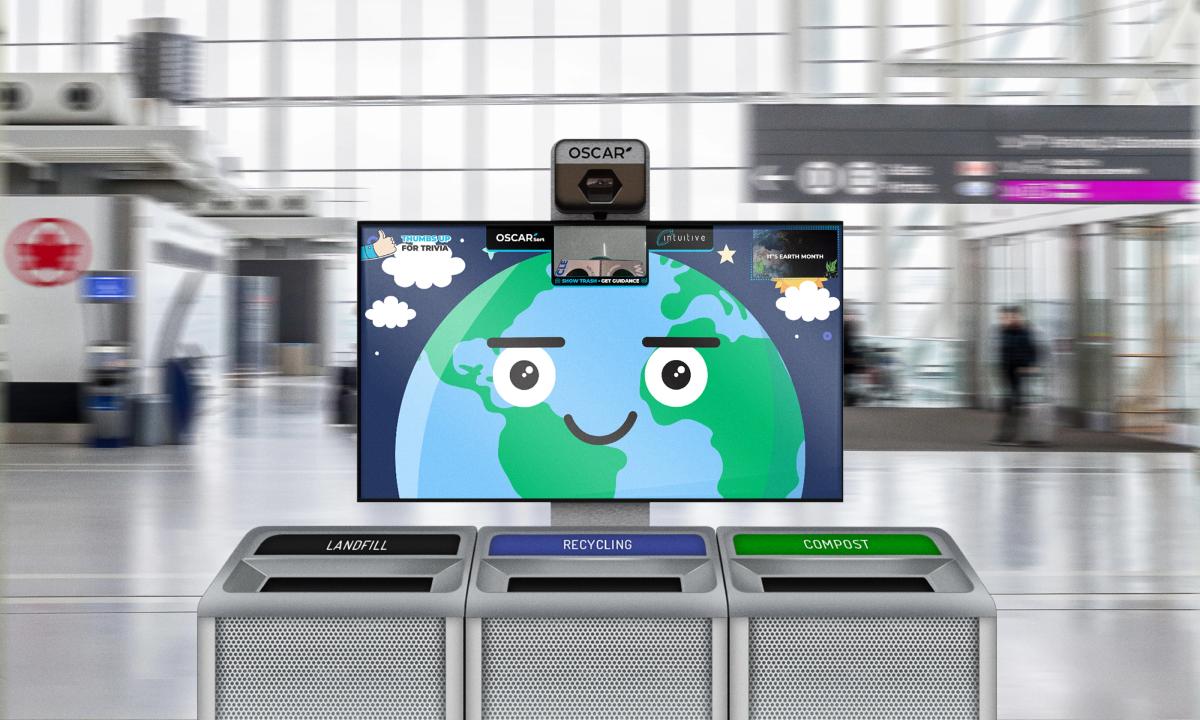
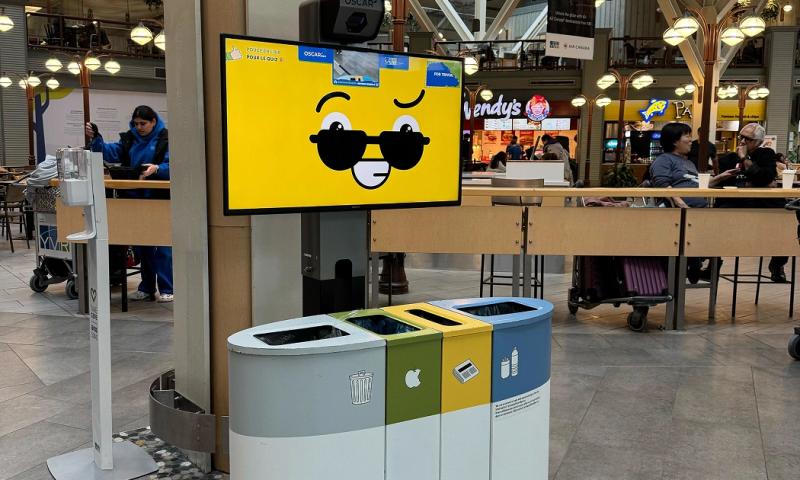
The sweet-faced anthropomorphic Earth whose name is Oscar tells me I can’t recycle my iPhone and should instead return it to my pocket. My coffee cup? Dump the remaining liquid, it advises, then separate the lid (which can be recycled in this city) from the cup (which cannot).
I’m standing in front of garbage bins at the airport, and Oscar, an AI-powered recycling assistant mounted above on a video screen, is telling me what goes where. My food container is closed, but Oscar knows there’s still a bite left of my sandwich: I should toss that in the compost, along with my napkin, and then recycle the box. Oscar is happy I did the right thing – which is not common. According to the Canadian government, we get it wrong most of the time: in 2022, only 27 per cent of our solid waste was successfully recycled.
Oscar – formally called Oscar Sort – was developed by Hassan Murad and Vivek Vyas to mitigate our wishcycling tendencies. They co-founded the Vancouver-based startup Intuitive AI in 2017 with a primary goal of chipping away at Canada’s underdiscussed waste crisis. It starts, they say, within three seconds. If you can eliminate that guesswork at the bin by addressing the problem of human error, which costs municipalities millions of dollars each year, then maybe you can improve the fraught downstream process that too often ends unfavourably: at waste incinerators that expose nearby residents to air pollution, in landfills that emit methane and a contaminated liquid called leachate, or with microplastics swirling around the ocean, where fish mistake them for food.
Oscar uses computer vision and machine learning to identify waste items in just a few seconds, then checks them against local regulations automatically. It has so far been deployed in 20 countries, at big international events like the 2026 Super Bowl and in various locations across Canada’s non-residential sector – shopping malls, federal government buildings, airports and universities – which generates about 60 per cent of the waste that gets sent to landfills.
“In Ontario especially, that sector really isn’t held to any standard,” says Karen Wirsig, the senior program manager of plastics at Environmental Defence. She argues that most of these organizations aren’t even required to separate their garbage from their organics (Oscar has slots for each), so several million metric tonnes of food waste are being sent to landfills that will be full in the next decade.
Murad, who likes to call himself Intuitive AI’s resident “trash-talker,” says Oscar can improve recycling rates by up to 96 per cent, and that one bin saves 10 to 20 cars’ worth of CO2 emissions. Globally, the company estimates its annual reduction of greenhouse gases is equivalent to what 467 acres of forest would absorb. Intuitive AI has already started beta-testing Oscar Pocket, which you could use at home on your phone.
“It was a real wake-up call when we started looking into the waste space here, because we’d thought we would eventually build something that would clean up the oceans in developing countries,” says Murad. He was born in Pakistan, while Vyas grew up in India. Both come from countries whose infrastructures struggled so badly to manage their waste production that related public health emergencies have exploded; they were surprised to find that Canadians are some of the highest waste producers per capita in the world, and that plastic in particular is a problem.
“Most people can’t remember the 9,000 different recycling regulations and rules of their municipalities,” says Murad, noting that the guidelines are often updated without anyone knowing. “We tried to simplify the process, so that the entire waste resource recycling conundrum can actually work and go to the right areas.”
Oscar’s screen toggles between an Earth-like image with a pleading face and facts about sustainability. It can be programmed to give you a “reward” (QR code coupons and deals, for example, or entries into monthly draws for gift cards) when you get it right or gently admonish you if you don’t. It’s meant to gamify what can otherwise feel like a mundane annoyance, to turn an unsure, unenthusiastic decision into a quick hit of dopamine.
Last year, Mike Posteraro, the senior manager of environmental operations and sustainability at the University of Guelph, installed two machines in the school’s busiest areas. In an earlier job at Seneca Polytechnic, he found Oscar’s “slot-machine effect” worked on students, and he’s hoping to replicate that success at Guelph.
“It can tell us what our biggest contaminants are,” says Posteraro, opening the online portal to show me how many people threw napkins and coffee cups in the wrong bins over the last year. (Contamination – when non-recyclable items are sorted into recycling bins, or when acceptable recyclables are so soiled that the whole bin needs to be sent to landfill – is one of the biggest headaches at Canada’s material recovery facilities.) “That’s the feature we use the most,” he adds, “because it gives us the opportunity to improve in specific areas and divert more waste.” Once the problem areas have been identified, such institutions can employ more targeted signage to modify behaviour, or switch to suppliers whose materials are more recyclable.
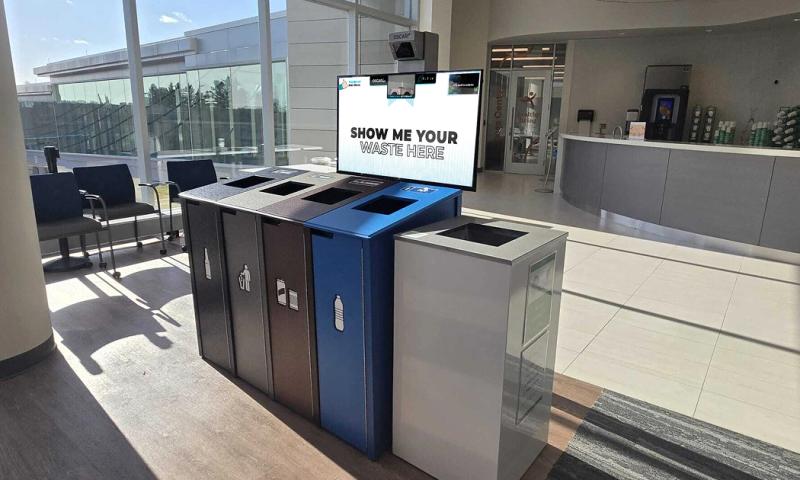
Earlier iterations that Vyas and Murad piloted in universities were less successful. Because both came from a background in robotics – Murad formerly worked under Elon Musk as the youngest intern on Tesla’s autopilot team – the first draft of Oscar was totally automated, programmed so that it would sort everything itself. “We found that it actually made people dumber,” says Murad. The point was to reform our passive, detached treatment of waste into one that was active and data-driven, and the co-founders discovered they’d undermined their own philosophy. “We learned you can’t just automate everything, or throw robotics and AI at any problem.”
The next version they tried was affixed with a GoPro. To test it, they’d sit in the food court and press buttons manually so the screen would “grouch” at anyone who incorrectly sorted their waste (the association with the Muppet character Oscar the Grouch is coincidental: the name is an acronym for “Object SCanner And Recognition”), and they immediately noticed an increase in time spent sorting. The so-called Hawthorne effect, whereby people modify their behaviour because they know they’re being watched, became the basis for the version they took to market.

Canada has been undergoing a lot of shifts in its recycling processes in an effort to meet the federal government’s goal of zero plastic waste by 2030. The single-use plastics ban was formalized in December 2022. The federal plastics registry, which forces companies to report how much and what types of plastics they’re sending to market, was implemented in late 2025. And over the past two years, several provinces have been transitioning to the extended producer responsibility framework, by which waste management costs and operational responsibility are shifted from municipalities to brand owners, importers and manufacturers.
Oscar is just one further intervention in a symphony of many – one Wirsig says needs to be supported by simple efforts to “buy less shit” and “repair and reuse what you have.”
“The goal is to make circularity more attractive to everyone, and to turn materials into resources,” says Murad. “We want a future of resource management, not waste management.”