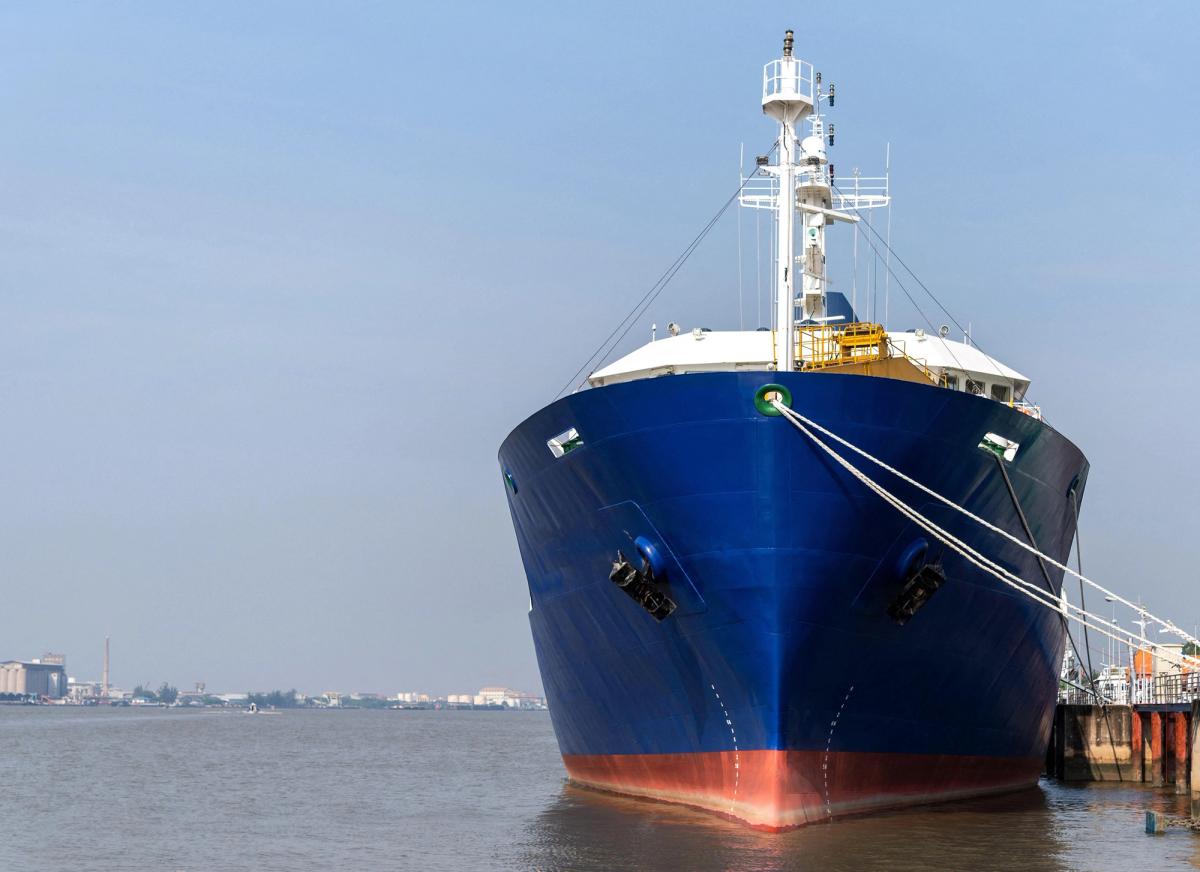
A Newfoundland startup has developed “paint with feelings” to solve the problem of corrosion on the high seas.
Copsys Intelligent Digital Skin (CIDS) can be sprayed on a ship, coating it in low-power electrons that identify rust above and below the waterline on navy and commercial vessels, as well as on offshore oil and gas platforms.
In early November, founders Mike Maguire and Farzad Hashemi presented the science behind their high-tech paint at a meeting of NATO’s Science and Technology Organization in Turkey, and in September they earned a berth with the Port of Rotterdam’s 2026 accelerator, PortXL, the only Canadian company among 10 others from the EU and the U.K.

Get our new book for free.
Subscribe to our newsletter and we’ll mail you a printed copy.
"We've got traction in the North Sea and Europe right now," says Maguire, an engineer who co-founded Copsys with inventor Hashemi in 2020. It's an area where 74 per cent of goods enter and leave by boat.
Regular paint acts as a barrier between metal ships and seawater. But when a coating fails, the metal hull can rust. CIDS gets sprayed on much the same way as regular paint does, but when the smart coating fails, it sends out a signal to say the vessel has been exposed to corrosion, communicating with a dashboard that can be monitored remotely from a phone.
Maguire has had experience examining corrosion up close, crawling around in ship hulls as a Lloyd’s Register surveyor. Rust usually forms out of sight, he explains, but the “persistent digital presence” of the Copsys coating will prevent navies and shipping companies from having to spend time and money on manual visual inspections.
The kernel of the CIDS idea came to Hashemi while he was figuring out how to drive in his first Canadian winter. He was sitting in a Moncton, N.B., car dealership when a sales associate asked if he wanted a rust-proofing package. The salesperson explained it would protect the undercarriage of the car from corrosion caused by snow and road salt.

“That was the trigger point, because I had over 25 years’ experience providing corrosion management systems in my home country, Iran,” says Hashemi. “I loved thinking about how to adapt the technology to this new environment.”
Hashemi spent six years developing his idea, applying for patents and working with regional agencies such as Moncton’s Business Immigrant Mentorship Program (BIMP), Inovacorp, the National Research Council and Springboard Atlantic, where he met Maguire.
Though rust is the main problem CIDS seeks to solve, research and testing suggest it may do more: the coating could help keep barnacles from hitching a ride on the hulls of ships and submarines, which creates drag and spreads invasive species. And there’s also the possibility that the paint will keep submarines from being detected. “Conventional cathode protection throws out electrons willy-nilly into the universe, and for navies using this, it results in a potential underwater electric signature that can be detected by enemy craft,” says Maguire. “So there is a cloaking aspect with our system.” But those applications are further down the line.
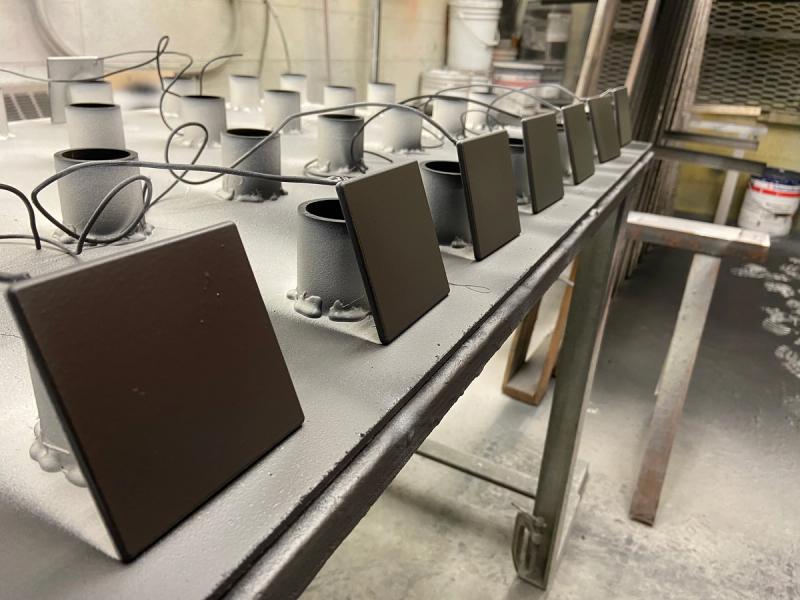
On the rust front, Maguire and Hashemi have done third-party testing with Dalhousie University engineering professor George Jargoura and the Naval Engineering Test Establishment (NETE), the Royal Canadian Navy’s principal test and evaluation centre, using a salt fog chamber to see how their paint would hold up in an ultra-humid environment.
But sooner or later, Copsys will have to move from testing to sales. The company is targeting national navies and offshore oil and gas companies, which spend millions protecting their above-water piping systems from corrosion.
Susan Caines, an engineering professor at Memorial University’s School of Ocean Technology who specializes in corrosion, says Copsys has come the closest to addressing corrosion under insulation – a difficult task because when pipes are covered in insulation and cladding, it’s impossible to see rust spreading underneath, a dangerous situation in the middle of the North Atlantic.
In 2022, Copsys was one of 20 startups selected for Scotland’s Net Zero Technology Centre’s Open Innovation Programme, an oil and gas innovation accelerator, which enabled them to test their technology with North Sea energy companies. According to Net Zero, 60 per cent of pipe failures and more than 20 per cent of major oil and gas incidents reported in the European Union between 1984 and 2018 were associated with corrosion under insulation.
While Caines says Copsys’s science and engineering are sound, moving from prototype to commercial sales is challenging because companies are reluctant to try new technologies on critical systems like the safety monitoring of ships and offshore platforms at sea.
“Anything that’s offshore has to be so well-proven because you’re dealing with people with limited rescue [options],” she says, explaining how much effort goes into designing safe systems. “It makes sense that they wouldn’t automatically be like, ‘Oh, you say you have a solution? I trust you.‘”
But some early positive signs for commercial sales are emerging. Copsys participated in NATO’s Defence Innovation Accelerator for the North Atlantic (DIANA) earlier this year, which helped the co-founders get in front of potential buyers on both sides of the Atlantic, and in September Maguire and Hashemi won the Innovation Leadership Award at the Turning the Tide Marine Industry awards, which recognize innovation in the Newfoundland and Labrador marine sector.
“We hope some of the operators who’ve looked at trialing this will see an opportunity to do a small piece out of the gate,” says Maguire, who aims to sign Copsys’s first commercial customers in the first half of 2027. “We just need a couple of good strategic projects to get people talking.”