When a monarch butterfly nicknamed Eddie was released at the Living Prairie Museum, a tall-grass preserve in Winnipeg, he spent some time darting around the city before the migratory impulse drove him south. Two months and 1,258 kilometres later, he wound up in Osage City, Kansas, with stops in Saint-Pierre Jolys, Man., the outskirts of Fargo, North Dakota, Saint Cloud, Minnesota, and Minneapolis-St. Paul, where he made an unscheduled stop, for reasons known only to Eddie, at the Metropolitan Wastewater Treatment Plant.
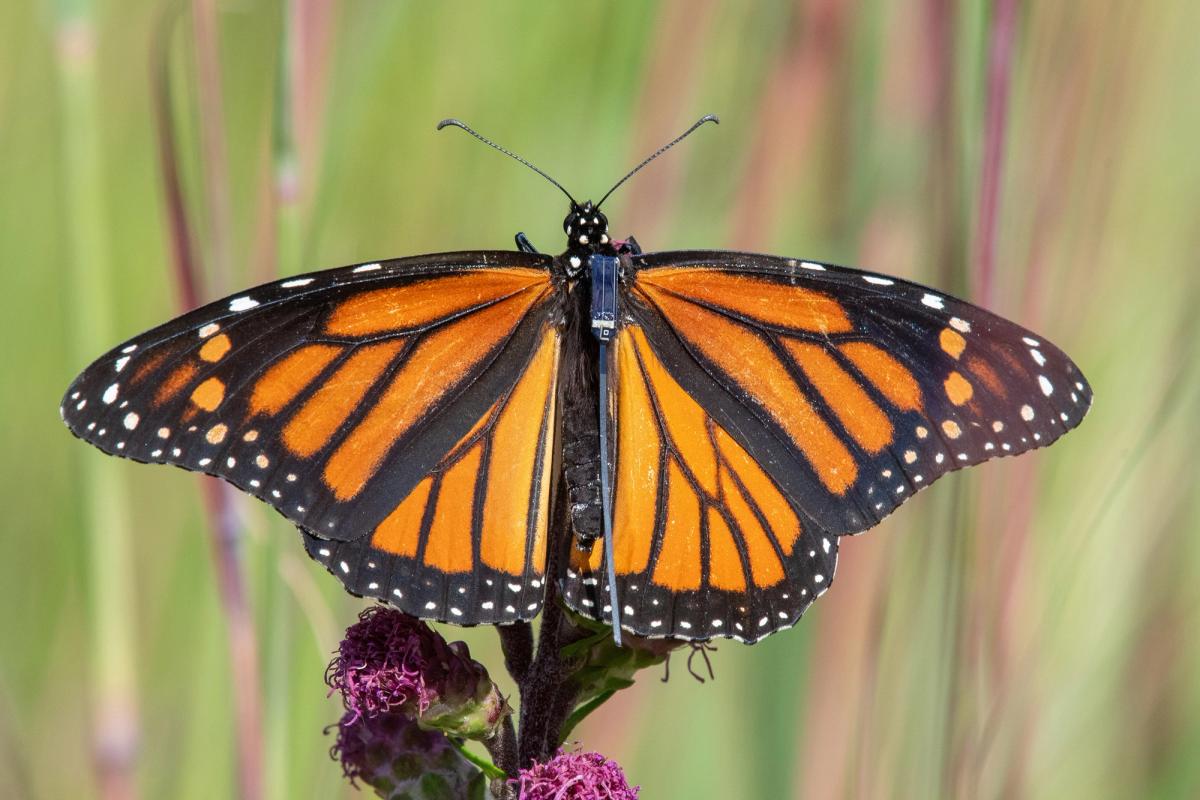
That we can follow Eddie’s travels in such detail is due to the BlūMorpho transmitter he’s wearing. This fall, 29 monarchs in Winnipeg were tagged with transmitters, among more than 1,300 that have been tagged across Canada and the U.S. “They are part of the ‘super generation’ of monarchs that will hopefully make the full migration from here in Manitoba to Mexico,” says Laura Burns, conservation programs manager at Winnipeg’s Assiniboine Park Zoo, who helped tag the butterflies.

Get our new book for free.
Subscribe to our newsletter and we’ll mail you a printed copy.
The “super generation” of butterflies is also called the Methuselah generation. They live for up to nine months, compared to the usual two- to six-week lifespan of a monarch, in order to make the roughly 4,000-kilometre trip to Mexico, where tens of millions of butterflies from eastern Canada and the U.S. spend the winter in high-altitude forests, packed together on tree trunks or in meadows. Their job in Mexico is to hibernate away from the cold, then make the return journey north in the spring, mating, laying eggs and dying along the way. Their offspring continue the journey north to breed a new Methuselah population and start the process over.
“But where they’re going [in the fall] is really the remarkable thing,” says Burns. And how they get there is becoming clearer now that the tech has become lightweight enough to be practical as butterfly carry-on.
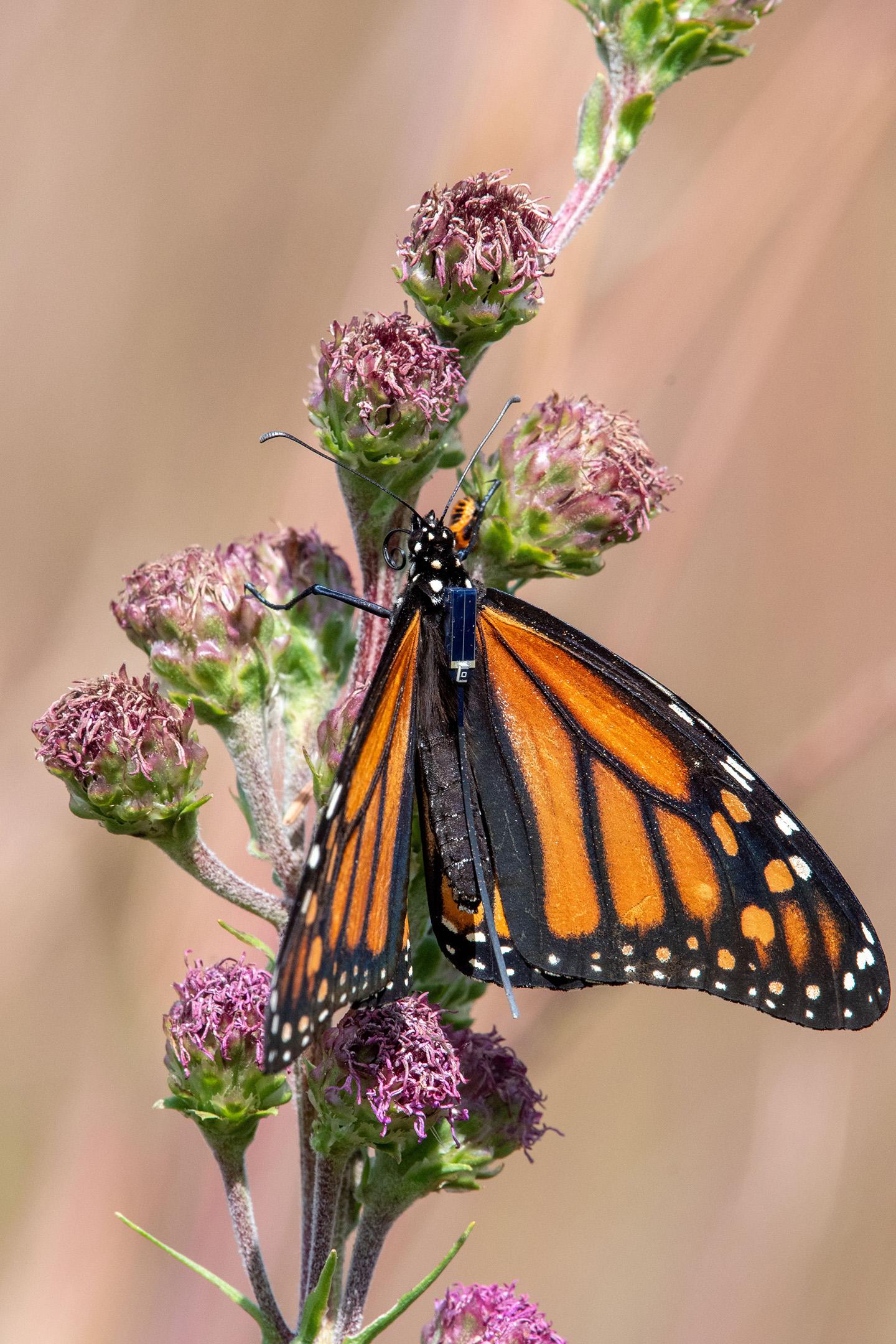
Until the development of the BlūMorpho transmitter, scientists knew where monarchs bred and where they wound up in winter but had little information about what happened in between. Now the tagged monarchs can be followed on an app developed for Project Monarch, available to anyone with a smartphone, tablet or computer. Eddie is identified as MB26002, and his tag number is C87EDD1E, which is how he picked up the nickname. His transmitter had been detected by receivers between Winnipeg and Osage City 1,021 times, but as of Oct. 29, he hadn’t been heard from in 19 days, which isn’t great news for Eddie. However, MB26011 made it to Mexico in 40 days, following a remarkably straight southern route 2,761 kilometres to the Sierra de Zapalinamé mountain range in northeast Mexico, except for a sharp western detour at Fergus Falls, Minnesota, which he corrected. Five of the 29 monarchs tagged at the Assiniboine Zoo had made it to Mexico by late October, and MB26018 was ahead of all the others, in the mountains east of Aguascalientes.
The BlūMorpho device was designed by Cellular Tracking Technologies (CTT), a New Jersey tech firm that specializes in wildlife telemetry. In 2023, it partnered with the non-profit Cape May Point Arts & Science Center to launch Project Monarch, a collaboration of 82 organizations in three countries, including Environment and Climate Change Canada, that gathers data to guide conservation decisions to support this endangered species.
“Getting migration data is like the Holy Grail to piecing together a monarch’s full life cycle,” says David La Puma of CTT. And that matters because, as pollinators, monarchs are crucial to agriculture. But ironically, herbicide use in large-scale farming – along with climate change and suburban sprawl – is obliterating milkweed, their main food source.
That’s also where Project Monarch comes in. Tracking can identify which communities are butterfly “gas stations,” where there are enough nectar-producing flowers for them to refuel on the flight south. Crucially, it can also figure out where butterflies get stuck or die off, in spots where their habitat is lacking. Using data from Project Monarch, local communities like Sylvan Lake in Alberta are planting monarch-friendly plots: native milkweed, goldenrod, coneflower, blazing star. These volunteer, citizen-led ventures are called “monarch waystations,” and the hope is that enough towns between Canada and Mexico will pitch in to build informal transcontinental butterfly routes. There’s a “milkweed hotline” on Facebook for people to share plants and seeds.
The Kootenay Native Plant Society has built 13 of these waystations, populated by showy milkweed, brown-eyed susan, dogbane and western yarrow, along a southern corridor to promote migration. “So that’s really about building up those nectar sources,” says Angeline Emmott, who works with the Kootenay group, “and it’s kind of the model of, ‘If you build it, they will come.’”
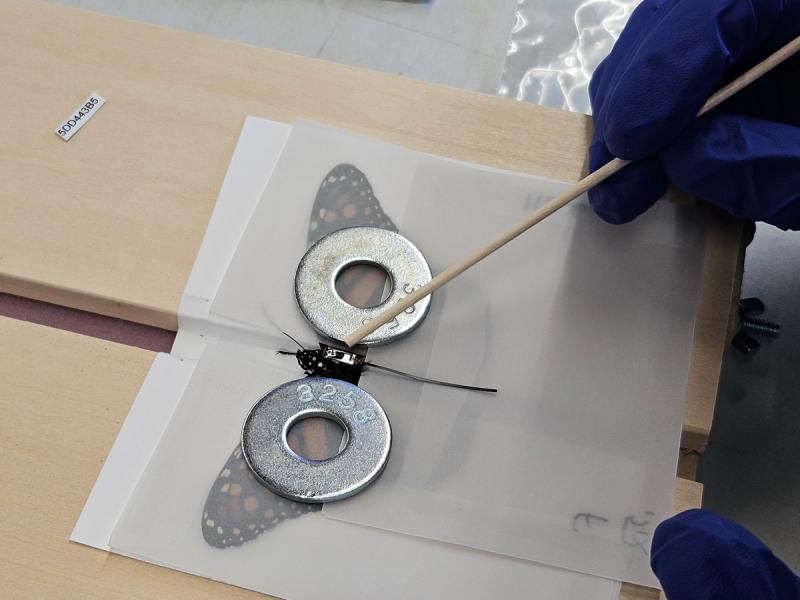
The BlūMorpho itself looks like a robot tadpole. It weighs 60 milligrams, roughly one-tenth the weight of a mature monarch, about as much as three uncooked grains of rice, made ultra-light by using a tiny solar panel instead of a battery to run the transmitter. It’s applied to a co-operative butterfly using eyelash glue, on a day when there’s no rain in the forecast, so that the glue will cure. The monarch is held down by a glassine envelope, the kind used by stamp collectors, and two metal washers, no different than what’s found at
a hardware store, to stabilize the wings. It’s a modern update to the first monarch tag, conceived by Torontonians Fred and Norah Urquhart who, starting in the 1950s, placed tiny numbered stickers on the butterflies’ wings.
The transmitter lets out a signal every second on 2.4 gigahertz, which is in the frequency range of Bluetooth receivers. Any smartphone or tablet within 100 meters of a BlūMorpho will acknowledge the signal and pass it on to the Project Monarch server, whether it has the app downloaded on it or not, provided Location Services and Bluetooth are turned on. Between the millions of civilian cellphones and dedicated wildlife receivers at zoos and universities, data can be crunched and an accurate path mapped out on the app. And it’s searchable, so you can pick a favourite butterfly and be notified of its progress.
“It’s hard not to be enamoured,” says Burns of the monarch. “They’re kind of like the rock star of the insect world. They’re big. They’re flashy. They do an amazing migration. They congregate in huge numbers, and they also show up in your backyard. It’s a wildlife species that people can engage with directly and watch the whole life cycle. Children love them because they can watch the egg, the caterpillar, the chrysalis [and] adult metamorphosis.”
They can also watch their flight path to Mexico. For the optimistic, it’s possible that Eddie has decided to stick it out in Osage City (although portentously, his last cellphone ping came from near South Cemetery, off the Romine Ridge cul-de-sac), where monarchs are known to gather. One Facebook monarch enthusiast posting in October said, “I’ve personally seen thousands, both roosting and flying over the Konza Prairie Biological Station [about 125 kilometres from Osage City] for almost three weeks, beginning September 17.” That shouldn’t be surprising. The region is rich with nectar, and the Kansas City minor-league baseball team, whose home field is about an hour away, is called the Monarchs.