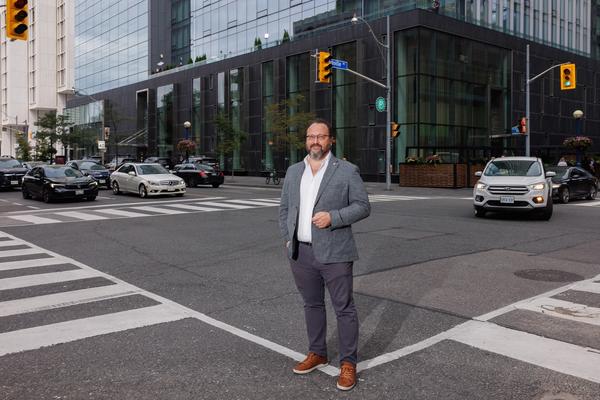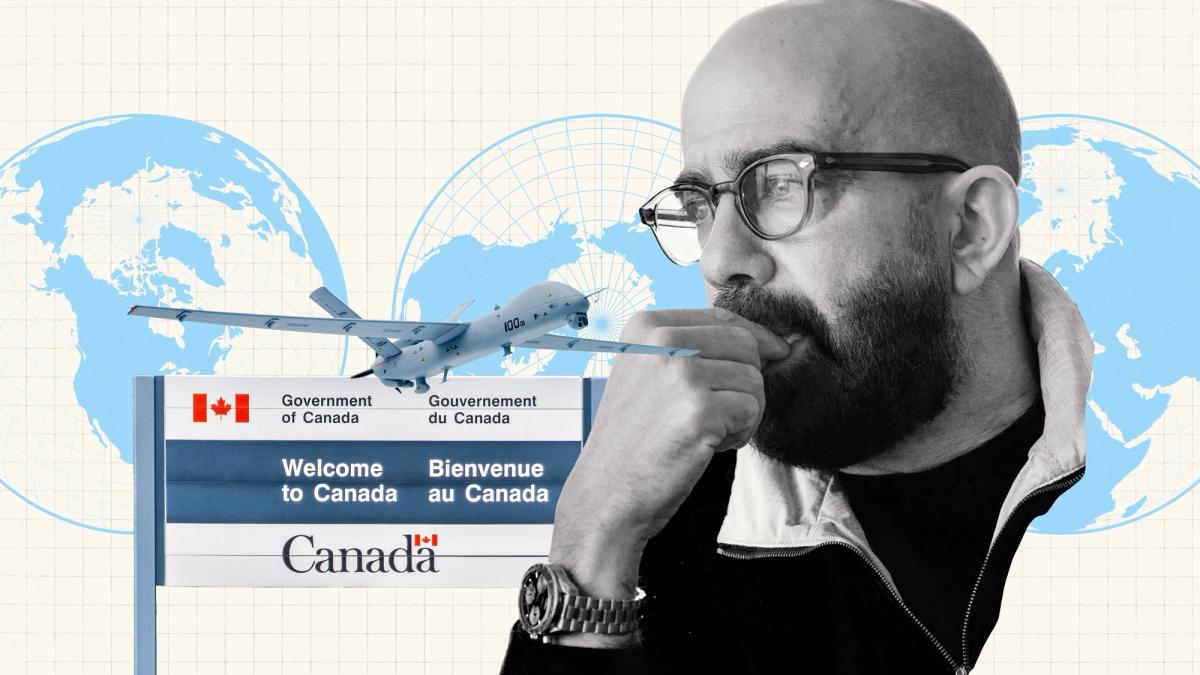
Every year, leading defence and security officials from around the world – most notably from the United States and Europe – gather in Nova Scotia for the Halifax International Security Forum. Peter Van Praagh founded the event in 2009 after working as a senior policy adviser to then Canadian Foreign Affairs Minister Peter MacKay. He calls it “an education opportunity for policymakers,” and it’s one that has become increasingly valuable. Be Giant spoke to Van Praagh about shifts in global geopolitics and Canada’s role and responsibilities in an uncertain world.
Let’s start by talking about what has changed since you started the forum. It seems to me that Canada’s security arrangements were fairly static, going back as far as the postwar period when Lester Pearson helped found NATO. The last few years have been quite turbulent. How has Canada’s role in global affairs changed?
The period from 9/11 to the withdrawal from Afghanistan was tumultuous for everybody. But it’s the Russian invasion of Ukraine that has set the tone for this new period that we’re in. The way the world works is that something happens – it could be a natural disaster, a political event – and governments around the world, Canada included, don’t react to the event. They wait to see what Washington is doing. Then everybody reacts to how Washington reacts, including adversaries.
But the United States has become so unpredictable now that nobody can wait, and everybody’s skill set has atrophied. Essentially, they’ve given up sovereignty. Now all of a sudden every sovereign nation, including Canada, is back at the drawing board and not waiting for the United States. They have to react on their own and say, ‘What is best for our country?’ We’re in a brand new space. The way I like to look at it is that we have a blank page. We have lessons that we should learn, and let’s use all the tools available to Canadians with our partners and allies to create something that works going forward. That’s the conversation that I want to bring to Halifax.
Get our new book for free.
Subscribe to our newsletter and we’ll mail you a printed copy.
So we have to develop our own sovereign capacities. But for Canada, because of our traditional pacifistic political character, the gap between where we were and where we suddenly need to be is bigger than for other countries.
Canada has prioritized spending on other things. That’s true of other countries as well, but not to the same extent because Canada has benefited from being the neighbour of the United States. It’s probably fair to say that Canada took a little bit of advantage of that. So did other countries. That’s one of the gripes that got Mr. Trump elected. So at this juncture, we have to figure out what it is that Canada needs to invest in to maintain its sovereignty, together with its partners.
From the Pearson era until now, Canada sought security by integrating in a NATO that includes a co-operative United States. Postwar France went another way, aggressively building up its own military, its own sovereign capacity. Is that the approach to take?
The French are distinct. Every country is distinct, but with France it goes back even before the French Revolution to how the French think of themselves. I think Canada is going to skip over a bunch of generations of technology – to leapfrog – and so if you look for an example of this, it’s actually Turkey.
The Turks also have been under the American umbrella, as the eastern flank of NATO. During the Iraq war, some of the Western European allies refused to give Turkey some of the defence capabilities it required, and so Turkey decided to build its own infrastructure domestically. It leapfrogged. It got into drones without having fifth-generation fighter airplanes, and changed the landscape of warfare with the Bayraktar drone. It was first used in the Karabakh war [between Azerbaijan and Armenia], and then was introduced into the first days of the Ukraine war, which helped repel the Russians.
What Canada can do, and should do, is learn from the battles that are happening right now, use some imagination and create equipment that can sustain Canada, but also can be marketable to other countries. If we’re just trying to replicate and build things that already exist in the world, we’re going to fall behind, and so Canada needs to do a lot of different, creative things.
You see Canada as having the capacity to do that?
It’s interesting, you know, you look at Northern Telecom, at BlackBerry. Canada starts off ahead in a lot of these things, and then doesn’t put the R&D in that the United States can afford to [put in]. Then Canada ends up losing intellectual property to others. Canada needs to learn those lessons in this field, and build up things, and not just sell to Canadians.
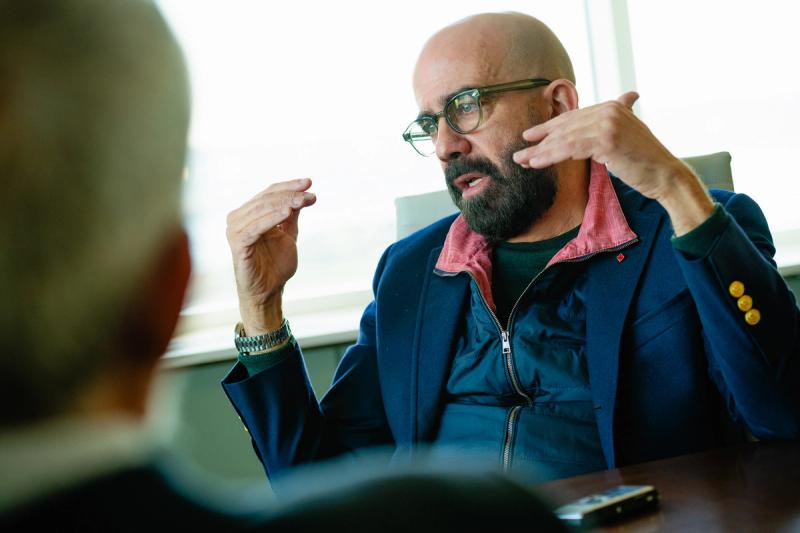
But isn’t it Canada’s natural political impulse to not spend on the military? To think that once Trump is gone it will go back to the way it was, and that we’re protected by two oceans and an ice cap?
You know, at DND [Canada’s Department of National Defence], the map of the world that’s in peoples’ offices is from the top and not from the side, and you can see how close Canada is to its neighbour, Russia. To me, the challenge really is looking at and figuring out the Russia-China threat.
Let me challenge you on the question of the Arctic threat. It’s very remote. It’s difficult to build things there. You can’t really have a land invasion from there. Is it really going to be a theatre of operations?
No, the idea that we are going to be invaded by any land army is not going to be the threat. The threat comes in a different way, a more insidious way. Remember we had this period leading up to World War II – in World War I and then the interwar period – when a big country could decide the future of smaller countries, whether by force or by economic coercion or threat. After World War II we established institutions so that wouldn’t happen again, and that lasted for some time.
Then, for whatever reason, in the period between 9/11 and the Russian invasion of Ukraine, enough mistakes were made that the whole premise of why we fought World War II has now been challenged by Russia. It’s a Security Council member, and it is trying to determine the future of its smaller neighbours. And that’s what I mean by a blank sheet of paper going forward. If we return to a place where bigger countries can decide the fate of smaller countries, that will head, eventually, to a major conflict. And that’s what we need to try to prevent.
And where does Canada fit in that calculation?
Canada, as large as it is geographically, is still a small country, power-wise – a middle power. But as the prime minister said, “If we’re not at the table, we’re on the menu.” That’s why we need to protect our borders up north, because as these authoritarian regimes become stronger, we don’t know exactly how they’re going to be countered. The countering used to be led by the United States. If that ceases to exist, then that’s going to diminish Canada’s safety in the world.
And it’s not just defending Canada. Canada is going to have to help defend European partners so that in turn they feel good about helping defend Canada. And if Canada just feels that it can benefit from everybody else’s investments, it’s going to be left behind and made to be very, very vulnerable.
The prime minister is taking advantage of a shift in the public mood to reach a level of defence spending we haven’t had in decades. What’s your view of how it’s going? Is it haphazard? Is it methodical? Are we investing in the right things?
It’s fast. I think it’s important to do and fast is good but fast is never ideal. I think the priority in the first instance was to get to a certain number, and I think that that is again both good and bad. I think there needs to be some strategic orientation, figuring out what Canada needs, what Canada is good at, what’s the best value for money.
What I’m trying to do at this year’s Halifax forum is take the new technologies – especially AI – into account. How are we maintaining our ideals as we go forward? We need to remember what it is we are securing. Why do our young men and women put on a uniform, sign up for military service? They’re defending Canadian sovereignty. But what is Canadian sovereignty? It is maintaining the values and ideals of the rule of law and peace, order and good government. There’s a big difference between a Ukrainian soldier and a Russian soldier, and you know we’re on the side of Ukrainian soldiers.
This is an exercise in nation building. It’s up to Canada to build Canada, and so let’s get to work. We’ll work with the Americans when the Americans are ready to work with us, but the future is ours. The future has to be ours to determine.
This interview has been edited for length and clarity.