As anyone living outside a Canadian city will tell you, one of the hallmarks of rural life is self-sufficiency. It’s an independence that involves sacrifice, a perpetually tight budget and often back-breaking labour that isn’t guaranteed to pay off. So it helps when the tools that make rural work easier can be fixed by the person using them.
Accelerating technology, however, has been interfering with this age-old equation. Much like televisions, furnaces, fridges and cars, tractors have become increasingly complex, built with motherboards, microprocessors and sensors that can’t be repaired by their owners – a fact noted in Bowden, Alta., a town that has become an unexpected polestar in the right-to-repair movement.
Driving between Calgary and Edmonton, one passes Bowden, which is just west of the QEII highway, a little south of Red Deer. It’s a quiet agricultural community of roughly 1,300 souls and is perhaps notable for being a place most Albertans would rather not visit, given that it’s home to the Bowden medium-security federal prison, a 600-inmate facility just north of town. Prison aside, the town’s primary economic drivers are a nearby oil and gas terminal and the agriculture industry.
Get our weekly newsletter - the people, places, and ideas revealing where Canada is headed.
Doug Wilson is one of those people on the agriculture side of town. He knows all about the frustrations of not being able to fix something. He grew up in small-town Ontario and came west for work, going into construction, “as most guys do when they move to Alberta,” he told me. “Everybody thinks Alberta is an oil-based economy, but it’s only when the oil industry is building things that the economy here really booms.”
Wilson did well in construction and one day realized that there was money to be made by selling equipment as well as using it. So he started a little side hustle selling used construction equipment, which in the early 2020s morphed into selling new construction equipment. He named the enterprise Ursa Ag – Ursa for bear, because that’s what his little niece used to call him, and Ag for agriculture.
Then, one day, about four years ago, a farmer wandered into his shop. He’d bought a piece of equipment from Wilson, but what he really needed, he said, was a tractor. A tractor without computerization, that is. Wilson had no idea what tractors cost, so he looked into it and was surprised by how expensive they were; a fully kitted out and computerized John Deere can go for more than $1 million. He got back in touch with the farmer and said he thought they could do better than that. They put their heads together and “figured out what we needed to do to build a tractor.”
Of course, building a tractor isn’t a basement hobby project. The learning curve was steep. But over time, Wilson was able to source parts from other manufacturers, about 50 in total, including alternators, batteries and tires. Then there was another set of parts, 50 or so, that they made at their own factory. “Obviously, there are hundreds of parts in total,” says Wilson. “But we don’t touch any parts inside the alternator or other components that come to us complete.” A 150-horsepower mechanical diesel tractor from Ursa Ag currently retails for $129,900.
A few hundred tractors later and Wilson can’t keep up with demand. “It’s all happened quite quickly,” he says. “I think it’s just that the idea of not having technology in a tractor is attractive to a segment of the agricultural industry.”
Anthony Rosborough, president of CanRepair and assistant professor of law and computer science at Dalhousie University, agrees with Wilson. “The right to repair agricultural equipment tends to bring the core of the movement into focus,” Rosborough says, “because it shows how repair speaks to wider concerns of food security, the resilience of rural communities and a sort of shared authorship over technology that is underpinned by democratic ideals. In this way, repair is a form of sovereignty.”
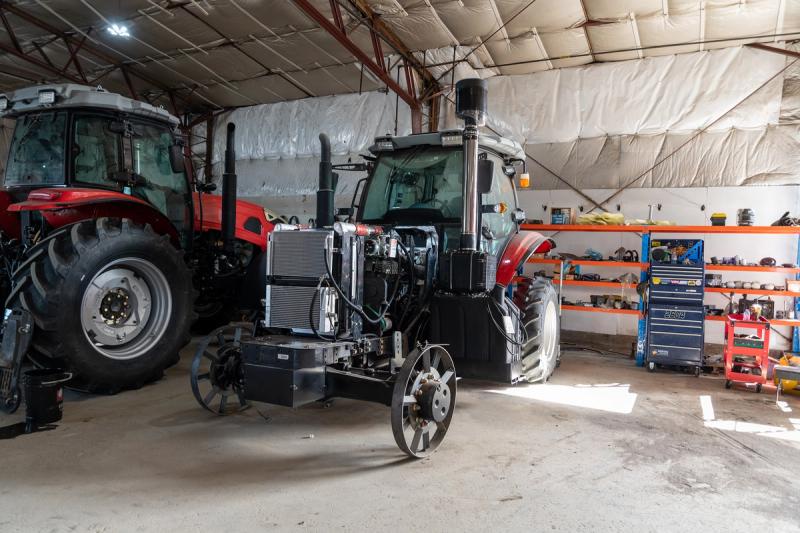
Rosborough also believes that computerization shouldn’t necessarily cause repair barriers. In his view, these are deliberate choices made by manufacturers “to monopolize the aftermarket for repair and servicing” and are a sign that the needs of equipment owners, farmers and independent businesses are being neglected downstream.
“In the short term,” Rosborough says, “Ursa Ag represents a trend that we will likely see more of, where users and third parties are removing tech bloat that makes repairs difficult or expensive. In the long run, what we’re going to need is better product design that takes repairability into account from the outset.”
The computerization of the basic tractor started in the 1980s, when electronics were increasingly added to diesel engines. Most of the computer systems were elementary and quite stable. This became the norm in engine-building and soon migrated to transmissions so that an electronic engine could speak the same language to an electronic transmission. The advantage of computerization was consistency of seed spread, spraying and harvesting, so that there would be no overlap in field patterning – the paths tractors take to harvest crops – and therefore less waste. With so much farm consolidation taking place over the course of the last generation, farms have gotten bigger, and the larger the farm, the greater the advantage of computerized patterning. Or so went the thinking, and it didn’t take long before the industry standard was to have fully integrated and interconnected computer systems in tractors, right down to the radio in the cab.
The core of the problem, asserts Wilson and others in the right-to-repair community, is the idea that increased complexity equals greater progress. “That’s a mistake,” he says, “to the point that electronics and computers have blown by the needs of the actual consumer and taken on a life of their own. I mean, nobody running an auger cares whether their radio talks to their transmission.”
In farming and across the consumer spectrum, the right-to-repair movement has picked up steam alongside the increase in products that create proprietary dependence. Many carmakers charge subscription fees for added services around safety, maintenance and performance options. Even something as seemingly basic as an Oura health-metrics ring requires the purchase of a subscription to unlock all but the most basic data-collection and -interpretation features. Ring and Nest home devices also require subscriptions for premium features, and the same goes for your Peloton. When it comes to tractors, a John Deere software subscription is often needed to access some of its “precision agricultural features.”
It was once common for purchases of consumer items to come with restrictive warranty terms that required the use of only the seller’s repair services. But such strictures are coming under challenge. On November 7, 2024, Parliament passed Bills C-244 and C-294, which amended the Copyright Act to allow people to bypass software locks on items they own. It is an evolving issue, but at the heart of it is a simple concept: a consumer should have the right to repair a product in the manner, and through the vendor, of their own choosing. Which, in the case of tractors and farmers, is usually themselves.
“I think what it boils down to,” says Wilson, “is that a lot of people just want to go back to when they could understand a thing.” And, of course, with farmers and ranchers, it doesn’t help that they’re often in more remote locations. They can’t just drive down to the dealer.
The changes Ursa Ag tractors have brought to the market are deceptively simple. A computerized John Deere will have both its engine and transmission controlled by a computer. If you want to switch gears, you press a button and the computer tells the transmission to shift. If you need a different torque on an augur, you press a button and the transmission alters the speed. Same with the front-end-loader speed and reach.
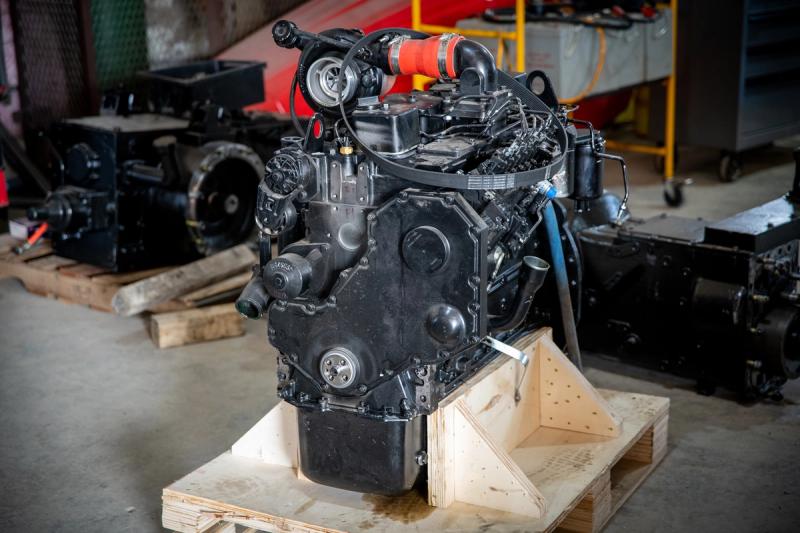
But when you’re driving an Ursa Ag mechanical tractor, you engage the clutch and shift the gear lever, and the transmission changes gears mechanically. Pushing a button to change gears instead of pushing a clutch and shifting a gear is not a great advantage, says Wilson, so to his mind, computerization isn’t worth the sacrifice.
And while Wilson is making and selling mechanical tractors, what he’s really trading in is something existential. He’s offering people agency. We all feel beholden to our technology at some level. So many of us wistfully talk of taking tech holidays, of putting our phones away for a week, of shutting off the computer.
Wilson gets calls from people asking him to build mechanical trucks, mechanical washing machines and mechanical refrigerators. There’s a craving for simplicity. It’s also becoming a “societal demand,” he says. “All I know is this year we’ll make 50 tractors and next year we’ll do a hundred.”
Wilson is so confident in the analog desires of Alberta farmers, he tells me, that he believes if he could build a thousand lo-fi tractors, he’d sell those too.