The line between city and country in Winnipeg is no metaphor. It’s a four-lane ring road called the Perimeter Highway. You can see it from space. Inside the Perimeter are the usual urban comforts: Netflix, Door Dash, Amazon, Xanax. Outside, or so I always thought, it’s mostly dirt and dust: farm country.
Driving past the Perimeter to Grosse Isle, 35 minutes north, I pass through an ice fog that settles hoar frost on the trees, turning them white. I’ve switched to Rural Radio on Sirius XM, Channel 147, for the hourly newsfeed: mature chickens down four per cent; 19 billion pounds of milk; cows up by 200,000 head; grain on the rise; refined flour under attack.
When I get to Rutherford Farms, the fog has lifted. It’s winter and it seems quiet, with just a truck idling in the yard. Pastor Rod Bieber on Rural Radio cites Kings 2:6 to explain that Jesus cares about everyday farm problems, given the parable of Elisha and the axe head. The snow-covered fields are flat, treeless. This is the Prairies. You can see both ends of a long train on the horizon. Even this far out of Winnipeg, 40 kilometres, it’s possible to see the fireworks on Canada Day at The Forks downtown. I know this because Rick Rutherford, who owns this seed farm, posted a picture on X.
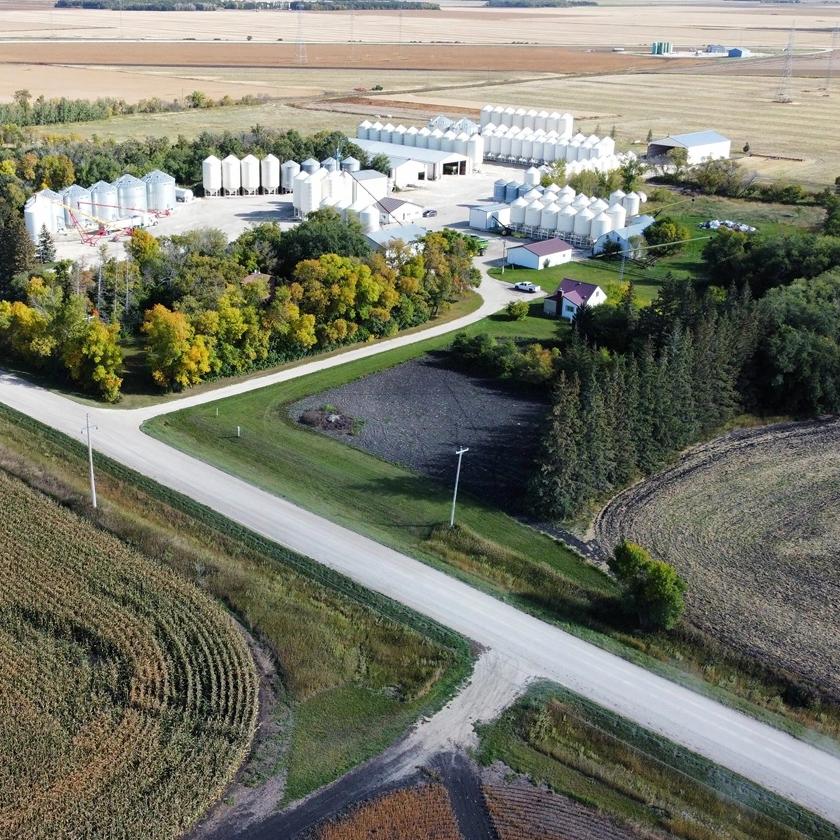
In the main yard are 110 grain bins, ranging in size from 3,000 to 75,000 bushels for a total capacity of 850,000 bushels of seed (according to a proud email from Rutherford). A single bushel is about 60 pounds (27 kilograms) of grain, the weight of a large dog. The bins stand on stilts and are funnelled at the bottom. They dominate the scene. But I know, I’ve read, that this place is wired to the hilt, sensors in the ground and at times in the air, connected to what’s called the Internet of Things: a network of objects that talk to each other in the cloud.
In the West there are two solitudes, city and country. The city figures the country is by now mostly industrial, commercial, large-scale farming; the strip mining of nutrients for the production of Cap’n Crunch. The country assumes the city is an idiot: alarmist, elite, by some standards (especially those of Mennonite farm country to the south) godless, and impossible to satisfy.
Both are partly right and mostly wrong. For sure, big companies like Cargill and Bayer have dominated the supply chain since the Canadian Wheat Board closed, but rural Canada is no grain factory: it’s diverse. It’s the world’s largest producer of canola, dry peas and lentils, the second-largest oat producer, a top producer of soy beans, flax, sugar beets, apples, carrots, mustard seed. Canada put up 166,000 tonnes of blueberries in 2024 (trivia: that’s about the weight of a thousand adult blue whales.) Canada has 62.2 million hectares of farmland, second only to the United States in the amount of land given to seeded crops. And yet, 97 per cent of Canadian farms are family owned.
A hectare is roughly the size of a sports field, the oval of grass inside a high-school running track. A farm 2,000 hectares or more is considered a large farm in Canada. Rick Rutherford’s seed farm is about 2,000 hectares. The average farm, though, is still small at 350 hectares, even though there are massive grain farms in Saskatchewan that reach 20,000 hectares. Despite corporate trends to consolidate and assumptions in the city that farming is getting bigger, the smaller farm still rules. And that’s partly thanks to technology: doing more on less land, once a slogan of the Green Revolution in the 1960s. In many ways, artificial intelligence (AI) tools and smart farming technology, called precision agriculture, are advancing efficient land use even more, making small farmers more competitive than they were a generation ago.
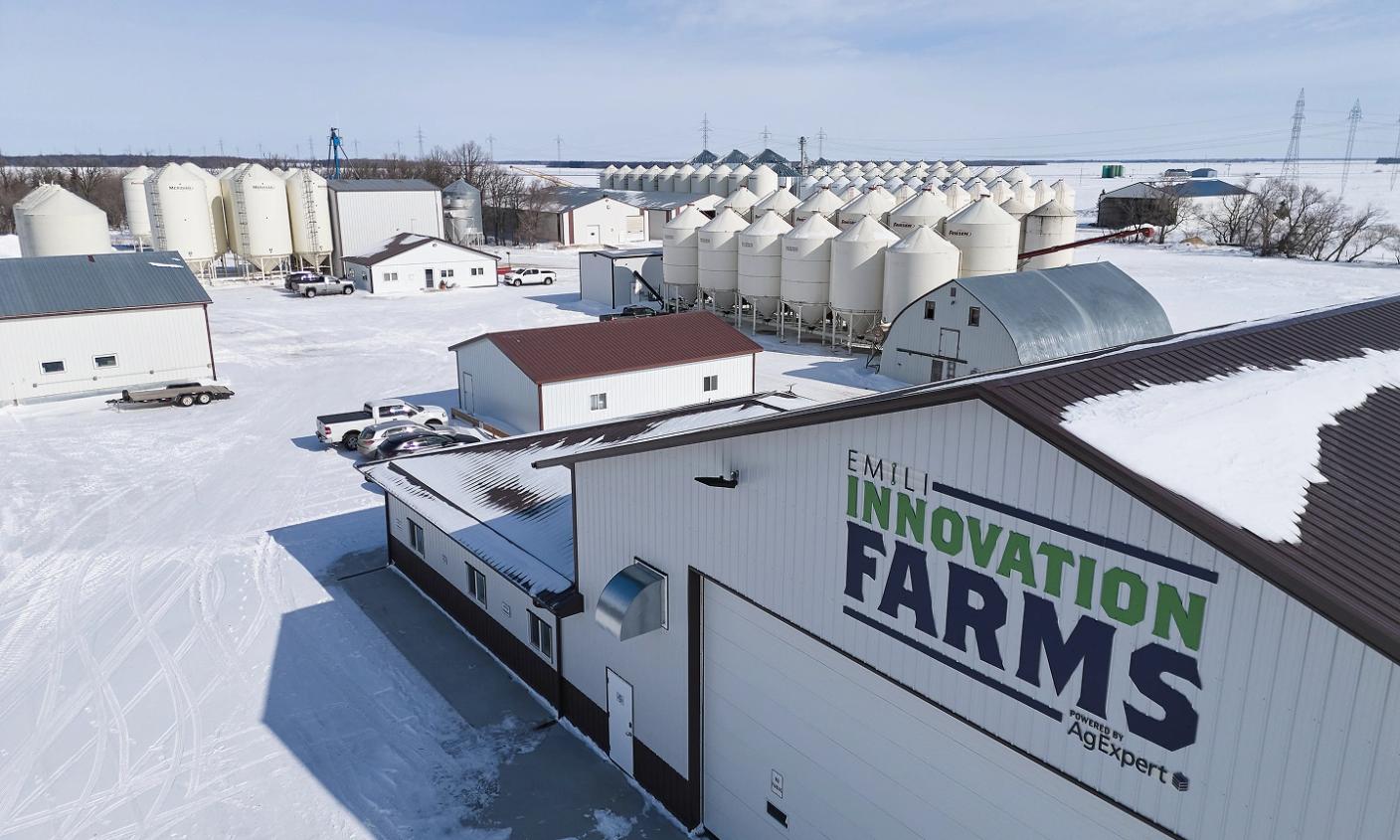
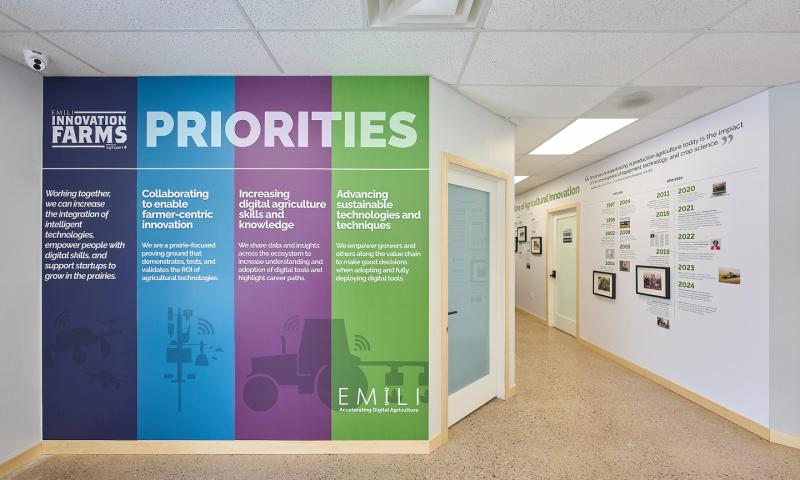
Rick Rutherford is a farmer’s farmer; he produces and sells cereal grains, soybeans and canola to other farmers for planting. But he’s also a technology farmer. Rutherford Farms is the site of Innovation Farms, run by EMILI, which stands for Enterprise Machine Intelligence Learning Initiative, a Winnipeg non-profit funded by industry (companies like John Deere and MacDon Industries) and by Farm Credit Canada, a Crown corporation that gives loans to farmers. In 2024, the federal and Manitoba governments kicked in just over $2 million.
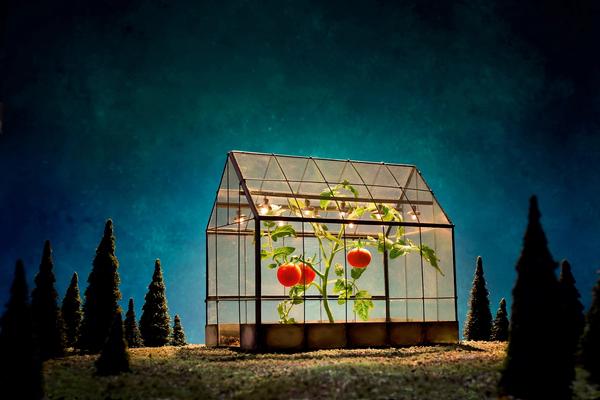
What EMILI does is take new technologies developed by startups and universities and try them out in real-world conditions, what Rutherford calls “ground truthing,” a term coined by NASA and used by the military to describe how things really work in the muck and rain and hail and wind of, in this case, everyday farming. Example: some startup makes a new robot that can pick a tomato without squashing it (this work is actually going on at the University of Manitoba). But who wants to be the first farmer to buy it to see if it really works? EMILI doesn’t make or sell tech, it ground truths it on the farm, in the muck and hail and rain and wind, to see if it works. Manitoba excels at muck, hail, rain and wind.
Rutherford, 67, says farming has always been quick to adopt new technology. His grandfather used draft horses on this property in the 1930s, arguably a technology. His father farmed with simple plows and binders and by the end of his career was operating a GPS-guided tractor on the same fields that Rutherford has since wired up for AI. “Artificial intelligence,” he says, “just takes it to another level. We don’t realize ourselves how much we’re using it.”
He’s friends with Ray Bouchard, a local John Deere dealer and EMILI board chair, and that’s how the partnership came about: Bouchard was looking for property for EMILI to spread its wings and Rutherford was interested in how EMILI might help his own farm with new ideas. He’s keen but careful, not so much an evangelist of new tech but more of a theologian; a believer, not a zealot. He has no financial stake in any of the startups piloting ideas on his farm, but then neither does EMILI.
Rutherford shows me a satellite map of the acreage on his smartphone. His hands are like baseball mitts. One of his fingernails is bruised black. He wears a black John Deere cap and a black Carhartt hoodie, same as city hipsters only without the irony. We are meeting in the EMILI boardroom at the farm, which has standard corporate functional furniture, a conference-call pod on the table, promotional material, and pictures of flying drones on the wall. This is not like dropping in at someone’s farmhouse for tea.
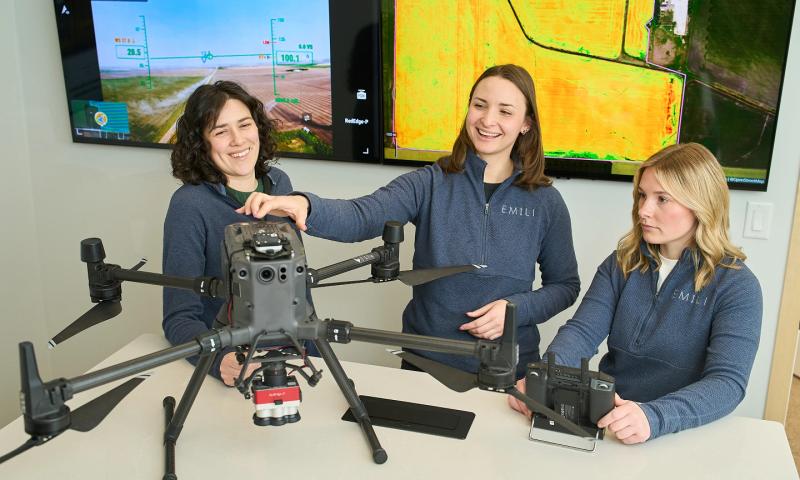
With us is EMILI’s farm manager, Leanne Koroscil. She wears an EMILI-branded zip fleece; the vibe is urban hiker. She uses terms like “best practices,” though she comes from a farm family, too, in Sandy Lake, three hours west, population 300. Koroscil took a master’s in plant science from the University of Manitoba and is a licensed drone pilot. Her family’s acreage, though, is not a smart farm like Rutherford’s. They have a hard enough time with cell service out there. They use CB radios in the field.
The Grosse Isle farm, Koroscil says, is “fully sensored,” in the ground, on weather pillars called Crop Sentries that act as panopticons so that EMILI and Rutherford can, in theory, monitor the field from anywhere – from the combine, the tractor, indoors. Rutherford was recently in Chile, where he works with local farmers on new technologies, and was able to monitor the farm from his phone using the John Deere Operations Center app. Ground sensors that measure moisture, a big deal on the dry prairie, look like meat thermometers or lipsticks. Ultrasonic wind sensors look like two bicycle bells stacked one on top of the other. These are plugged into the Internet of Things.
The goal is information, scads of it. Precision agriculture, also called Agriculture 5.0 (with 1.0 presumably being Sumeria), has two main streams: the collection of data that can inform decisions made by human farmers who, so far, still run things; and the remote control of equipment such as tillers and seeders and sprayers that, through AI, get better at their jobs the more they perform them. This leads, in theory, to less waste and brisk performance in the spring and fall, when the seeding and harvesting windows are shockingly short. A slow farm won’t get enough seed in the ground in the spring and won’t get enough plant out of the ground in the fall.
I say “in theory” because the research on productivity is also limited. “Some of the advanced technologies,” says a 2023 study in the journal Sustainability, “can be very useful… if these are applied in a specific way.” You hear companies say that new tech leads to better crops and it sounds right, but where’s the proof? In the field, Rutherford says. “My crop every year is my report card.”
Right now, the industry is bullish on drones. They show promise as crop surveillance tools (and cattle surveillance for ranchers) and as applicators of seeds and sprays. Rutherford has one that can take pictures, to see where water is lying in the field, for example. Consumer drones are cheap. People fly them in parks to annoy dogs and each other. EMILI’s drone is not cheap, $15,000 for the DJI Matrice and $15,000 for the commercial camera. It has four rotors and looks like a comically large spider. Software and AI measure heat, even light on individual plant leaves, which can generate maps: more data.
There are bigger, commercial drones with tanks that carry liquid payloads such as pesticides or herbicides for targeted spraying on fields. The DJI Agras can carry a payload of 40 kilograms. I’ve seen a TikTok from Asia of a man riding a drone like the space car on The Jetsons, not, presumably, what the manufacturer had in mind. (For now, there are no agricultural pesticides you can legally spray on farms in Canada, although the federal government is studying their use.)
Can drones make a farm more productive? Probably, maybe. Precision spraying by a smart drone that can tell the difference between a weed and a canola plant would likely reduce waste and therefore cost. Also, given that the charge time on a commercial drone is 55 minutes, it makes more sense for smaller properties than big farms. What we do know is that the drone business itself is booming; the global commercial drone market was worth US$30.67 billion in 2024 and is expected to reach US$992.87 billion by 2035. Agriculture is where a lot of the growth is happening.
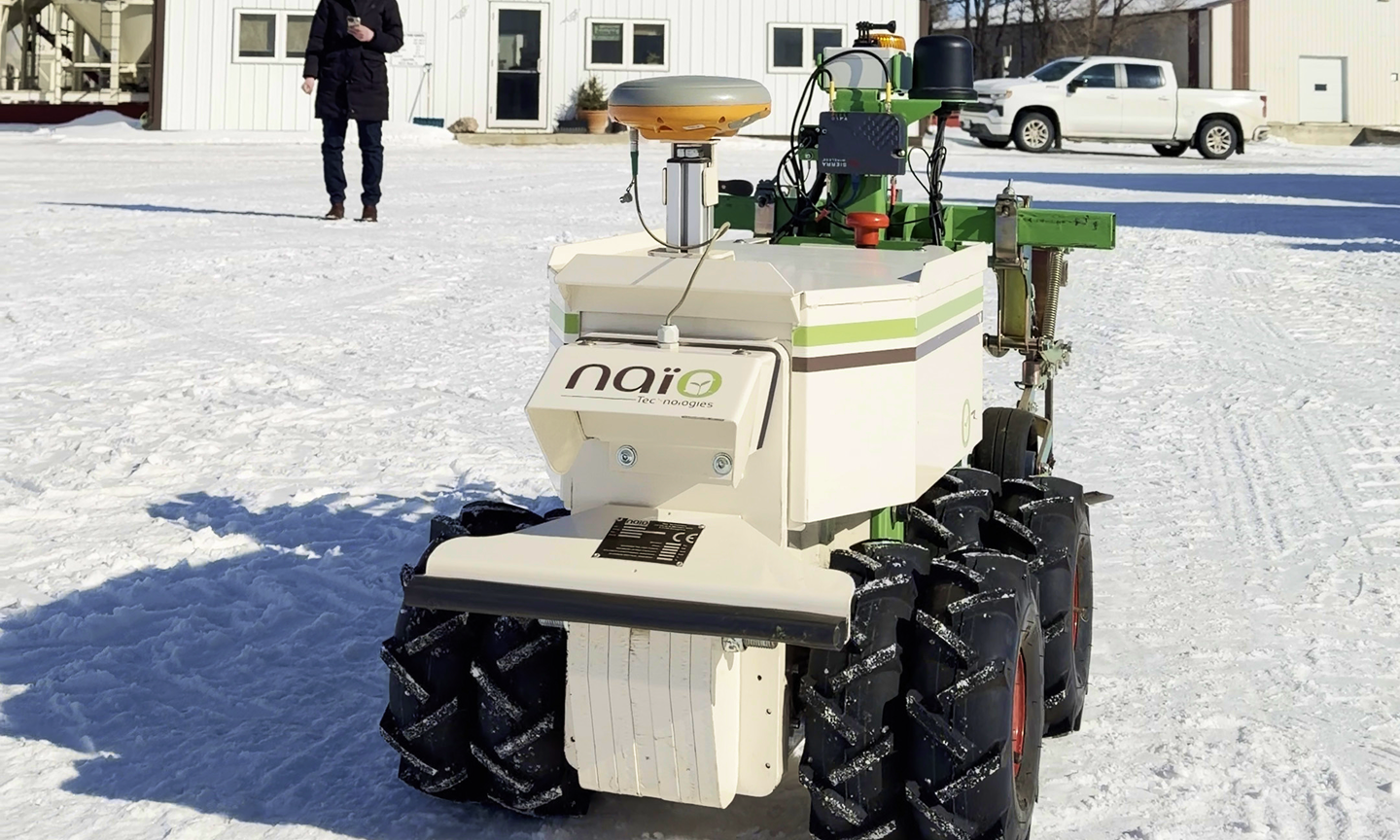
As for robots, EMILI has one that I saw in the tool shed. It’s an OZ 440 from France, about the size of a living room ottoman on knobby little tires, anthropomorphic in its way: it seemed lonely, and put me in mind of the agricultural robots nicknamed Huey, Dewey and Louie, in the 1972 sci-fi film Silent Running with Bruce Dern. The OZ is slowly finding its way in the marketplace, to be charitable. There are 10 working in Canada: it can sow and cultivate and weed specialty crops like artichokes on a small scale. “Even if it gets lost, it stops and lets you know. No problem,” a farmer’s testimonial on the company website says, half-heartedly. I’ve seen pictures of the OZ pulling a little yellow wheelbarrow like a distracted child. It’s as far from a giant John Deere combine harvester as it’s possible to get but again, if there’s an application for the OZ it’s on a smaller farm rather than a big one.
Vancouver-based Geco Strategic Weed Management uses AI to predict where weeds will turn up, say, next season. The farmer can be proactive. Maps are loaded into the smart gear, like AI-directed sprayers, and a hot spot on the field can be treated before the weeds even grow, which has to be good for the crop. But at the same time, it presents an existential puzzle: if we treat the hot spot that Geco predicts and weeds don’t grow there, is it because Geco was right and it was the correct spot to treat or because Geco was wrong and there were no weeds in the first place? In any case, the software has been “ground truthed.”
Of course, beyond predictability for the farmer, data itself is valuable to companies that collect and aggregate it and build algorithms from it, like Bayer AG, the aspirin company, which acquired the agricultural biotechnology company Monsanto in 2018 for US$63 billion. Data “is collected and deemed valuable and worthy of investing in,” says a 2024 paper in the journal Big Data & Society, “based on its assumed ability to generate future income, revenue and returns,” meaning that, while the farmer grows crops, the company grows shareholder value from his data and the combined data of all its clients. Growth patterns, fertilizer use patterns, weather patterns – they all create prized data pictures.
This isn’t unique to farming, of course: you're contributing to Google's shareholder value every time you search something, like “Fitbit for Chickens,” online, as I have recently, thus messing up my algorithms. (Fitbits for Chickens are not actual branded Fitbits, but small backpacks with similar wireless technology that reads pecking and preening movements in birds, thus giving the farmer useful information on mite infestations. Wearables for cattle are also in the works.)
Will Robbins is a fourth-generation farmer near Laura, Saskatchewan, not far from Saskatoon. His mother, Nettie Wiebe, is a past president of the National Farmers Union. The family runs an organic farm of just over 1,000 hectares, of which about 400 are cultivated with the rest given to pasture. They grow pulses, oats and wheat.
“We’re a modern agricultural farm,” he says. “We use a pretty standard air drill for seeding; we run a GPS on the tractor,” meaning it steers itself, though Robbins has to control it from the cab. The rigs are diesel. He doesn’t spray for weeds, but has a mechanical weed controller that runs on camera optics, made in Austria by Einböck. “You run it off a phone,” he says. As for human labour, he says, “it’s mostly me.” He hires help for the harvest.
I wanted to know if travelling salesmen were coming up his driveway with brochures for new technology, for drones and robots and sensors, dabbing their foreheads with hankies against the noonday sun like in some kind of Flannery O’Connor short story.
“Yeah, well,” he says, “there’s definitely a push, at every point of contact with the farm. We have people trying to sell us at farm shows. Some of it seems kind of useful, some of it seems onerous. Or at least makes me wary. I think anything that has the subscription model which most technology companies have moved to makes me leery.”
For smaller farms, cost of entry is a problem. The upgrade to turn a John Deere 9RX tractor driverless for tilling is US$40,000 to $45,000, and the upgrade will only work on a Deere. Beyond capital outlay, there is also a $10,000 annual subscription fee for the upgrade and you have to call John Deere if it breaks; you can only fix it yourself using their proprietary software and tools. (As of March 2026, Deere is still armpits deep in a U.S. Federal Trade Commission anti-trust lawsuit that claims the company forces farmers to use certified dealers for equipment repair.)
That said, if and when spraying pesticides with drones becomes legal in Canada, you won’t have to buy one for the same reason that, if you want to use public transit in Winnipeg, you don’t have to buy a bus: a small farmer on a budget can book a drone company to do the work. Also, the “smaller size of most… robotic platforms as compared to traditional tractors and implements,” says the report in Sustainability, “brings greater opportunity for the use of these technologies by small-scale growers.”
Plus, Rutherford says, AI “levels the playing field” since the small farmer would get the same data output from networked sensors and the internet as a farm 20 times bigger. If there’s a new Green Revolution, it is, in theory, democratic. Things will get weirder if farm tech develops swarm capability: everything connected, from moisture and light mapping to spraying and harvesting, and operating with a single, guided purpose. John Deere imagines a fully autonomous farm by the year 2030.
Walking through the yard at Rutherford Farms, Rutherford and Koroscil and I pass the grain bins, tall as five-storey buildings. A piece I read recently in The Atlantic described farm work in a short sentence: Your hands will bleed. Also, you can fall off tall things and into sharp, toothed and turning things. It is dangerous work, and always has been. The fields are more or less, to the eye, the same as they were for Rutherford’s grandfather, as is the weather. It’s an odd thing – even sincere and hopeful – to imagine algorithms and drones as part of the operation, when you’re outside and the farmland seems endless and unforgiving. I once watched a YouTube video of a farmer fixing his combine header with a sledgehammer because he hit a rock. That’s not something AI can help you with.
Rutherford shows me the seed processor, housed in a shed. This is the heart of his business. There are dozens of rubber drive belts hanging on hooks and a low-tech control panel that looks vaguely Soviet. The air is full of dust. It’s loud as soon as we open the door. I can feel the dust in my throat but it’s warm here, compared to -25 C outside. He reaches into the hopper and pulls out a handful of seed that the machine has shaken free from chaff and nature’s crud and the other less plump seeds, which will wind up as animal feed. This, the good seed, is what he sells.
“What it’s doing,” he says, “is floating the seed, and the light seed is going to one side and the heavy, robust seed is being driven to the other side.” He’s been doing this, examining seeds, feeling them in his hands, for decades.
The notion, fuelled in part by assumptions from the other side of the Perimeter Highway, that farming is industrial and large-scale and is driving families out of business, and that innovation is only for the big operators, is not entirely true. Families like the Rutherfords and the Robbinses are making a go of it in part because of GPS and the data that sharpens their business decisions, and if AI doesn’t destroy us, it could make agriculture more user friendly and even attractive to younger generations who’ve been leaving rural Canada.
At the same time, artificial intelligence can’t do what Rutherford’s doing here in the processor shed: feeling seeds in the palm of his hand, admiring them and judging them at the same time. It’s not as smart a farmer as Rick Rutherford is, not yet.