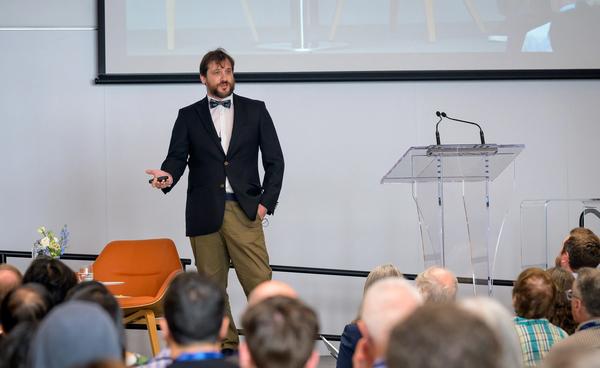
While the United States and China battle one another for AI dominance, Canada is charting its own course through the changing landscape of AI innovation, enterprise and regulation. One of the leaders charged with navigating that passage is Elissa Strome. As executive director of the Pan-Canadian Artificial Intelligence Strategy at the Canadian Institute for Advanced Research (CIFAR), Strome works with the heads of Canada’s three national AI institutes to advance our standing in the field. On Sept. 16 in Montreal, she’ll be addressing tech industry decision makers among the 6,000 gathering for All In, Canada’s largest annual AI conference. Here she tells Be Giant’s Patchen Barss what the future of an AI-driven Canada looks like from where she’s standing.
Canadian tech sovereignty was a major theme coming out of last year’s conference. How do you expect that to play out this time around, given the current geopolitical temperature?
The conference draws a big international contingent, and this year Canada is looking for opportunities to partner with some of our allies outside North America. This is a moment to showcase the Canadian AI ecosystem. Domestically, it’s also a space where innovators, researchers, policymakers and companies all talk about what they’re doing and why it matters. It’s exciting to see what new innovations are coming out of Canadian labs and startups, and also what bigger companies are doing – not just AI companies but places like Telus, Bell and Bombardier.
Get our weekly newsletter – the people, places, and ideas revealing where Canada is headed.
How should a country like ours balance AI sovereignty with international partnerships?
The U.S. and China are obviously investing to a much greater extent than [countries] anywhere else in the world. We don’t have those kinds of resources, but we have other things going for us. So we have to think about how we develop our AI ecosystem in a way that aligns with Canadian values and keeps companies here in Canada. Startup companies launch here every year, and we have to do a better job of providing them with resources, expertise and capital to grow their companies here.
Partnerships, especially with like-minded middle powers, are also a critical piece of the strategy. It might seem counterintuitive, but sovereignty really means having the capability to do the things you want to do, and that doesn’t always mean doing it alone. This year, Germany is the country of honour; there’s a huge delegation coming, which is a key partnership opportunity. Other partnerships are under discussion or nascent with the U.K., France, South Korea and others. These are countries that align with Canada’s strengths and that Prime Minister Carney has identified as opportunities for collaboration on AI, and also countries that are part of the international network of AI Safety Institutes with Canada.
This year, you’re speaking on a panel about health care. Give me a rundown of Canada’s goals and risks in that field.
I think health is actually one of the strongest areas of opportunity for us. We have this rich foundation of expertise, interest and innovation, and our publicly funded health-care system is a real asset for the systematic deployment of technology.
The diversity of our population is another really great strength. Canadian health-care data represents different ethnic and racial backgrounds, and also different environments – rural and urban. So, since AI applications built on Canadian health-care datasets reflect Canadians and also other parts of the world, there’s an opportunity to commercialize and disseminate technologies built here.
How would that kind of initiative deal with patient privacy?
Patient privacy is paramount, and Canadian researchers are at the forefront of developing privacy-preserving approaches to AI. Any future application of models developed in Canada would have to ensure consent for data usage for this purpose and privacy protection. Our privacy laws are currently being updated; the federal government tabled the Protecting Privacy and Consumer Data Act in June.
Being able to understand, predict and plan for where we need specific health-care resources at certain times is also a really good application of AI. We also have huge opportunities for scientific discovery around drugs, treatments and diagnostics. There are Canadian AI health startups like Swift Medical, a Toronto-based pioneer using AI and smartphone data to assess, measure, and track wound care. Or Clarius Mobile Health, a Vancouver-based medtech firm building wireless, handheld ultrasound tools that are integrated with AI analysis.
Can average Canadians help shape Canada’s AI future?
Canada’s AI for All strategy has a strong focus on building trust with Canadians in AI systems, including a recently launched National AI Literacy Initiative. I encourage Canadians to take advantage of opportunities to learn about AI and try out AI tools. You have to get a feel for what they can do, their limitations and capabilities, before you can really understand how you feel about them. I advise students in particular to make sure they’re evaluating information with a critical lens. This is partly about using the same set of critical thinking skills that educators have been helping students develop for decades: understanding the sources of information and their veracity; fact-checking; checking information against your own understanding of a topic; using trusted sources (and recognizing that even these contain errors); not taking everything at face value.
What is one AI safety issue you’re concerned about, and what is Canada doing about it?
I think about the transparency of AI systems and developing ways for users and researchers to know when they’re interacting with AI systems. These systems are getting more and more powerful. What are the risks to society when AI agents are driving the narrative in the media, or when misinformation is being used to influence elections? Understanding and detecting misinformation and disinformation is a big priority for both policymakers and researchers in Canada right now.
If all of this work and investment in AI pay off, what does the positive-case scenario look like for Canada’s future?
I think there really is a strong opportunity for Canadians to see both the social and economic benefits of AI. I mentioned the huge opportunities around health care. I’m also hopeful about the benefits to our energy systems, if we can deploy AI to take more innovative and efficient approaches to renewable energy, and better manage our grids and infrastructure. It could improve transportation, with downstream effects on climate change and CO2 emissions. And I hope we’ll find opportunities for people to leverage this technology in their work.
What do you anticipate the labour market of the future will look like, and what are the biggest challenges in preparing Canadians, especially younger Canadians, for it?
We don’t know exactly how the labour market will be affected by AI, but we can anticipate major changes. We have seen this over and over again historically with major technological changes. Jobs will be created and jobs will be lost. I think the job creation side is interesting and real, and that there will be more need for human oversight and for individuals with strong AI literacy skills – this is core to the AI for All strategy.
The best way to prepare for an unknown job market is to build skills that generally help you navigate the world, for example critical thinking and communications skills, which are always essential, and pursue areas of study that you are passionate about. One of the biggest challenges is not getting too hung up on learning a particular technical skill, because the technology is changing so quickly.