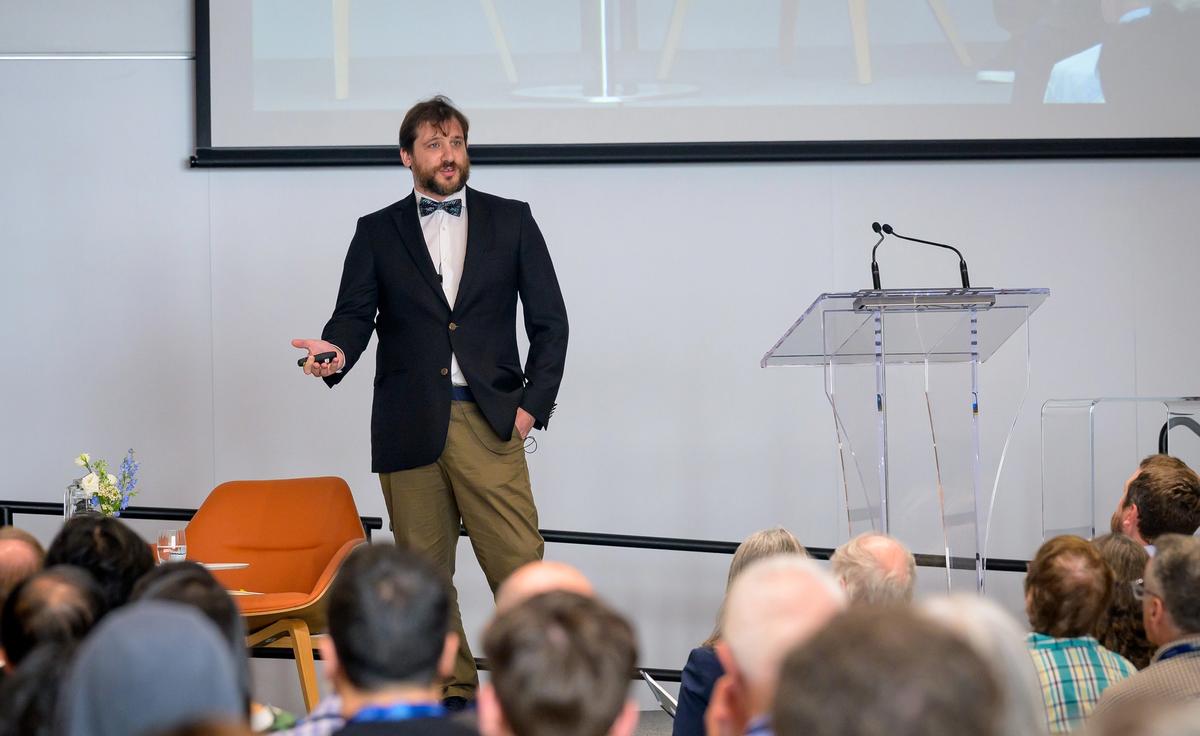
As the prospect of superintelligent AI becomes increasingly plausible, who will step up to keep humanity safe?
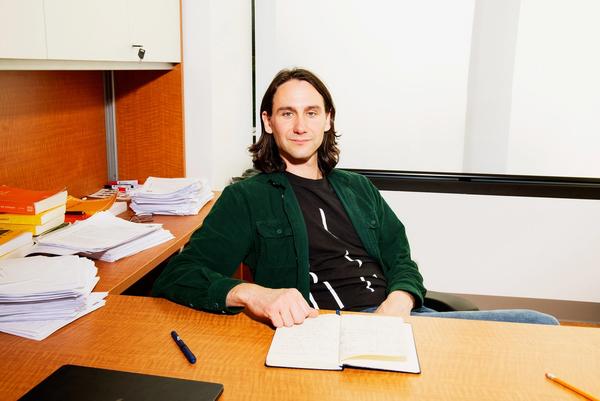
Engineers, coders, policymakers and activists all play a role. And now, through a new AI safety institute to be headed by Jacob Tsimerman, a prize-winning Canadian academic, mathematicians are ready to do their part.
“The thing about AI is that we don't have the right ideas yet to make a safe superintelligence. We're trying to build something where we don't yet know the answers, and that's where mathematicians are extremely comfortable,” says Tsimerman, a professor at the University of Toronto.
Get our weekly newsletter – the people, places, and ideas revealing where Canada is headed.
In July, he was one of four recipients of the world’s most prestigious math prize, the Fields Medal, sometimes described as the “Nobel Prize of mathematics.” This week, he announced he is shifting his focus from the esoteric work that garnered him this and other accolades to become the scientific director at the Mathematical AI Safety Institute (MAISI), an organization he co-founded.
Over the past decade, Tsimerman watched developments in AI with growing concern – as a mathematician and as a human being. As neural networks got more and more powerful, it became clear to him that we weren’t ready for the moment when artificial intelligence surpassed human intelligence.
In 2025, Tsimerman co-authored a paper devastatingly titled “A Taxonomy of Omnicidal Futures Involving Artificial Intelligence.” It outlined multiple scenarios where all, or almost all, of humanity could die as a result of people’s use and misuse of AI, or from AI escaping our control and acting on its own.
“Whenever I get asked which of the concerns out there matter to me, my main answer is ‘all of them,’” he says. “We have to worry about how it impacts society, how it affects the economy, about bad actors, about good actors with different values. But my priority and focus are squarely on the science of superintelligence.”
Through this new institute, he is seeking ways to help humanity avert AI-driven extinction-level events, while still allowing us to benefit from the technology.
“We build these systems that learn. They understand and take actions in the world. But how do you look at the pile of numbers that a neural net has inside it and try to extract what it's learned, how it thinks about the world, how it makes decisions?” he says. A better understanding of those decisions and actions could be the key to developing intelligent machines while preserving our autonomy.
MAISI will be based in the San Francisco Bay area, which, in addition to being home to many large AI companies, is also a major hub for AI safety organizations. The institute will begin its first full research semester in January 2027.
While it is unaffiliated with a larger institution or company, it will borrow approaches typical of a university math department, including holding learning and research seminars, facilitating working groups, organizing guest lectures and collaborating with other AI safety organizations.
“We're going to bring others together and rapidly get them up to speed on existing theories. We're not reinventing the wheel; we‘re trying to get the most out of what's been done so far,” Tsimerman says.
When necessary, they will sidestep traditional academic peer reviews to publish new ideas and insights as quickly as possible via lecture notes, blogs or other formats. Tsimerman treats the work as a race against time and the pace of AI’s increasing capabilities.
“We really aren't interested in credit at all. MAISI would be thrilled to be scooped and have someone else solve the problem of safe superintelligence before we even open,” he says.