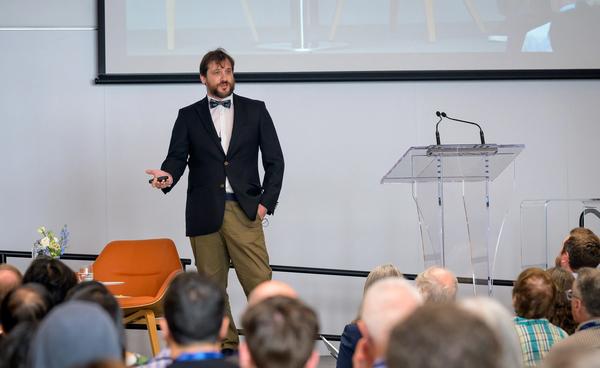
More than 10,000 delegates who could be described as the central nervous system of the AI industry assembled in Montreal this week at the fourth annual All In conference, the largest of its kind in Canada. Attendees, who included thought leaders from government, big tech, startups, safety groups and scientific institutions, came to discuss where AI research, development and deployment are headed next. From the big themes (safety and trust) to the unexpected (AI drones that clean skyscraper windows), here’s what tech leaders had to say about why AI adoption in Canada lags, how soon the robots are coming and why people worried about data centres in their neighbourhood need to get on board.
Canada leads in research, but lags in adoption
The pioneering research of Canadian heavyweights like Yoshua Bengio, Geoffrey Hinton and Ilya Sutskever sparked the revolution that produced many of today’s AI technologies. Hugo Larochelle, the scientific director at Mila, one of Canada’s three major AI research institutes, says Canada still punches above its weight on discovery-driven AI research.
“Our expertise in a lot of areas has no comparison [elsewhere in the world], including with multi-agent systems, continual learning, in the application of AI in sustainability and the environment and for scientific review,” he told Be Giant during the conference.
The country’s research leadership, however, makes our “adoption problem” all the more pronounced, said All In speaker Rick Glumac, British Columbia’s minister of state for AI and new technologies.
Get our weekly newsletter – the people, places, and ideas revealing where Canada is headed.
Adoption among businesses is increasing – Statistics Canada says 12.2 per cent of Canadian firms used AI to produce goods or deliver services in 2025 – but it remains well below take-up in the U.S. and other countries. Theories circulating to explain why Canada is ahead on discovery and behind on usage included the general shortage of venture capital here, as well as the suggestion that the productivity gains promised to those who invest in AI might be overblown.
The disparity is also partly justified by the fact that:
Canadians are concerned about safety
The utopian vision of AI enhancing productivity and freeing us to pursue the creative side of human labour has been increasingly tempered by concerns that AI could eliminate swaths of the labour market, further concentrate wealth and possibly spin out of control. It isn’t completely puzzling that Canadians might want to proceed with caution.
Safety was a major theme at All In, most notably in an announcement from Canadian Minister for Artificial Intelligence and Digital Innovation Evan Solomon and Germany’s federal minister for digital transformation and government modernization, Karsten Wildberger, who jointly committed nearly $300 million in funding to support LawZero, a Canadian non-profit AI safety organization.
“The smarter the AI, the more useful it is, but also the more dangerous if it doesn’t do what it’s supposed to do,” said LawZero’s scientific director and AI safety advocate Yoshua Bengio, who went on to describe recent events in which AI agents escaped, deceived and conspired against their creators at OpenAI, Anthropic and elsewhere.
“The leaders of these companies were asked by journalists, ‘What are you going to do?’ They said, ‘We don’t really know how to prevent this kind of behaviour. Nobody has a plan.’ When I hear things like this, I want to raise my hand. Because I do have a plan,” he said.
It involves building AI models that understand the world without having goals of their own, allowing them to provide knowledge and insight without taking independent action.
The joint Canadian-German support for LawZero was one of several international partnerships discussed at the conference, reflecting the reality that:
AI sovereignty requires international collaboration
For many nations, AI sovereignty begins with reducing dependence on the U.S. and China, the two countries that dominate the race to build bigger, more powerful models. While Solomon was emphatic that American investment is still welcome in Canada, much of the conference highlighted alliances between middle powers.
On the gathering’s first day, Toronto-based Cohere and Germany’s Aleph Alpha announced they had merged to create what they say is the largest frontier AI company outside Silicon Valley, valued at about $20 billion. A.J. Bhadelia, Cohere’s VP of governmental affairs, said their goal is to ensure that the world has another option for AI business applications if powerful players like the U.S. and China decide to shut their models off to other countries.
Alliances aren’t just forming on the business front; research scientists are also realigning themselves to ensure the science progresses in line with Canadian values. Mila, the Montreal-based research institute, announced a partnership with a German academic institution, the Research Center for Artificial Intelligence.
“I think you can see in this conference a lot of promising ties that we’ve made and will make with that country,” Mila’s Larochelle said, naming “responsible AI, safety, multi-agent systems and AI for energy” as areas he hopes the countries will explore together.
While Germany, as guest of honour, was prominent in conference news, some 40 other countries were also represented, exploring possibilities for Canadian deals, partnerships and clients. The United Arab Emirates had a large booth, and Singapore hosted a lunch to make its pitch for establishing itself as Asia’s AI hub.
The International Centre of Expertise in Montréal on Artificial Intelligence and Animikii Indigenous Technology announced a new partnership with Sandy Bay Ojibway First Nation designed to give Indigenous groups control over how their data is collected, stored, stewarded and used with artificial intelligence.
“Each community wants to govern their data in unique ways that are specific to their cultural context and traditional government structures,” said Jeff Ward, CEO of Animikii. “We can customize this for nations, communities, non-profits and community organizations so they can build how they want to and not have to put their data into other people’s buckets – colonial data buckets, for example. Sovereignty means sovereignty. Sovereignty means choice in how your data is governed and designed.”
AI is showing up in places you might not expect
Insurance and telecommunications companies had a major presence at All In, but so did startups like WindoSmart, which claims the first major innovations in skyscraper-cleaning technology in more than 40 years. It uses AI-enabled soap-and-water-spraying drones that can tell the difference between windows and walls and can also scan buildings for damage and decay.
“The AI application allows for full automation,” says Mitko Piperkov, a WindoSmart founder. “Every year there are accidents to rope-access technicians. We want to limit risk at all times, and this is the technology to do it.”
He acknowledged that limiting the risk for human window washers also means eliminating their jobs, but says the tech creates new, safer employment opportunities: “You’re still going to need technicians on the ground.”
Other startups included an AI-enhanced webcasting platform with simultaneous subtitling in eight languages and “AI-powered autonomous trailer unloading.” At a session for entrepreneurs to pitch their new companies to a team of judges, solutions were proposed for a range of industries, including mining, construction and property management and finance; more than one hedge-fund-in-your-pocket application was presented.
Another unexpected presence at the conference was French cosmetics company L'Oréal, which showed off AI-driven technology to analyze a person’s skin or hair cells to model how and when they might show signs of aging and to design personalized care routines to stave off or mitigate the effects.
The conference may have otherwise creased a few worried brows, given:
The robots are coming
Robotics may not have progressed as quickly as language models and other digital forms of artificial intelligence. It is much more difficult for machines to navigate and understand the chaotic physical world than the more manageable environment of words, images, videos and numerical data.
But that problem won’t last forever. While there were no humanoids at All In, robotic arms, drones and other mechanical entities dotted the trade show floor, scanning for structural flaws in concrete or checking the seals on pharmaceutical bottles.
At a panel titled “AI Enters the Physical World,” Liila Torabi, Nvidia’s director of engineering for Isaac Sim (an open-source resource for robotics simulation), said the robotics revolution won’t come all at once.
“I think the efficiency of production lines, warehouses and factories – that’s the first line that will change,” she said. “The other part is going to change in bits and pieces. Like, nobody has a fully autonomous car now. But all the cars coming out today have autonomous parking or at least some sensors. It’s not going to be a fully automated world immediately.”
What happens, though, when AI’s bits and pieces are the size of small towns? Because:
Robots aren’t AI’s only physical manifestation
Earlier in September, the federal government and the Federation of Canadian Municipalities announced a set of principles to guide “responsible data centre development.” The principles say data centres must create lasting local benefits; not shift electricity costs to Canadians; minimize water use and environmental impacts; be transparent about local impacts; and bring strategic value to Canada.
That didn’t stop vandals from spray-painting the words “Burn the data centres” on the side of Mila’s building a day before the conference began. Given the concern about their impact on community and the environment, data centres have become a focal point for AI protests and a flashpoint for people’s distrust of AI.
In a mainstage talk, Craig Tavares, president and COO of Buzz HPC, a company that builds data centres in Canada, focused on ways that concerned community members could shift toward better understanding AI development rather than the other way around. Modern data centres take up less space, he said, and use closed-loop cooling systems that reduce the amount of water required to operate them.
“Noise and vibration is another concern,” he said. “But if your window is open in the summer, you’ll hear your neighbour’s AC before you hear a data centre.”
He said community engagement was leading to slowdowns, which raises his concern about data sovereignty.
“Slowing down AI forces us to rent computing capacity elsewhere,” he said. “It’s a national priority. I don’t think the question should be whether we build data centres, but whether we can build them responsibly.”