For those in the know, it was not a huge surprise that Jacob Tsimerman won the Fields Medal, mathematics’ highest honour, earlier this month. The University of Toronto professor has been in contention for the award since he was a kid, when he earned a perfect score at the International Mathematical Olympiad, and he became an odds-on favourite when he and two collaborators proved the long-unsolved André-Oort conjecture back in 2021.
What did come as a surprise, however, was the news Tsimerman shared after winning the Fields: that he’d be joining OpenAI to work on AI safety. What will one of math’s biggest brains, more accustomed to working with chalk on a chalkboard, do at a Silicon Valley tech giant building artificial intelligence? And why the switch now? Luc Rinaldi, a Be Giant writer who did an escape room with Tsimerman in June, got back in touch to talk about that and more.
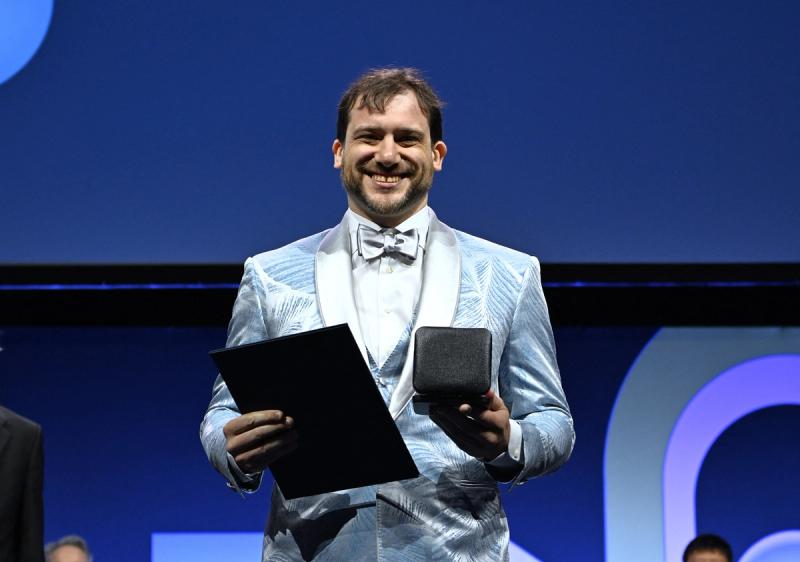
First of all, congratulations on winning the Fields Medal. I promise we’re going to talk about that, but first I need to know the story of that incredible blue tuxedo you wore to the awards ceremony. What was going on there?
I normally don’t wear formal clothing. I wear comfortable, loose-fitting clothes. But for my wedding last year I had a purple tux tailored. And then once I found out I was going to get the Fields Medal, I thought it’d be fun to get another one. So I went through a bunch and that one seemed cool.
What’s your life been like since the award?
A whirlwind. I’m doing a lot of media, which is not something I typically do. I feel very privileged to be able to talk about stuff that I think is important. I’ve gotten a lot of congratulations, which have been very nice.
It was wonderful to be able to celebrate with my colleagues. [Mathematics] really is a team sport, and it’s not an exaggeration to say I wouldn’t have gotten nearly as far or done nearly as many interesting things as I have been able to do – or had as much fun – without my colleagues.
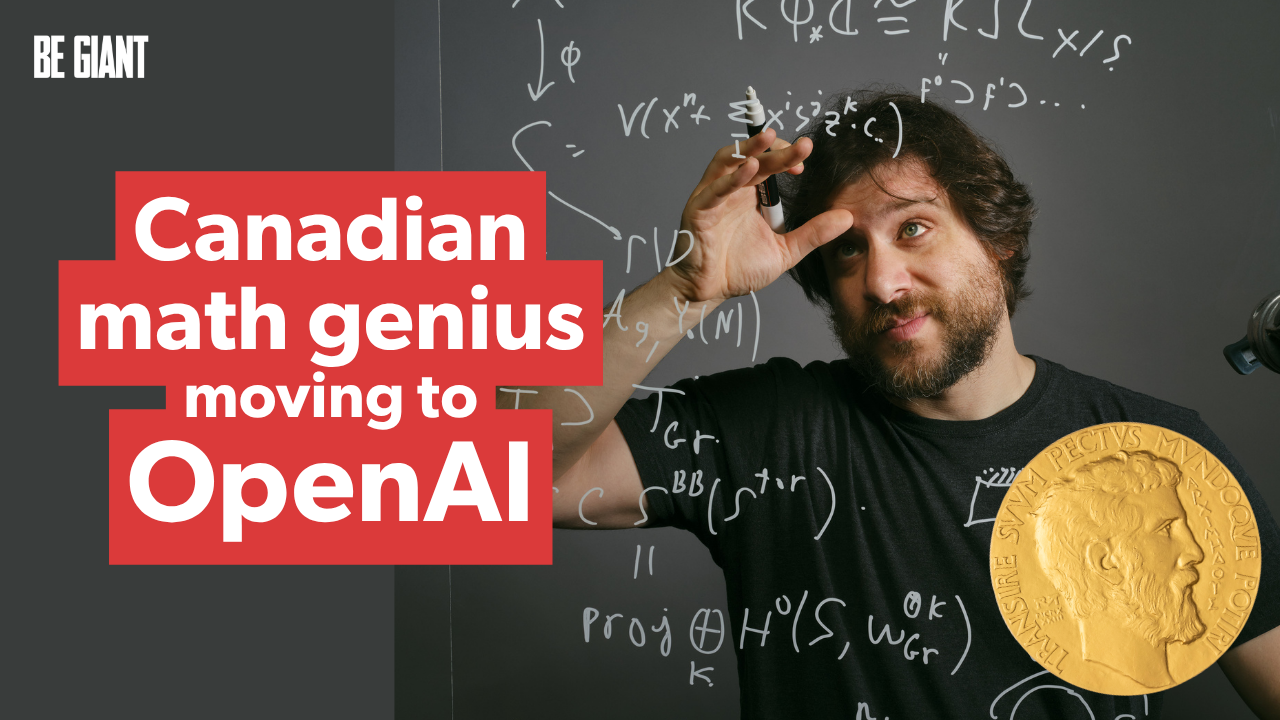
There’s been a lot of attention on a bombshell you dropped after winning the Fields, which was that you’ll be going to work at OpenAI. Why the move?
It has seemed clear to me for a while that AI is going be an extremely transformative technology, even more so than we’ve already seen. And with that comes a lot of new promises and a lot of new risks to engage with.
I don’t say this to fearmonger or give people a sense of fatalism, but it’s the responsible thing for society to put a lot more effort than we have so far into thinking through how AI is going to work. AI safety is basically the name for that, and there are a lot of different parts. There are governance parts to it, social science aspects to it, engineering aspects, economic aspects.
It seemed to me for a while that I was going to pivot into AI safety. A lot of things have changed to make this a particularly good time to do that. One is that it is just easier now to move into software engineering work or coding work, because now you can offload a lot of the barriers to an AI assistant.
I really believe that it’s crucial for us to have a robust and healthy ecosystem that works on AI safety from the technical side at the very least. Companies have AI safety divisions and I think that’s really important. It’s also very important to have third-party companies that monitor AI capabilities and the inherent risks. I think we need a lot more governance, we need more regulation and more government branches dealing with this. I’m already engaged in trying to learn as much as I can about what exists now, how I can fit in. And for the moment I thought OpenAI was a good place for me in particular to go.
What do you in particular as a number theorist and a mathematician bring to the table when it comes to AI safety?
I think mathematicians have a lot to bring to the table. AI right now, with some notable exceptions, is a very empirical subject. We get systems that are powerful through some core ideas, but a lot is through trial and error. And we have very few guarantees about how they work, what they’re going to do, why they do what they do. The systems, as many people have said, are grown much more than they are programmed.
Mathematics is kind of the language by which other subjects acquire their firm foundation. It’s kind of miraculous how quickly you can go from a very idealized mathematical model just proving one thing to very robust applications in the real world with very complicated systems. This has happened with information theory, it’s happened with complexity and computation theory, it’s happened with physics obviously. And it’s happening now slowly, with AI. I think many people have a part to play and mathematicians certainly do as well.
Do you have a specific role at OpenAI or is it open-ended?
There’s so much to do, from evaluating systems to understanding pieces of how they work to whether we can design them to work better. We’ll see what I end up engaging with more.
You co-wrote a paper about omnicidal events, possible futures where AI basically either kills or contributes to the killing of all or most humans. So, fun stuff. Now that’s not something that will happen tomorrow, but what is legitimately worth worrying about? What might be coming our way if we don’t tackle AI safety in a meaningful way?
That paper was written because a lot of prominent AI leaders, such as Geoffrey Hinton and Yoshua Bengio, were saying that AI potentially poses catastrophic risks on par with our most powerful weapon systems and technologies. And people very naturally want to understand, well, how would this work?
Scientists who’ve been studying it for a long time are telling us to take it seriously, but it’s harder to imagine what concretely would happen. And people rightly have some skepticism if they can’t imagine it. So the point of that paper was to write a bunch of different scenarios that say, look, here’s what I think could happen.
When you write about the future, you’re almost always going to be wrong – I don’t have the wisdom, and I don’t know if anyone does, to get things perfectly correct. The point was to write a bunch of stories such that people could find at least one that strikes them as, like, “This actually feels plausible to me. This is something we should pay attention to.” It definitely wasn’t meant to convey that this is certainly going to happen and that it’s unavoidable, go and panic in the streets. Panic is not a useful or appropriate response. But the way we mitigate real threats in our world from coming to pass is by looking at them honestly and soberly and taking steps to make sure they don’t happen. We’re not powerless. We’re still developing this technology. We’re facing many challenges, co-ordination challenges, theoretical challenges, but the idea was to make us see the risks with clearer eyes.
So part of the reason you got into AI safety was the pull factor – it’s important and interesting, and you felt you could lend something to it. But you’ve also described a kind of push factor – you’ve told me you believe AI will probably be able to do the kind of work that you and other mathematicians do better than you can within a few years.
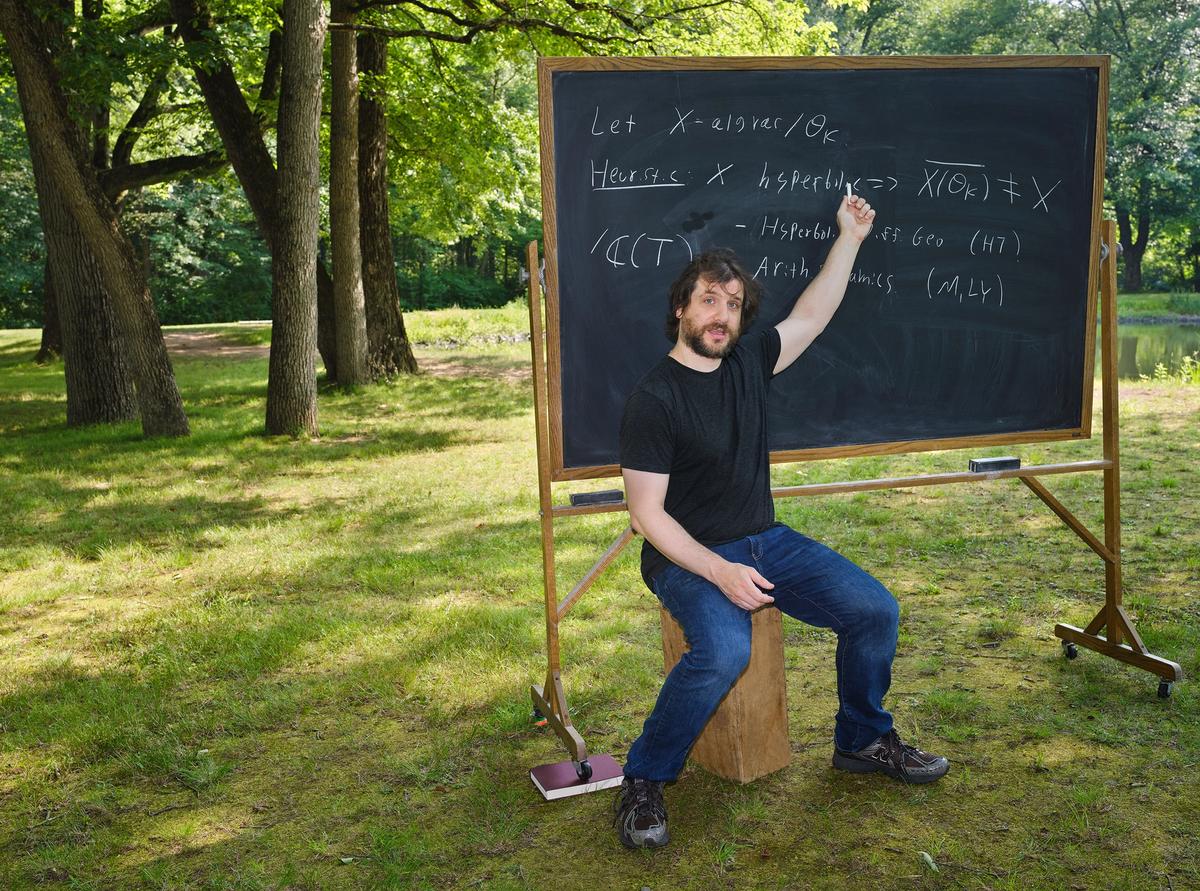
I think this is something that a lot of different professions are going to have to face soon as AI systems become more and more capable. We’re already seeing it. Mathematics, for a number of reasons, is maybe being hit faster. Partly that’s because math is a pure thought activity – mathematicians just need a blackboard and some chalk, they don’t need any sort of labs or tools to interact with. AI has a faster feedback loop. It can learn faster. There’s a number of important conjectures that AI systems have solved by themselves. They’re certainly at least picking off low-hanging fruit at a rate that mathematicians simply can’t [match] because there aren’t enough of us and we don’t think quickly enough.
No one knows the future, but my opinion is that very soon AI will become robustly better at the rest of what we do as well. In terms of what mathematics looks like, that’s an important question, especially for younger people entering the field. Math remains a beautiful and esthetic and elegant and important thing to do. But we have to grapple with the fact that the way humans have made it into a profession is going to have to change.
I’m involved in organizing some workshops to bring people together and take this idea seriously and spitball what the future could look like, how we should pivot. I think we should be having this conversation robustly in departments, in government, and in society.
We’ve talked about young people and the need to develop perseverance when encountering hard problems – to bang your head against the wall and not give up. But now if you’re having a hard time, maybe you just ask AI and it has the answers for you. What do you tell a young person about training their mind in that way, encouraging them to help develop those skills and faculties?
A few things. First of all, I would encourage young people to not be nihilistic about the whole thing, to not stop investing in themselves or learning, pursuing their passions. Because the future is extremely unclear. Anyone who tells you what exactly it’s going to look like in 10 years, I would be skeptical of.
And humans are going to have a part to play in everything. What that part is, I don’t know. So I encourage people to keep abreast of developments and to hedge a little bit more. What I advise against is keeping your head down, hoping that the AI noise dies down, the phase passes, and we can get back to business as usual. Cause I don’t think that’s going to happen.
In terms of asking AI for answers to all the questions, what I would say is [that] the questions that AI has the answers to, I would probably ask. There’s been this sort of false dichotomy created where either you engage with AI for help or you invest in yourself. I think you can do both.
Make sure you do learn some skills. If you have an exam to pass, you won’t have the AI there helping you. A great way to see if you understand something is to measure yourself, whether it’s through exams or tests or whatever. Also, get a feel for what AI can’t currently answer, because there’s a lot it can’t.
What does this next chapter mean for you as an academic, as a professor? Will you still be affiliated with U of T, or does this mean stepping down?
No, I’m definitely affiliated with U of T. I plan to be for a long time. I’m going on leave, but I’m not leaving. I’m still involved in mentoring a number of students and I definitely plan to stay involved with the Department of Mathematics.
Okay, last question. When you win the Fields Medal, you get $15,000. Have you decided what you’re going to do with it?
It’s probably going to be invested in some account for my daughter.
So not a fun answer, but also the best possible answer. Congratulations again on the win, and best of luck with what’s next. The fate of the world might depend on it. No pressure.
Hah! Thanks so much.
Get our weekly newsletter – the people, places, and ideas revealing where Canada is headed.