Drones have already transformed war by delivering long-range destruction at steep discounts to combatants in Ukraine and the Middle East. At a more benign level, they may be starting to transform retail by providing Luckin Coffee lattes through “smart kiosks” in Shenzhen, China, and conveying pastries to backyards in Fayetteville, N.C. So why aren’t drones delivering groceries or T-shirts or prescription medications in Canada?
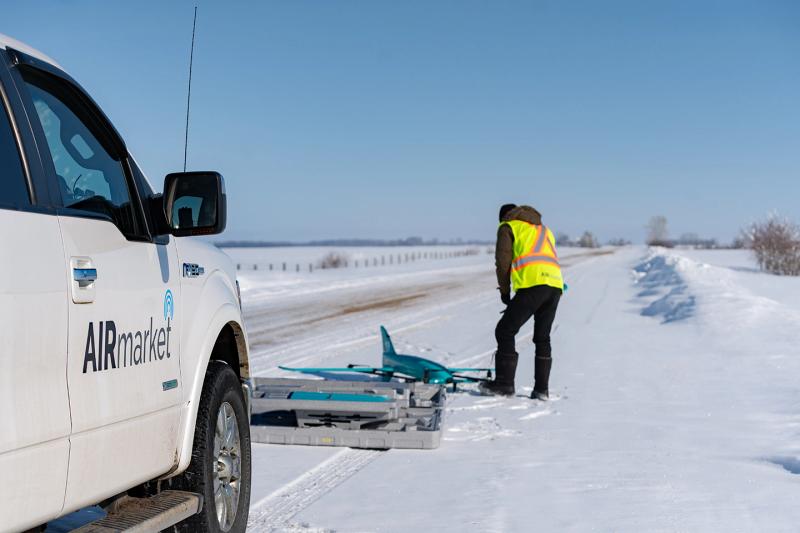
To help answer that question, pilots Justin Cruse and Cale Griffith have come to a field just outside Andrew, Alta., a one-intersection village of 400 an hour northeast of Edmonton, on a cold morning in late March. Cruse works for AIRmarket, a company developing air traffic control systems for drones. He sits in the back seat of a white Ford F-150 with spinning radars and antennae grafted to the roof as he reads through his pre-flight checklist.
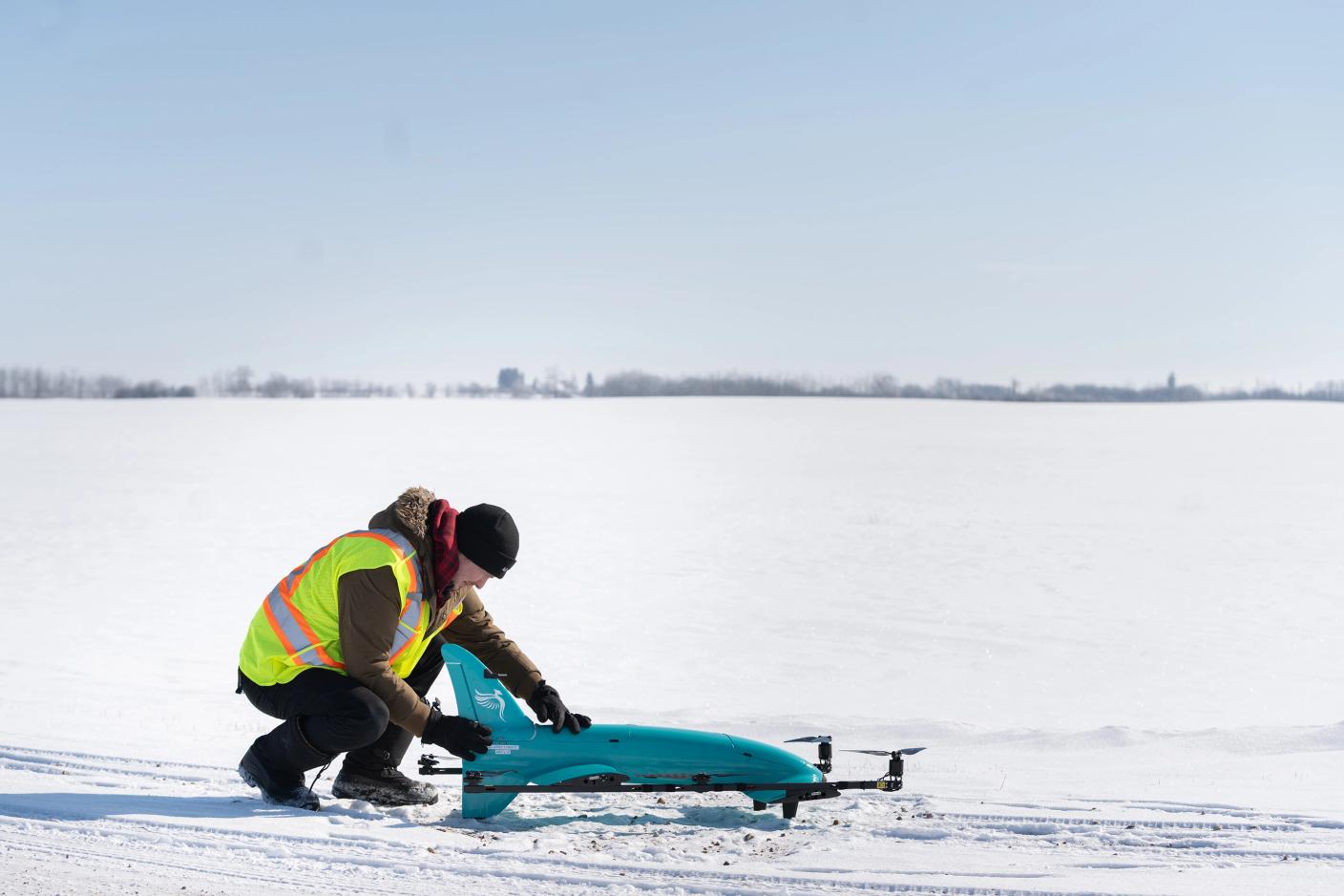
“We have flyway instructions for FLYsafe [the company’s drone management platform]; we have an ambient temp of approximately minus 10,” he says into his headset as Griffith prepares an electric ARACE Phoenix drone outside. “Wind speed, 10 kilometres an hour, south-southeast. GPS status: 28 satellites, no geofences. We’re waiting for Lindsay’s approval.”
Back at AIRmarket’s Edmonton control room, company founder and CEO Lindsay Mohr is on the line, set to provide his pilots turn-by-turn directions as he watches the flight in real time on FLYsafe. He gives Cruse the approval.
Moments later, Cruse wields a hand-held joystick to send the six-motor drone, which sounds like an army of tiny lawnmowers, into the air. It’s a fixed-wing, canard-style aircraft with a 2.3-metre wingspan, and it’s headed to St. Paul, about 90 kilometres to the northeast.
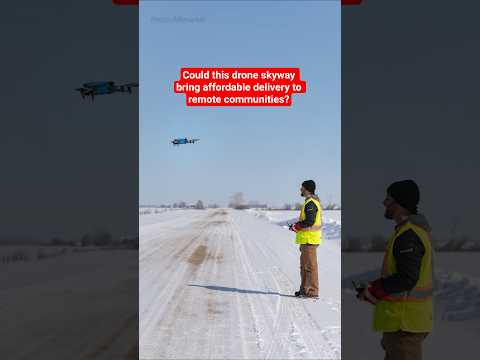
AIRmarket’s flight on this day is the second time the company has tried this route. During an earlier demonstration flight last September using a smaller drone, range was a challenge. Griffith had to land the drone three times to allow an AIRmarket chase crew to swap its batteries to cover the distance. The Phoenix drone flying today has two batteries and much longer range. “We’re going to go all the way to St. Paul and fly about 75 per cent of the way back as well,” says Griffith, “so really stretching its legs.”
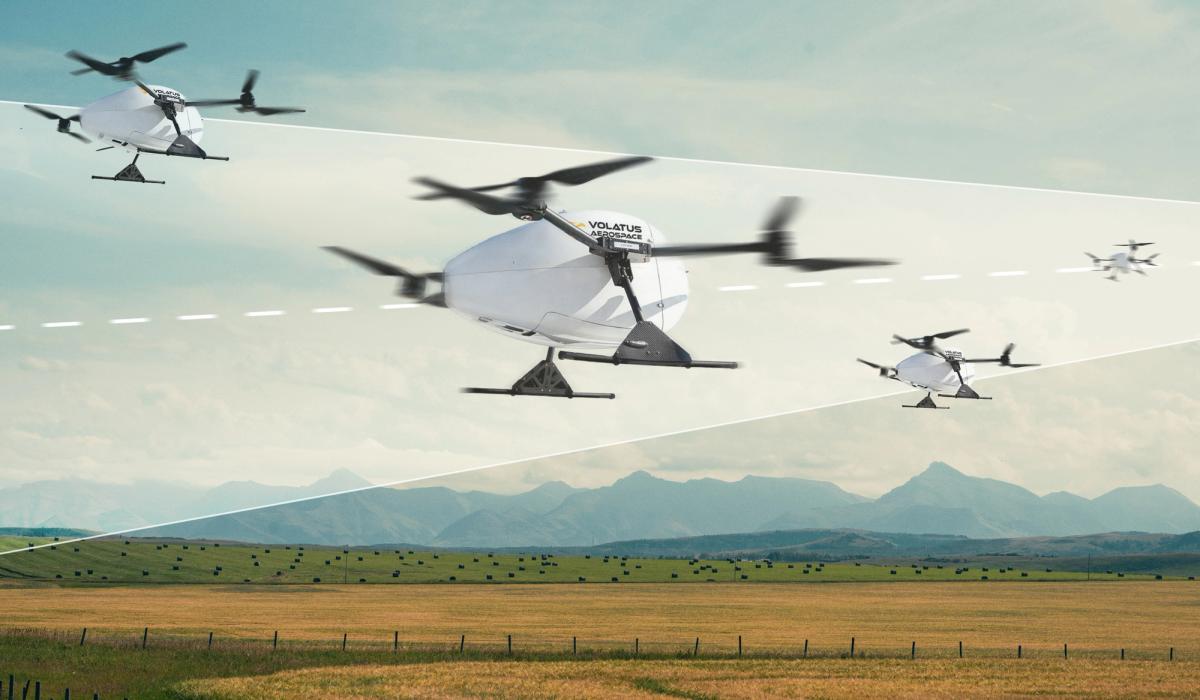
But today’s flight is about more than testing the aircraft. It’s also a demonstration of the Alberta HUB Skyways project, Canada’s most ambitious “drone corridor.” It’s a system of flight pathways spreading across nine communities and two oil-field aerodromes in northern Alberta, with buffers around 20,000 obstructions, mainly houses and farm buildings.
While Canada has dozens of existing drone skyways, each one is restricted, allowing a single provider to use drones to fly medical supplies, confidential documents or blood samples across limited distances. Alberta HUB, a rural economic development organization, created the Alberta HUB Skyways project to establish pathways for commercial drones to fly much more freely across the northern reaches of the province – creating 1,500 kilometres of open routes – and perhaps set a pattern for the rest of the country to follow.
Most Canadians might think of drone delivery as something that will soon deliver their Amazon packages to their front door. The Alberta HUB Skyways project is more practical and more ambitious. “We’re not looking at connecting drones to people’s front lawns,” says Dan Juhlin, the main architect of the project. Instead, he says, the vision is to enable “middle-mile” drones from any company to carry freight from distribution centres to airports or drone pads in the communities linked together. Each of these communities struggles to move things in or out quickly or affordably, from situations involving individuals needing building supplies to industries moving resources to market. “Are these corridors going to live on beer and pizza deliveries?” Juhlin says. “No, it’s more likely going to be lab samples between hospitals, or ‘hot shots’ for the oil fields.”
That’s just phase one. Juhlin has sketched out a second phase, covering the entire Eastern Alberta Trade Corridor, an economic zone the Alberta government has created, from the Montana border all the way to Fort McMurray. “That would enable the use of drones for delivery for that entire region,” he says. “It’s crazy.”
But it’s also entirely doable, Griffith says. Back at the truck, he points out that the Phoenix drone is already capable of moving small payloads across the skyway. AIRmarket’s traffic control system, meanwhile, is capable of ensuring the drone doesn’t collide with other aircraft in or near the skyway, though some broader systems and regulations aren’t harmonized yet. Still, to make today’s three-hour, 180-kilometre flight possible, Griffith and Cruse must chase behind to maintain a visual line of sight to comply with Transport Canada regulations, as well as to maintain a communications link for AIRmarket’s technology, via the truck’s antennae. They’re small hiccups that will eventually be eliminated. “It does prove that drones can actually go out here and start doing work,” Griffith says before he jumps into the truck.
Canada’s emerging drone-based delivery market reached $382 million in 2025. To grow to the $2.21 billion it’s projected to hit by 2031, many more skyways will be necessary.
In the United Kingdom, Project Skyway has established 265 kilometres of routes to create safe pathways for drones to move medical supplies, such as drugs or pathology samples, between hospitals. In January, New York City established a test skyway above the East River to enable cargo drones to fly to and from distribution hubs in Manhattan and Brooklyn to get deliveries off gridlocked streets. In Rwanda, an autonomous drone skyway project that’s been in operation since 2016 has recently been expanded to provide the entire country with medical deliveries.
It helps to think of skyways as roads in the air that avoid putting aircraft above humans or buildings on the ground. This avoidance is important not only for safety but also for public perception. Transport Canada’s 2025 drone strategy points to social acceptance, rather than technology, as the main barrier that’s limiting economic growth for drone deliveries. Even with that barrier, the report suggests drones already outnumber crewed aircraft in the sky, with 53,000 drones and 37,000 aircraft. Most of those are hobby drones, though, and not the freighters many anticipate will take to the skies in the future.
Nicole Meiklejohn, AIRmarket’s vice-president of operations, says skyways essentially create roads to fly within, but basic air traffic control is the other big challenge. “It’s kind of a safe route that they have identified,” she says. “But what our system provides is air traffic control, so it brings in the manned aviation with the drones [and] you get a full, complete picture.”
An air traffic control system for commercial drones is about to go mainstream in Canada. In 2020, NAV Canada, which functions as our eyes and ears trained on the skies, as well as Transport Canada, launched Remotely Piloted Aircraft Systems Traffic Management trials, inviting companies, including AIRmarket, to co-develop an ecosystem where private industry provides commercial drone operators with the same services those federal agencies currently provide to crewed aircraft. In 2025, it beat the United States (by a few months, but still) in launching a regulatory system and requirements for pilots to fly drones beyond their visual line of sight, known as BVLOS – a scenario that demands effective air traffic control.
AIRmarket has been testing its systems since 2020. Each demonstration and test shows another hurdle overcome. “We’re working with [regulators] to say, ‘Here’s the framework that can be actually delivered and used,’” Mohr says. And in 2026, he expects that system to become far more visible and established. “We’ll have multiple agencies flying,” he says. “They’ll be submitting their flight volumes and we’ll be exchanging them between different service suppliers.”
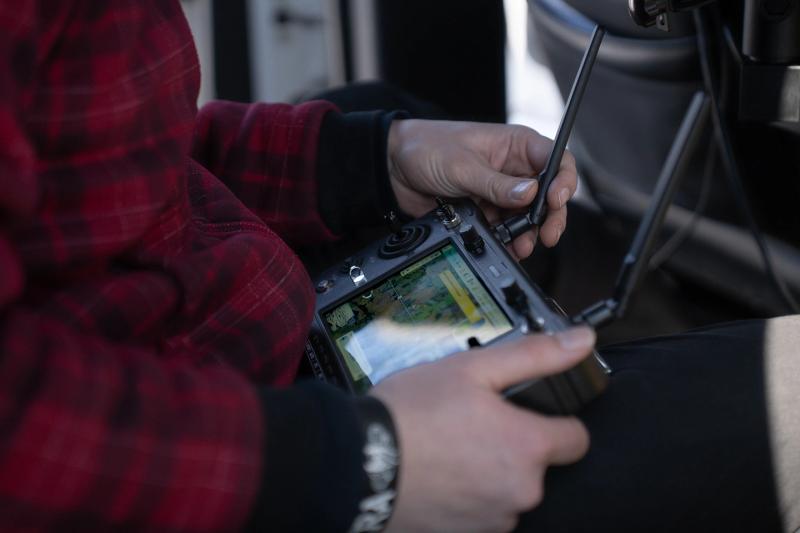
To explain the lingo, Mohr says it helps to imagine any commercial flight you take today: your pilot gets instructions to push back, to taxi, to take off, to land, to cruise. “All of those services basically have to get right-sized for drones,” he says. What might not be obvious is what air traffic control creates when it clears your aircraft to fly. Effectively, it’s a box of air that the aircraft must stay within from takeoff to destination. Air traffic controllers use that box to ensure approved routes never overlap or intersect. Mohr and AIRmarket’s FLYsafe system do the same for commercial drones, creating an entrance point for organizations to fly drones safely and, most crucially, whenever they need to. “We make sure that box [of air] is there, available, ready to go,” he says.
The AIRmarket system will eventually speak to existing commercial air traffic control to automate drone flight approvals, effectively ensuring that no drone flight intersects with any crewed aircraft.
That will be welcome news nearby at Edmonton International Airport. Trevor Caswell, who’s been in charge of drone operations at the airport, says the organization has pioneered the use of drones, first employing a Robird falcon-shaped drone in 2017 to scare birds away from its busy runways. That led to a project with Vaughan, Ont.-based Drone Delivery Canada, launched in 2022, that used a Sparrow cargo drone carrying up to five kilograms of cargo from an airport warehouse to nearby Leduc County. That project was then expanded in 2024 to deliver pharmaceutical products to an Indigenous health facility 10 kilometres away, first flying from the airport to a nearby train line, which provides what amounts to a pre-built skyway, as there are no buildings along it.
Much like the AIRmarket test flight, each flight is observed by people on the ground to add a layer of safety. Caswell shows a video of a drone hovering at 50 feet while a Porter jet flies above at 800 feet. While the moment may seem insignificant, he says flying a drone to and from controlled airspace is table stakes to convince Transport Canada that widespread drone delivery is possible. “That’s never been done,” he says. “The first few times that happened, the pilots were reporting, ‘Drone!’ and air traffic control was like, ‘It’s OK, it’s safe, it’s not going to hit you.’”
To date, the project has flown 3,000 flights and nearly 9,000 kilometres without incident.
The Transport Canada drone strategy points to a cleavage on what Canadians are ready to accept. While our earliest dreams of drone delivery were of coffee orders dropping from the sky onto our front steps, something companies in the United States are still pursuing, many Canadians want drones to first displace our reliance on helicopters and cargo planes to deliver medical supplies, food or other basic essentials.
That meshes with Mohr’s view of the future, at least when it comes to operations within cities. “I just want to puke when I hear people talking about delivery,” he says. “That’s going to be so hard from a technical way, and public acceptance of it.” In the near term, he says, expect to see more drone use for monitoring and surveillance, particularly by first responders. He points to nearby Strathcona County, which this year launched its Drone First Responder pilot program. When someone calls 911, pilots with small drones docked at two fire stations in the municipality can now use the AIRmarket systems to legally fly to inspect what’s happening before sending out their costly trucks and crews. “It’ll zip up and head over there right away,” Mohr says. “And they may decide to only send one truck on that call instead of two.”
He hints this is only the beginning, as municipalities are reaching out regularly. “In five years, Edmonton Fire will be using it, Edmonton Police – like, all the emergency response agencies,” he asserts.
Hyperbole about future potential is standard fare for any new technology. Few things make a more compelling case for Canada than cargo drones serving remote settlements, though.
Hundreds of rural and isolated communities dot our continent-sized landmass, each having limited access to essentials and being reliant on helicopters or planes for delivery. For example, in keeping with Transport Canada’s drone strategy, one skyway test project for Moose Factory in northern Ontario was less about convenience than reducing costs for groceries, given the community was reliant on food delivery by helicopter, costing $1,800 per hour.
That project’s launch followed a tragic 2016 story in northern Ontario. A woman died after the oxygen at a First Nation health clinic about 500 kilometres north of Thunder Bay ran out. Oxygen supplies were just 70 kilometres away but could not be delivered to the fly-in community – there were no roads, and a helicopter crew could not fly at night.
Many realized that a drone could. They included Curve Lake First Nation member Jacob Taylor, who founded a company in Ontario called Indigenous Aerospace with the goal of using drones to assert sovereignty. “It’s really a de-colonial effort where it returns the power into our hands so that we can again assert our own self-determination – determine how it unfolds within our region,” Taylor told CBC. Several other companies, including Sky Canoe in Ontario and both Orijinative Drones and Aboriginal Training Services in Alberta, are working to train Indigenous people to become drone operators or offer drone deliveries to their communities.
These examples play on the mind of Bob Bezpalko. He’s the head of Alberta HUB, the economic development organization that has helped find funding to build the skyway project. Though Bezpalko can talk for hours about the economic potential he sees in drone delivery, from unlocking the region’s resource economy to incentivizing investment, he repeatedly talks of how it’s all for the next generation of residents within the skyway’s rural communities.
The promise of drones filling the skyway may still be in the future, but the opportunity has already created positive change, he says. “Like [the village of] Andrew: they lost their public school, but they got a charter school back, and they incorporated STEM technologies and drones,” Bezpalko says. “There’s a small school in a village that’s part of this drone ecosystem that’s educating kids so they have the same opportunities” as kids in larger cities, he says. “We’re trying to even out the playing field.”