It’s early spring in Ottawa, snow piles are still dwarfing the houses and Shelley Lambert is already lifting a bucket of garden tools out of her just-parked SUV.
When you have a forest to grow, gardening season starts early.
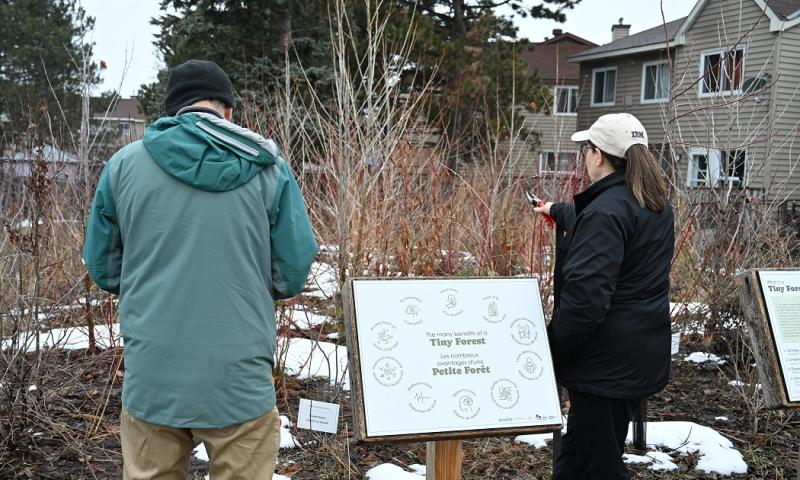
She’s pulled up to a tiny forest behind the Ottawa Community Housing bungalows near Hunt Club Road, southeast of downtown. In a kidney-shaped collection of saplings – hundreds of leafless trees and shrubs crowded into a space about the size of a suburban backyard – she examines four fruit trees at the edges of the thicket. Two years ago, Forêt Capitale Forest, the charitable non-profit organization she helped to found, included apple and pear trees as an “edible fringe” in this planting, but rabbits have taken that literally.
“Good Lord,” Lambert says. “I guess no one put tree guards on these?” She bends to look closer. Teeth marks girdle three of the fruit trees.
“It’s pretty awful rabbit damage,” she continues. “You can get pretty upset. It’s a pretty massive task. We have planted 20,000 trees . . . . On the positive side, we have a lot of rabbit droppings, which is fertilizer.”
Get our weekly newsletter – the people, places, and ideas revealing where Canada is headed.
This little forest in Ottawa is part of a movement sweeping across Canada: dense plantings of trees, shrubs and understory vegetation shoehorned into small spaces in the heart of cities. These pocket forests gain their inspiration from the late Japanese botanist Akira Miyawaki, who has become a kind of guru for the movement. Tiny forests are big news everywhere, from the United Kingdom to the Netherlands, Africa, Asia and across the Americas.
Green Communities Canada, an environmental non-profit based in Peterborough, Ont., and the leading national entity in the movement, estimates there are 90 mini-forests across the country. It has helped to fund half of them over the past three planting seasons, with projects – including the Ottawa sites – from Richmond, B.C., to Moncton, N.B., and plans to bankroll another 15 this year. Green Communities Canada gets most of its funding from corporations, which are the main source of pocket-forest money; governments and charities also contribute.
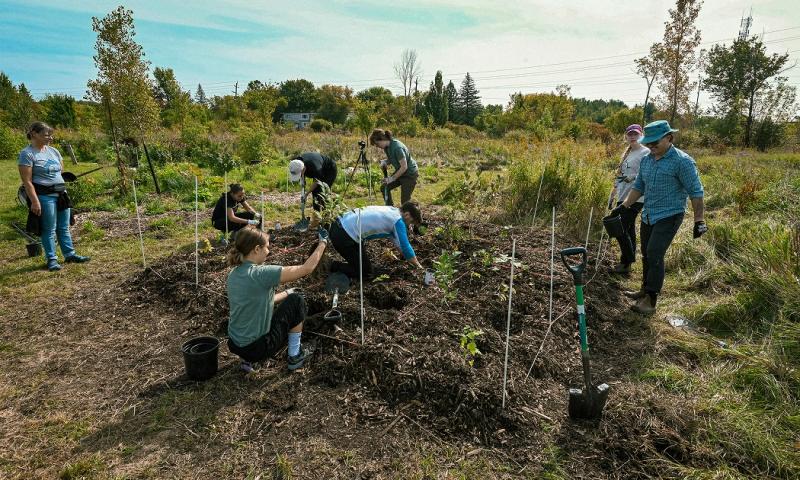
Many mini-forests, like those in Forêt Capitale Forest’s Ottawa Community Housing project, have been planted on public or publicly owned land. The federal government’s 2 Billion Trees Program, whose funding Ottawa has now capped, helped pay for some of them. Cities including Guelph and Toronto have also used public funds to plant pocket forests.
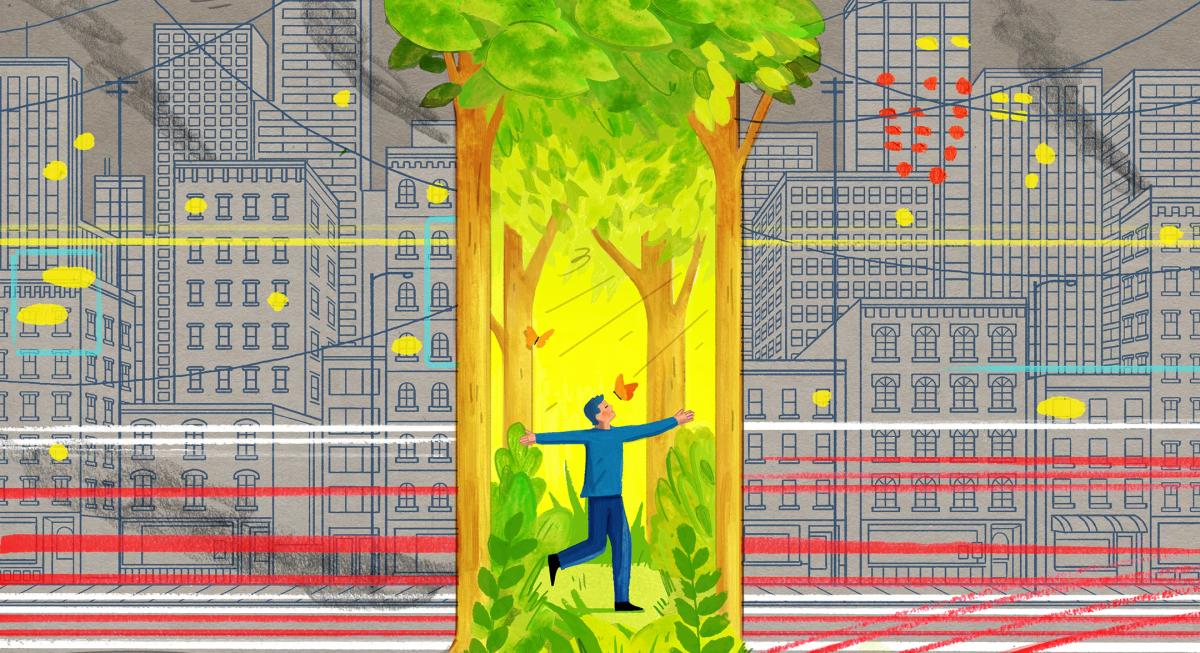
Advocates ascribe some big virtues to them. Miyawaki himself wrote that they “offer us places of relief from life in the urban desert . . . fix carbon at a global scale and help reduce the planet’s warming trend.” Miyawaki forests contain native tree saplings, shrubs and ground cover, planted cheek-by-jowl in soil juiced with organic matter and nutrients and cared for by passionate local volunteers. They soothe eco-anxiety as they flourish, growing up to 10 times faster, boosters say, than standard urban tree planting because the trees’ proximity to one another creates intense competition, which accelerates their growth. The wide mix of species draws bugs and bees, and thus birds. The new forest also pumps out oxygen, provides shade and soaks up rain, keeping it out of sewers.
Despite the spread of the Miyawaki method across Canada, longtime forest researchers note that, because most of this country’s first mini-forests were planted just five years ago, we don’t yet know whether they will succeed. The method, with remediation of urban soil up to one metre deep, copious compost and mulch and up to five times as many plants per plot as in traditional tree planting, can be expensive. Forêt Capitale Forest estimates that planting a mini-forest roughly the size of a tennis court can cost up to $50,000.
And is there an irony that Canada, containing nine per cent of the world’s forests and with nearly 40 per cent of its land mass covered by trees, is going gaga for miniature forests? Each spring and summer, legions of students and young stalwarts brave cold and heat and rain and biblical stinging insects to camp out and plant hundreds of millions of trees, often in remote areas. They’re replacing trees cut by the forest sector, sure, as well as those killed by pests or fire. Veteran forest observers don’t want to sway from that focus. “Planting trees is never necessarily a bad thing,” says Dr. Sandy M. Smith, professor of forestry at the University of Toronto. But of mini-forests she asks, “Is it money well-spent? I would hate to see a lot of money diverted from programs that are tried and true.”
Still, proponents argue that mini-forests provide unique benefits. Trees, they say, are communal life forms; planted tightly, they co-operate as they thrive and beautify our city spaces while they purify our air. The act of building them also generates a sense of community.
Akira Miyawaki, born in 1928, wrote his PhD thesis in plant ecology at the University of Hiroshima after training in Germany, considered the birthplace of forestry science, in the late 1950s. In Japan, he studied ancient remnant forests around Japanese temples that were spared when urbanization spread, to help create exhaustive maps of what he called Japan’s “potential natural vegetation.”
The Healing Power of Forests, the 2006 book he co-authored with Elgene O. Box (and originally published in Miyawaki’s native Japan in the 1970s), scorned conventional city plantings of large, often non-native trees with minimal root systems, spaced apart. “They often die regardless of artificial care,” the book declares. The keys to Miyawaki’s pocket-forest method: find a site, perhaps the size of a tennis court or smaller – a metre is wide enough; select native plant species that grew at that location before settlement; enrich the soil; engage volunteers to plant and tend. In an upending of conventional wisdom that plants need room to grow, he insisted on shoehorning three or more plants per square metre so that so-called virtuous competition for sunlight would hasten upward growth.
The global spread of his forest vision began when Miyawaki, then over 80, travelled to Bangalore, India, in 2009 to plant a mini-forest at a Toyota factory. Shubhendu Sharma, an engineer there, volunteered to help and was hooked. He quit auto-making for forest-making. And in March of 2014 he recorded a TED Talk about pocket forests in Vancouver. “I wanted to make these forests with the same acumen with which we make cars or write software or do any mainstream business,” he said. The talk went viral.
Sharma went on to create the social enterprise Afforestt, which has helped jumpstart a worldwide movement. The company itself has planted more than 200 tiny forests in 50 cities globally. It helped spark enthusiastic uptake in the Netherlands and has even had an impact in the Middle East.
The Miyawaki approach appeals to the analytical brain; mini-forest apostles in Canada are often private-sector engineers who like to solve problems and build things. Enter Sharma and people like Shelley Lambert, a senior principal software engineer. Because she gets up early to write code with Europeans, her afternoons are free for forest work. “It’s a very nice complement to sitting crouched at a keyboard,” she says as she and her husband, John Duimovich, himself a retired software engineer, take me on a tour of eight of their tiny-forest sites in Ottawa.
Lambert started by planting orchards in her Ottawa yard, and then planted one on National Capital Commission land on a stretch of Ottawa’s greenbelt. She and other tree advocates lament the failure of most conventional tree-planting efforts in the city. In 2020 she co-founded Forêt Capitale Forest to plant and then tend urban forests. In the past three years the group has planted 18 mini-forests, with plans for another five or six this year.
Faced with climate change, cities nationwide want more trees. And, at the very least, urban forests are a source of hope.
“People are loving it because it’s grassroots empowerment,” says Marc Hallé, a landscape architect with CCxA in Montreal who collaborated on a tiny forest at Leslie Lookout Park in Toronto, completed in 2024. “People feel helpless in the environmental crisis,” he says. Plant a tiny forest and “you see a whole new host of birds landing in your backyard. You have done your part.”
So mini-forests can help on multiple levels. But would Miyawaki approve of Canadian methods?
Calgary has among the lowest canopy cover of any Canadian city – just under 10 per cent – and faces a perennial flooding threat. To add to its forests, it has embraced the Miyawaki method. But it has also bent his rules.
Northeast Calgary, before settlement, was a grassland, or “foothills fescue.” In 2024, the Genesis Centre, a community facility in that part of the city, planted a tiny forest on its grounds. Miyawaki always said to plant what was there before. Still, the forest can thrive, insists Heather Addy, a retired plant biology professor volunteering with the Calgary Climate Hub. She notes the success of “shelterbelts’’ – rows of trees that prairie farmers have long planted close together, mulching and watering them intensely early on, for windbreak and shelter.
“And that’s essentially what we’re doing with Miyawaki forests,” Addy says.
Toronto’s climate isn’t as restrictive. And, commissioned to put in a new park on the city’s waterfront, Hallé – who had seen Sharma’s Vancouver TED Talk online – embraced the mini-forest method.
To plant a tiny forest at Leslie Lookout Park in Toronto, he teamed up with Heather Schibli, a landscape architect and ecologist who teaches at the University of Guelph. They, too, bent Miyawaki’s rules. They planted trees grown from seeds gathered at Point Pelee, Ont., mainland Canada’s southernmost point, on the logic that the climate is warming.
Schibli planted a mini-forest in her own backyard in Guelph in 2021. Asked on Zoom how it’s doing, she lifts her hands like an animal prepared to pounce and replies, “It was like an angry green blob for a couple of years . . . . It was really hard to get through. Even the dog struggled. Now the canopy is above eye level. I think the tallest tree is probably five metres.”
In her yard and in the Toronto park, Schibli strayed from Miyawaki’s dictum to plant what was there before. “You’re just throwing in a hot mess of species, many of which rarely show up together in the landscape,” she says, noting that adding a lot of nutrients is key. “There is a die-off that happens, and the actual plant community emerges from it. From what I have been told, that usually emerges around the 10-year mark.”
That strategy strikes some as a waste of resources. Dr. Danijela Puric-Mladenovic, also a professor of forestry at the University of Toronto, doubts, for instance, that forests will thrive on grassland in Calgary. “It’s very appealing, feel-good,” she says, “[But] I would say it’s not a silver bullet.” In areas near existing forests, it would be better to just fence off the space and let tree seeds blow in and take root. “If you just let succession do its job, you get a mini-forest for zero dollars.”
At the same time, tiny forests require a fiercely devoted cadre of volunteers. “The first three years of that forest’s life, it’s a little baby,” says Jared Blustein, director of the Calgary Climate Hub, which spearheaded the Genesis Centre’s tiny forest. “You need to be out there weeding and mulching at the right times, on top of watering.” Lambert, meanwhile, says her group has identified 500 volunteers to tend the forests it has planted in Ottawa.
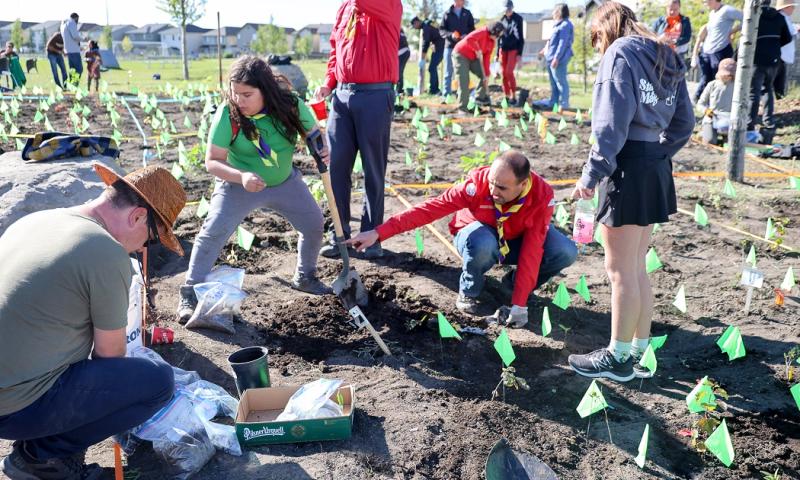
That reflects Miyawaki’s view of tree planting as a “communal activity.” Certainly, citizen involvement is a key piece of the Darlington Ecological Corridor project in Montreal, which seeks to link forested Mount Royal along a rail corridor to a rewilding site at a former racetrack further west. In 2023, along the corridor route in Mahatma Gandhi Park, 50 volunteers planted a micro-forest with 628 native species, three plants per square metre, in two hours. Joseph Chamoun, the co-ordinator, said they returned two years later and inventoried 425 trees – a survival rate he calls stellar – and also met a new arrival: cottontail rabbits. In his neighbourhood, Côte des Neiges, residents speak 100 languages, yet they have bonded over the mini-forest. “We speak the universal language of nature and gardening,” he says.