
Dive into the typical treatise on Canadian labour productivity and the picture that emerges is of a maple leaf-painted tortoise being outpaced by a star-spangled hare. The trope that Canada’s businesses can’t keep up with their American counterparts has been part of the national consciousness – and a source of collective self-doubt – for decades.
Bank of Canada officials have repeatedly flagged the productivity problem, using such phrases as “dead money,” “emergency” and “Achilles heel.” Former U.S. treasury secretary Robert Rubin questioned then–prime minister Stephen Harper about it back in 2013. More recently, Prime Minister Mark Carney has blamed “long-standing weak productivity” for making life less affordable, straining the government’s finances and putting social programs at risk. (His government’s new “Productivity Mega Deduction” is designed to spur investment and help solve the problem.)
The bad news is that the headlines are mostly accurate. Canada’s workforce is less productive than America’s. In 2023, for example, a Canadian worker produced the equivalent of about US$75 in goods and services per hour compared to US$97 in the United States, according to the Organisation for Economic Co-operation and Development (OECD).
More importantly, productivity growth, which captures improvements caused by innovation, new equipment or better-skilled workers, has trailed the U.S. since the mid-1980s – and the gap has been widening. Since 2001, American productivity has grown more than three times faster than that of Canada. And while we’ve done better than some European countries, we’ve still lagged the OECD average.
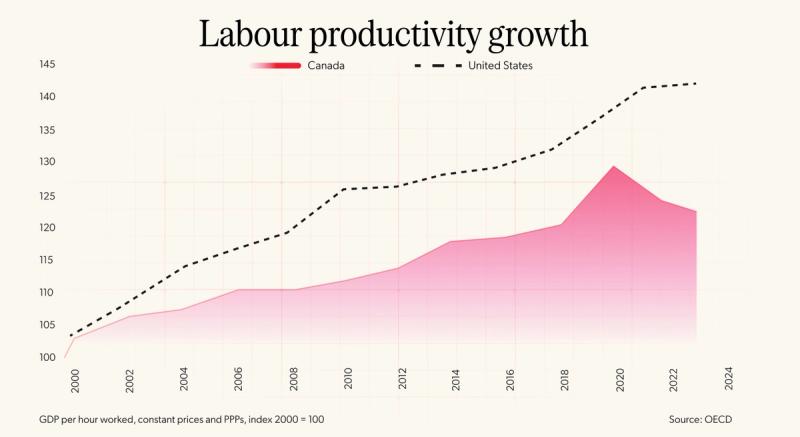
But within those figures are important nuances and room for interpretation – or even outright contradiction.
“I get so frustrated when I hear this constant reporting that Canada has bad productivity,” says Linda Hasenfratz, the executive chair of Linamar, a diversified manufacturing company based in Guelph, Ont. “It’s been circulated so much without nearly enough breakdown and analysis of the data to really understand what’s going on.”
Hasenfratz knows a thing or two about cross-border comparisons. She previously sat on the Prime Minister’s Council on Canada-U.S. Relations and also served as chief executive of the multinational company founded by her father, Frank Hasenfratz. (Linamar is a portmanteau of the names of Frank’s daughters, Linda and Nancy, and his wife, Margaret). Over a 45-minute interview, she bombards me with charts to make her point.
Perceptions about Canadian productivity are skewed by the non-business sector, she begins. Organizations that aren’t focused on maximizing profit, such as government entities, charities and non-governmental organizations, are – not surprisingly – much less productive than those that are, which drags the overall numbers down.
Statistics Canada data bears that out. The average Canadian business-sector worker produced $59.20 worth of goods in 2024, compared with $48.60 in 2000, adjusted to 2017 price parity, a clear improvement. Meanwhile, the non-business sector was largely flat, with the value of goods produced rising to just $53.40 from $50.20 over the same period.
Get our weekly newsletter – the people, places, and ideas revealing where Canada is headed.
It’s notoriously difficult to measure the value of work done by the non-business sector, explains Wulong Gu, a senior adviser of economic analysis at Statistics Canada. A tonne of copper or a car bumper gets sold for a certain price, but how do you tally the value of a teacher’s math lesson – or a statistic gathered by the government?
That’s why any “meaningful” discussion about Canada’s productivity growth tends to strip out the non-business sector, says Gu. But even doing that doesn’t negate the fact that while business productivity growth has been broadly on an upward trend this century, the gap with the U.S. has still been widening.
Economists tend to cite two main reasons for this: lack of scale and poor capital investment relative to the United States. Canada has more small and medium-sized businesses, which tend to be less efficient than the larger ones south of the border, and we invest less in technology and innovation.
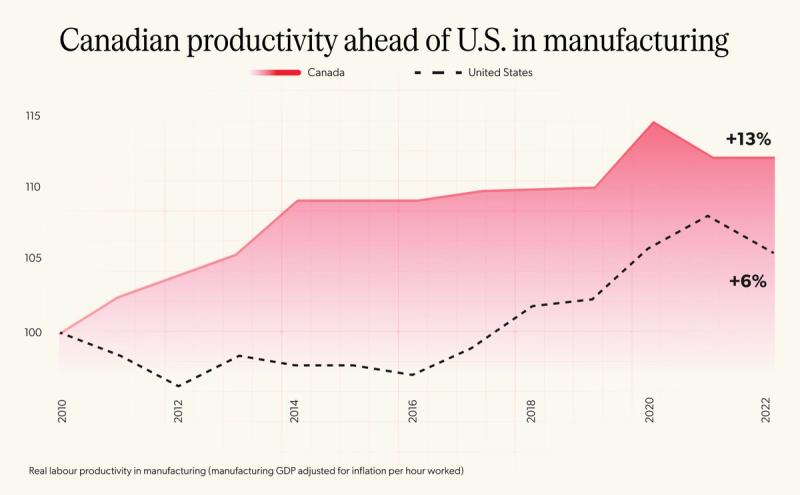
But Hasenfratz says those generalizations don’t tell the whole story, either. Dial down into the manufacturing sector, for example, and Canada is actually doing better than the U.S. in growing productivity, largely because of its strong investment practices, she insists.
“Our Canadian facilities have the best productivity record, in terms of continuous improvement and finding new opportunities and implementing them, of any of our plants in the world,” she says. “We also have an exceptionally strong workforce in Canada with very low levels of absenteeism, low levels of turnover and a very strong work ethic.”
Public data isn’t available to compare similar-sized manufacturing companies on either side of the border, and sectoral statistics sometimes break down because of different ways of measuring inputs and outputs.
Be Giant asked Gu to dig into Hasenfratz’s assertion that Canada’s growth in manufacturing productivity has actually exceeded that of the U.S. in recent years. Using data from the OECD database for comparable estimates, Gu compared the two countries from 2010 to 2023 and found that manufacturing productivity – measured as real value added per worker – did indeed grow an average of 0.5 per cent a year in Canada, compared to just 0.34 per cent in the States. “Based on these figures, one could conclude that labour productivity growth in the manufacturing sector was slightly higher in Canada than in the U.S. during this period,” confirms Gu.
This chart, supplied by Hasenfratz, expresses that a little differently but is supported by the data, Gu also confirms.
It’s also worth noting that Canada’s business productivity tends to be patchy, with a few sectors weighing more heavily on growth.
“One of the largest contributors to Canada’s weaker overall productivity performance has been the telecommunications industry,” Gu says in a follow-up email. “Limited competition within the industry has significantly constrained productivity growth.” That affects not only the sector itself but also other industries that rely on it, Gu says, and it’s doubly concerning considering the telecom sector would normally be expected to boost Canada’s performance, given that industries with greater use of information and communications technology tend to have better productivity growth.
Finally, there’s the question of why productivity matters. If the primary reason for wanting companies to be more productive is to create a robust economy that lifts wages and improves the lives of a country’s citizens, there’s actually more good news for Canada.
Avery Shenfeld, the chief economist at CIBC Capital Markets, recently published a paper on this subject after questioning an onslaught of negative headlines about Canada. “I kept seeing articles that said things like, ‘Ontario is now poorer than Mississippi.’ It didn’t seem plausible that we were really that poor – that we were poorer than any U.S. state,” he told me over the phone in August.
Again, statistics don’t tell the whole story. While Canada lags behind the U.S. in productivity gains in absolute terms, Canadians reap the benefits of productivity growth more than our American counterparts do, argues Shenfeld. That’s because Canada does a much better job of distributing income from what it produces across society, whereas in the U.S., a bigger share of the spoils is captured by the top 10 per cent or 20 per cent of households. In fact, “the median weekly earner, or median household, was actually gaining on Americans from 2000 to 2014.”
Some of that has to do with local affordability of things like apartments or university educations, but it’s also because some of the raw materials we produced – notably, oil and gas – tended to hold their value better over time than some of the high-tech products sold in the U.S., such as computers and mobile phones, which get cheaper every year.
John Baldwin spent 25 years studying the Canada-U.S. productivity gap as the director of economic analysis at Statistics Canada, until his retirement a decade ago. Work that he and a colleague did on gross domestic income, or GDI, backs up Shenfeld’s research.
Where real gross domestic product (GDP) measures the value of what a worker produces in an hour, and is the standard way of gauging productivity, real GDI looks at the purchasing power of the income generated by that production and better reflects our standard of living. There were even periods when the growth of Canadian real GDI per capita outpaced American real GDI.
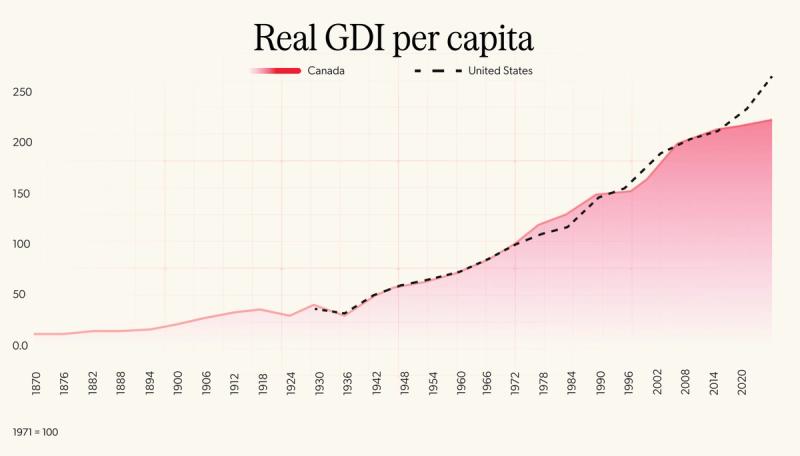
However, since 2015, disruptions to global commodity prices have muddied the picture – Shenfeld also notes that we’ve slipped in the past decade relative to the U.S. – but the rule still holds: if Canada can produce and export things that increase in value relative to those we import, we end up better off.
Spurred by our deteriorating trade relationship with the United States, the federal government is investing in new sectors, from critical minerals to quantum computing, to overhaul the economy. As long as the support goes to innovative knowledge-based industries, this should help productivity over time, says Shenfeld. Large homegrown capital-intensive champions could create highly paid positions for many workers, especially if such companies can resist the temptation to sell out to U.S. multinationals.
Bottom line? Canada has well-documented challenges, but the current trade shock is an opportunity to sharpen our productivity focus and build upon our less-talked-about strengths. Manufacturers have been growing productivity at a better clip than most people realize. Workers are educated and skilled. And Canada does a better job spreading the economic benefits of what we make across the population.
Things aren’t great right now, Shenfeld says, but “they’re not as bad as you’ve been led to believe.”



![“I get an inbound [email] every day asking can you get me into this meeting or that, and I’m just a small fry,” Frank McKenna says of the summit.](https://cdn.sanity.io/images/l3tzmu37/production/7faa2d5cc965d0933bd7c5a13e6fc6096ebca145-2880x1918.jpg?auto=format&fit=max&q=75&w=600)