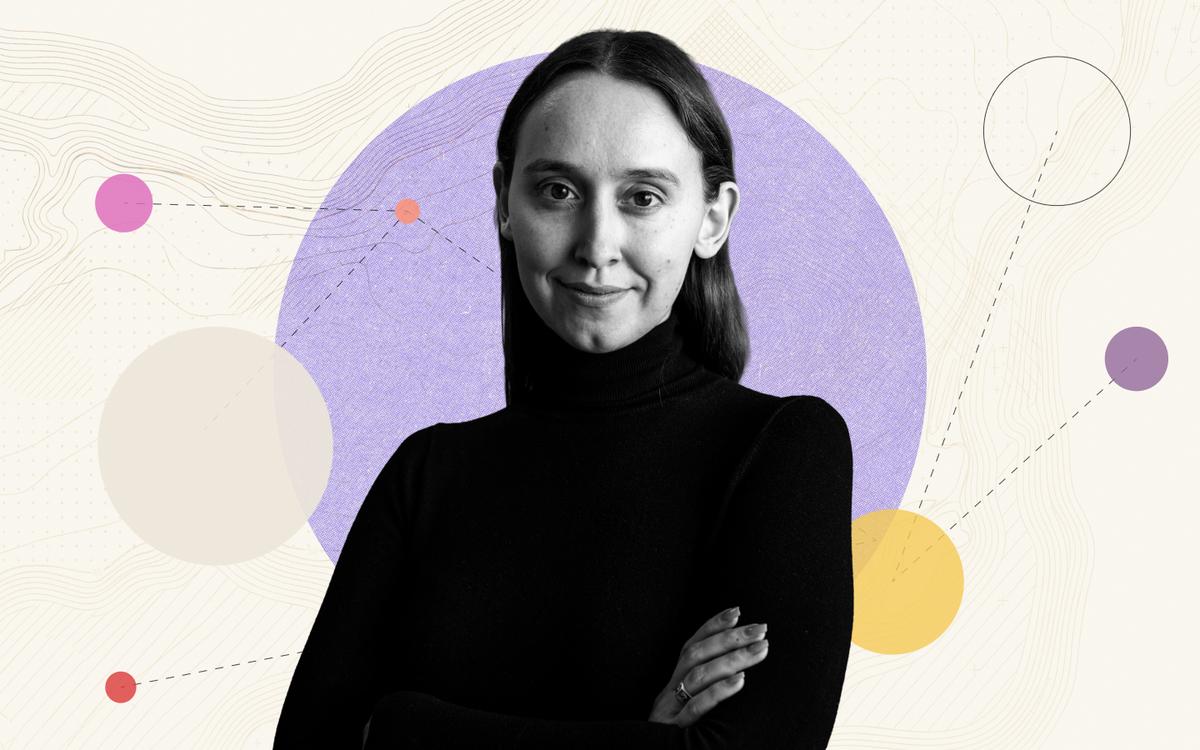
By the time Chicago-born Sabrina Gonzalez Pasterski had celebrated her sweet 16, she had already built an airplane, learned to fly it and received an open-ended job offer from Jeff Bezos to one day work at Blue Origin. In her early 20s, she was called “the next Einstein”; by then, she had traded aerospace for theoretical physics. Her discovery, along with several colleagues, of the “spin memory effect” was cited by Stephen Hawking before she had even completed her doctorate at Harvard University. And now, at 33, Gonzalez Pasterski heads up the Celestial Holography Initiative at the not-for-profit Perimeter Institute in Waterloo, Ont., where she is working to encode the physical universe as a hologram.
She knows almost as much about pop culture as she does about quantum gravity: she got a crash course in celebrity when she attended the Met Gala in May 2026 as a guest of Anthony Pratt, a billionaire recycled cardboard tycoon with a love of physics. Naturally, she made her dress with a 3D printer for the Vogue-hosted affair.
Here, in her own words, Gonzalez Pasterski reflects on early career expectations, how her parents supported her dreams and why she now calls Canada home.
Get our weekly newsletter – the people, places, and ideas revealing where Canada is headed.
Learning to fly
When I was very little, I wanted to be a singer or entertainer, like a Spice Girl. Harry Potter was also really big at the time, and I asked my parents for a flying broomstick. My dad helped me channel that interest into flight lessons.
My parents put a lot of resources toward interpreting magical things in realistic ways. We had a spare bedroom that was literally painted chroma key blue and had little pulleys from the ceiling to suspend you so you could blue-screen yourself into a scene where you were flying or levitating.
My parents both worked as lawyers and they just put everything they had into my interests. I was an only child and was spoiled in very specific ways. My dad sold his car to afford the aircraft kit for me to build my plane. I’m very grateful.
Border crossing
Canada's been part of my story since I was a kid. In my early teens I would go to Sarnia, Ont., for flight training because you can fly solo at 14 as a student pilot in Canada. So that was where I spent a lot of my youth – and did my first-ever solo flight.
After completing my schooling in the U.S., I worked as a research associate at Princeton. Then I moved to Waterloo in 2022 to work at Perimeter. Right away I noticed an anti-elitism culture in Canada. That was a good kind of culture shock. When I was in the States, it was all about, “Where did you go to school? Harvard? MIT? Stanford?” There's all this caring about going to a particular institution.
A lot of the U.S. tech scene runs on prestige and positioning – the right name, the right funding cycle, the right optics – and it can pull your attention off the actual science. Canada feels less encumbered by that. There's a genuine appetite to build, plus a lot of strong schools, and less baggage about how things “have to” be done.
The upside of audacity
I did more networking as a kid than I ever have as an adult. I would go to air shows and introduce myself to people from the Federal Aviation Administration. I wanted to meet people who took engineering seriously and could tell me things that books couldn't. I think I developed an interesting skill set coming from that – if you want to get to somebody, you can find a way. Those connections have long tails, too – just last week, the aviator Jamail Larkins wrote to me for the first time in two decades. He was the one who inspired me to go to Canada, because he also did his first solo flight there at 14.
Leaving Bezos on read
The signed offer letter from Jeff Bezos was waiting for me when I got home from Sarnia on my 14th birthday – the same day I soloed my Cessna 150. I was serious about wanting a career in aerospace at that time, but I don’t have any regrets about not responding. That offer's technically still pending. It’s an open door that I've never felt the need to close, and I love the path I actually took.
Taming gravity
Perimeter is unique as an institute dedicated purely to theoretical physics – it exists to let people think about hard questions without much noise. There’s also more opportunity to shape the research enterprise than you'd have at a large university.
I'm working on two things here. The first is celestial holography. Picture yourself at the centre of a giant sphere: everything in the universe casts a pattern onto the inside of it. Celestial holography says you don't have to watch the whole 3D universe play out – you can read it all off that flat 2D pattern on the boundary. That matters because our two best theories, gravity and quantum mechanics, don't get along, and gravity is the one that keeps breaking. Celestial holography is one of the only approaches that seems to tame it – by swapping the messy 3D problem for a cleaner picture with no gravity at all. Making that work for the real universe, not just simplified models, is a genuine shot at quantum gravity.
The second is Project Theoria. I'm building tools – WiPhy, PaperView, TheoryBench – to get AI and theoretical physics actually working together, rather than letting AI labs assume they can solve physics without physicists in the room. The collision of AI and physics is the most exciting thing happening right now.
The joy of hobbies
My hobby is having new hobbies. I don’t do them to quiet my mind, but to direct the noise. I like little short-scoped hobbies, when it’s easy to be impressed with yourself because you're a beginner.
The Met Gala dress is an example. I wanted to wear physics, to turn the ideas I work on into something you can see. I used Gemini to design the 3D parts based on a Hopf fibration, a mathematical structure that maps a sphere into a pattern of linked loops. Then I printed them with the 3D printer in my office. And I learned how to sew a bit to create the outfit’s tulle overskirt.
Up next: I’m buying a humanoid robot from China. The Unitree R1 is the cheapest off-the-shelf one you can get. I'm going to try to make it look a little bit less Terminator style and more cutesy.
Big shoes
I was first called “the next Einstein” when I was building my plane. It started when the now-defunct Ozy Media ran a story – a teenager doing serious physics is an easy headline. I never asked for the label and I've always been rather wary of it. Of course I wanted to be amazing, but it was a lot of hype and I felt like, “How do I live up to this?”
Recently the label has come up again following a couple of high-profile livecast debates I did on AGI (artificial general intelligence) – one with Sir Roger Penrose in September 2025 and another with Google co-founder Sergey Brin in January 2026. This time, I felt more like, “How can I use this to help Perimeter?” I’m treating the spotlight as a resource, not a trophy. Concretely, that’s getting more attention and funding for Project Theoria.
I also hope that I can show more young people, especially ones who don't see themselves in physics, that the door is open.