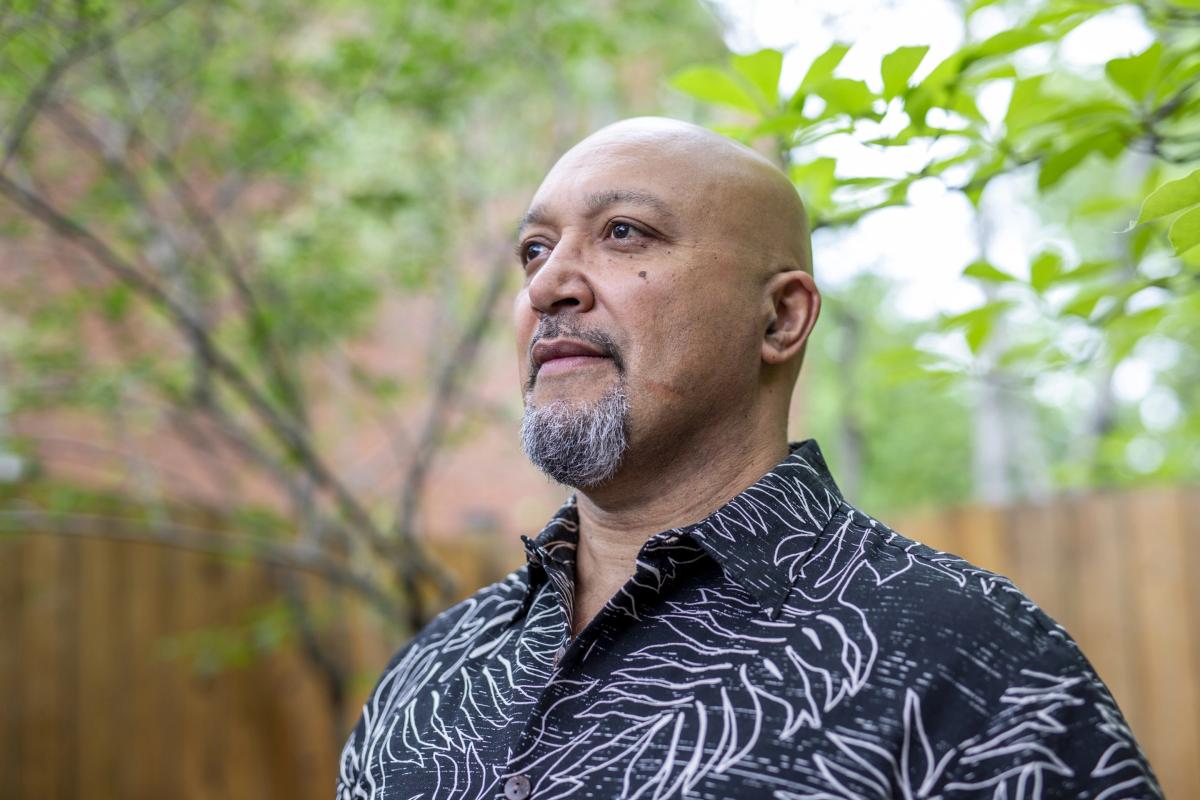
Jason Edward Lewis slides his glasses up and rubs his eyes. He’s tired. Or maybe just tired of the mainstream discourse about artificial intelligence. “So much of the AI conversation is a bad conversation,” says the digital media theorist. Behind him in the video chat, tropical greenery whips around in the winds of a blurred-out paradise. It’s the end of winter on the North Shore of Oʻahu, Hawaiʻi, and Lewis, who is Samoan and part of the Kānaka Maoli diaspora from Hawai‘i, is battened down on a few months‘ sabbatical.
Lewis is a professor of computation arts at Montreal’s Concordia University. Occasionally, he’ll make the trip to visit colleagues at the University of Hawai‘i at West O‘ahu’s Create(x) Immersive Media and Data Visualization Lab. But mostly, the hideaway is a chance to recalibrate from his hectic urban routine. “I have a limited timer for living in the big city,” says Lewis, who grew up a self-proclaimed “redneck mountain kid” a couple of hours outside Sacramento, Calif.
However, at the moment, his life back in Montreal is calling. Lewis is on the last push of an omnibus midterm report for Abundant Intelligences, the six-year research initiative he co-directs that brings together researchers, scientists, artists and Indigenous Language Keepers to explore how Indigenous ideas of intelligence could shape the future of AI. Headquartered in Montreal, Abundant Intelligences has a network of Indigenous community-engaged research pods that spans Canada, the U.S. and the Pacific Islands.
Get our weekly newsletter – the people, places, and ideas revealing where Canada is headed.
Lewis believes that the AI systems being built today reflect a very narrow idea of intelligence – individual, rational and goal-oriented – and that those assumptions are becoming embedded in the infrastructure shaping our future, one that ignores the other kinds of intelligence that actually hold communities together. He isn’t advocating for the abandonment of AI, noting that asking people to stop using tools like ChatGPT is akin to asking people to do without electricity. “The question is, what kind of intelligences are we going to articulate and optimize for?” he asks.
Abundant Intelligences is a response to that question. The project is backed by $23 million from the New Frontiers in Research Fund, plus additional funding from two other Canadian federal funding bodies, the Social Sciences and Humanities Research Council and the Canada Foundation for Innovation – as well as the MacArthur Foundation and the 11th Hour Project in the U.S.
Lewis knows Abundant Intelligences is ambitious; six years isn’t enough time to rewrite AI’s trajectory. But with the brilliant minds and diverse vantage points it has brought together, he’s hopeful the initiative will nudge our approach to AI in a more inclusive direction.
The Aboriginal Territories in Cyberspace (AbTeC) Lab at Concordia is quiet. Much of the space, which also houses the Abundant Intelligences headquarters, is painted purple, a colour used by the Haudenosaunee Confederacy to represent civic affairs and political matters.
On the walls are stills from TimeTraveller, a futuristic nine-episode cyberpunk series by Skawennati, an urban Kanien’kehá:ka (Mohawk) multimedia artist. Shot in virtual world Second Life, the series is described on Skawennati’s website as “about a Mohawk man’s journey to find his way in an overcrowded, hyperconsumerist, technologized world.” Other signage in the lab promises the future is Indigenous in the languages of the different pods. Through the windows, a few blocks away, Mount Royal shoves the skyscrapers apart.
Skawennati is the reason Lewis ended up in Montreal. He started his education at California’s Stanford University at 17, studying German philosophy and symbolic systems, then he pursued a new degree that combined computer science with philosophy, linguistics and psychology to examine how humans process information. It was the 1980s and everything was happening around him all at once – Macintosh computers, the desktop revolution, AI breakthroughs, the internet. “A lot of my mentors had turned their ’60s countercultural impulses toward computers,” he says, “machines for liberating the imagination.”

At the same time, there was a resistance to this rapidly organizing narrative about technology’s role in our lives. Lewis’s undergraduate supervisor, Terry Winograd, a pioneer in human-computer interaction, expressed disillusionment with the narrow definition of intelligence that technology was focusing on. It fuelled Lewis’s already skeptical nature. It was during this time that Lewis also started to explore his Indigeneity more deeply. He got involved in Indigenous politics at the university, co-chairing the Stanford American Indian Organization, a group devoted to cultural exchange and activism.
In 1999, Lewis went to an event at Alberta’s Banff Centre for the Arts and Creativity, where he met members of the early Indigenous digital scene, including Skawennati, who was living in Montreal. Lewis was smitten. In 2001, he says he made an irrational decision: “You move to Montreal with this woman. You don’t have a job and are in a place where the economy sucks, there’s no money and no technology scene.” He began teaching at Concordia and, in 2005, Skawennati and Lewis launched AbTeC to support Indigenous inclusion in digital media and virtual spaces.
In 2017, a team of Google researchers released “Attention Is All You Need,” the pivotal machine-learning paper that introduced the concept of the transformer, the “T” in ChatGPT and the dominant architecture for much of the AI we use today. It was as if the elastic between Lewis’s early research on symbolic systems – stretched further and further as his curiosity moved toward digital design and Indigeneity – had finally snapped back, catching him directly in the forehead.
He realized it was time to start thinking about our relationship with machines. Suzanne Kite, an Oglála Lakȟóta artist (who now leads the Wíhaŋble S’a Center at Bard College in New York, one of the research pods for Abundant Intelligences), had come to Concordia University as a PhD student to work with Lewis on how to create digital instruments that reflected Lakȟóta values and knowledge. The idea of kinship came up.
Lewis says Indigenous cultures have different ways of acknowledging the relationship between humans and non-human entities. Alongside Kite, Archer Pechawis, a Cree multimedia artist (and co-lead of Abundant Intelligences’ T’Karonto pod at OCAD University and York University in Toronto), and Noelani Arista, an ‘Ōiwi (Hawaiian)-born professor and director of the Indigenous studies program at McGill University in Montreal, Lewis wrote the essay “Making Kin With the Machines” to explore why Indigenous perspectives might lead the way to better AIs for humans.
The paper, published in 2018, asks a provocative question: what if we stopped thinking of AI purely as a tool? What if future relationships with machines required something closer to responsibility and reciprocity? It proposes an extended “circle of relationships,” including everything from network demons to robot dogs to AI. “Ultimately, our goal is that we, as a species, figure out how to treat these new non-human kin respectfully and reciprocally – and not as mere tools or worse, slaves to their creators,” write the authors.
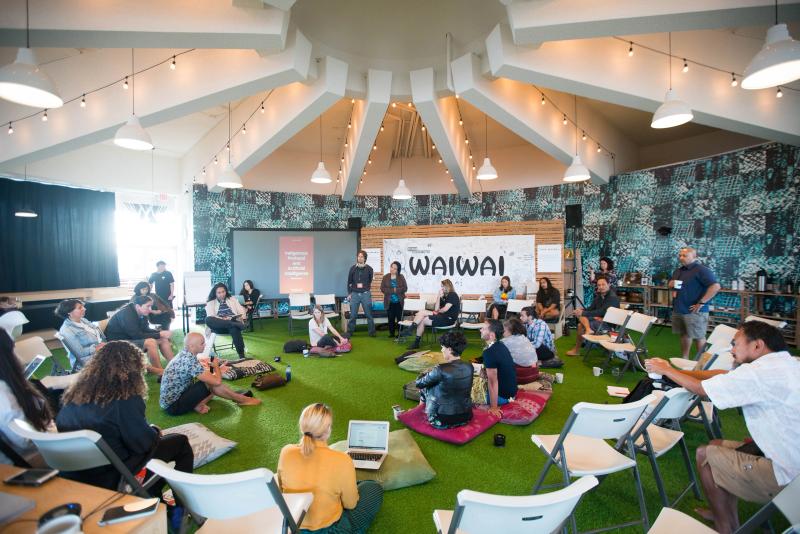
That paper triggered the Indigenous Protocol and Artificial Intelligence Working Group in Hawai‘i, a meeting of 35 researchers and artists from across the globe, many of whom would join Abundant Intelligences in 2023. Out of that workshop came a 200-page position paper that helped ground the concept in concrete guidelines, including designing AI in partnership with specific communities rather than assumed universal values, treating AI as an entity to which developers have obligations, ensuring that Indigenous communities maintain full control over their own data and extending ethical scrutiny across the entire development process – from how hardware materials are extracted from the Earth to how they eventually return to it.
Hēmi Whaanga, co-director of Abundant Intelligences and co-investigator at the Hiringa te Mahara pod in Aotearoa (New Zealand), was at that meeting. A prominent researcher in the ethics and practice of digitizing the Māori language and knowledge, Whaanga helped Lewis corral the ideas from the workshop into the paper and lay the groundwork for Abundant Intelligences. They both decided it would be critical to form pods within the Indigenous communities, combining both local researchers and Knowledge Keepers.
Being informed by community is critical, says Whaanga, and from that, responding as a collective to the needs and aspirations of communities in a world that’s changing very quickly. “We have second, third, fourth generations of our children being very disconnected from their home,” he says. To him, that’s the philosophy behind the pods and the wider work being done through Abundant Intelligences – creating opportunities for generations of Indigenous Peoples historically, structurally and systemically excluded from participating in the design of the system. “If you can’t see yourself in there,” says Whaanga, “then it’s very difficult to envision a future in which you are part of it.”
When I connect with the pod leaders, most are wrapped up in the chaos of the midterm report, which collates the three years of work generated since the project started in 2023, from more than 48 co-investigators and collaborators across 13 universities and a growing number of community-based pods. Its goal is to surface thematically aligned research ideas, whether that means concepts that hover around language, cultural practices, data sovereignty or governance and stewardship. Or, as Lewis asks, “Where are our big centres of gravity?”
It has also uncovered where the challenges are. “It’s more than just sticking a poster with the principles on the wall,” says Lewis. “What are the actual hardware stack and software stack that are going to allow us to exercise Indigenous data?”
The second half of the project will focus on converting ideas into action – prototyping new forms of AI that can understand Indigenous languages, developing policies that elevate Indigenous knowledge systems and definitions of intelligence within the wider approach to AI, or incorporating AI into traditional practices such as art and textiles.
Sabrina Smith, the data and storytelling lead at Abundant Intelligences’ headquarters, tells me they have around 54 projects, ranging from funded to confirmed and in the works. “We try to create a very relational structure,” she says, “[with] lots of conversations and opportunities to share updates face to face as much as possible.”
As I start to interact with the pods, I realize HQ isn’t a nerve centre so much as a part of the mycelium network that is Abundant Intelligences on the whole. It’s a highly decentralized, intelligent web where information, ideas and resources are always moving through the entirety of the structure, often all at once, often in conversation with each other. I meet with Sara Diamond and Archer Pechawis, the co-principal investigators at the inter-tribal T’Karonto pod in Toronto. Pechawis says that while Indigenous Peoples have historically been excluded from participating in the conversations and development of new technologies, they’ve always found a way to adopt and adapt colonial tools. “It’s the same with AI,” he says. “What we’re doing, and what we’ve always done, is make them culturally appropriate. Indigenous Peoples have always been early adopters and adapters of new technologies, including AI.”

Diamond explains that the pod’s work is grounded in the “Dish With One Spoon” concept, a peace agreement from Haudenosaunee and Anishinaabe legal traditions about how the environment can be shared and cared for to benefit all inhabitants. The agreement was woven in a wampum belt, a tradition that uses geometric designs to record significant events and pacts. “This is the basis for collaboration across nations, Indigenous and non-Indigenous – reciprocity, peace, shared resources, putting back what we take,” says Diamond. “This is also our basis for designing AI.”
Researchers at the T’Karonto pod have built early-stage sovereign AI infrastructure, including a community-controlled compute system – a bid to solve the same sort of concerns the world is grappling with right now as data flows across borders and questions arise over who controls that data.
Kari Noe, the lead for the Ka Hawai‘i Pae ‘Āina pod in Hawai‘i, and I exchange emails. Their projects are varied but tend to fall under two research themes: language and environmental and data stewardship. Researchers there are investigating how large language models can aid in the digitization of massive archives of 19th-century Hawaiian-language newspapers. This will help archive and improve search methods for Hawaiian-language databases and expand access to the historical documents that are filled with Indigenous-authored writing covering everything from daily events to meditations on sovereignty.
There’s a parallel between how Hawaiian communities were able to reappropriate the newspaper, a tool of colonial powers, and how the pod’s work is repositioning AI through a Hawaiian lens. “Our projects are looking at the practicality and sustainability of creating these AI systems and vetting them through Hawaiian value systems that ultimately affect the design and implementation decisions of how to effectively create, integrate and sustain these new tools in local contexts,” says Noe. “Then, we work to ensure that their intended impact is ultimately for our communities’ benefit and well-being.”
It’s complementary to the work being done with the Niitsitapi pod, based at the Centre for Indigenous Arts Research & Technology at the University of Lethbridge in Alberta. Leroy Little Bear, the pod lead, explains that Tékeniyáhsen Ohkwá:ri (Jackson 2bears), a co-investigator for Abundant Intelligences who now leads the Haudenosaunee pod at Western University’s Onkwehonwe Research Environment in London, Ont., started the project while still in Lethbridge. Little Bear tells me one of the Niitsitapi pod’s primary focuses is working through the complexities of teaching AI to recognize Blackfoot language patterns. Blackfoot is classified as an endangered language by UNESCO, with only around 6,500 speakers, the vast majority in Alberta, according to the 2021 census.
Large language models are disproportionately trained on English. But it’s not as simple as teaching AI new words. Little Bear explains how English moves from sounds to complete words to syntax (how words are arranged) to semantics (the larger meanings), whereas Blackfoot is a polysynthetic language. It isn’t word-based; it’s morpheme-based. Morphemes are the building blocks of meaning, and Little Bear likens them to elements on a periodic table. “A good Blackfoot speaker does not carry around a dictionary,” he says. “What she carries around is a periodic table of primary sounds. As things are happening, it’s as if she is running alongside the happening, describing what’s taking place.” In Blackfoot, a single word can do the work of an entire English sentence.
As Little Bear explains the beauty of the structure of the Blackfoot language pattern, it occurs to me just how fundamentally limited our current approach to AI is. How flawed and narrow the definition of intelligence has become. How stunted our current trajectory is by focusing on Western values. One language, one concept of intelligence. Why? We communicate kaleidoscopically – there are more than 7,000 languages spoken in the world.
According to a World Economic Forum brief, chatbots are trained on about 100 languages. And according to Statista, English – although spoken by less than 20 per cent of the world’s population – is used by nearly half of the websites, the main diet for hungry large language models. I expected complexity to be the challenge. But the Blackfoot language isn’t complex; its design is both intuitive and elegant.
In my conversation with Noe we also talked about the notion of AI surpassing humans cognitively within the near future and what that means for society if it is, in fact, possible. “What do we have to sacrifice to achieve it? What will change because of it? What does it mean to be intelligent? Is it worth it?” she asks. “I think there’s a large feeling of unease because the power to answer these questions is usually not held within local communities but by large corporations that are leveraging large amounts of finances, resources and political clout.”
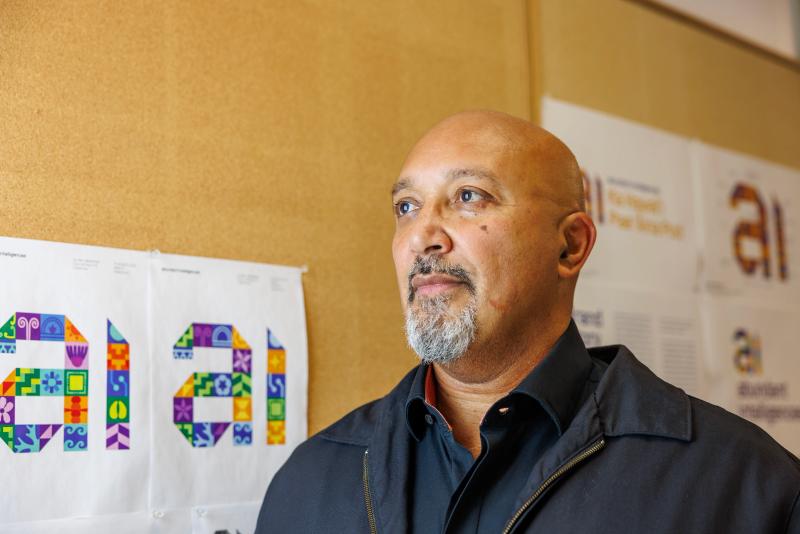
It’s been a year since Lewis and I first spoke about Abundant Intelligences, and AI has yet to save us. As a society, we’re spiralling even deeper into the dizzying narrative of how we’re supposed to let AI into our lives, tossed between the pearly-white promise of the technology and the gut-wrenching fear of what could happen if the experiment goes wrong.
Lewis points out that even Yoshua Bengio, Geoffrey Hinton and Yann LeCun, the so-called godfathers of the deep learning powering modern AI, fundamentally disagree. Hinton and Bengio (a co-investigator on Abundant Intelligences) see AI as an existential threat to humanity. LeCun says current systems are less intelligent than his cat.
Still, Lewis is optimistic, not just about Abundant Intelligences but also about AI in general. He refuses to accept that we’re stuck on this current trajectory. The history of technology development is incredibly contingent, he says. It’s a patchwork of individuals with great ideas and near misses, businesses that peaked too early or disappeared at the wrong time – it’s sloppy and hopeful and everything in between, and through that, we’ve ended up with 140-character limits and clamshell laptop designs and all sorts of weird ideas that became the way we do things. “None of it’s inevitable,” he says.
He believes in change at the margins, in the almighty incremental. His career has taught him that. But this moment feels different. Unlike during the seismic period of rapid technological change he came up through in the late 1980s and early 1990s, now Indigenous Peoples and other Western-marginalized groups have an opportunity to wrestle these technologies into shapes that directly benefit them.
“[During] the desktop revolution, almost no Indigenous people were involved in that story,” says Lewis. The same for the internet. This time around, the community is more diverse – yet connected through that mycelium network that is Abundant Intelligences – and robust enough to push against the walls of what is until there’s space for other ideas. “This is where we can innovate,” he says. “This is where we can make the margins a bit wider.”