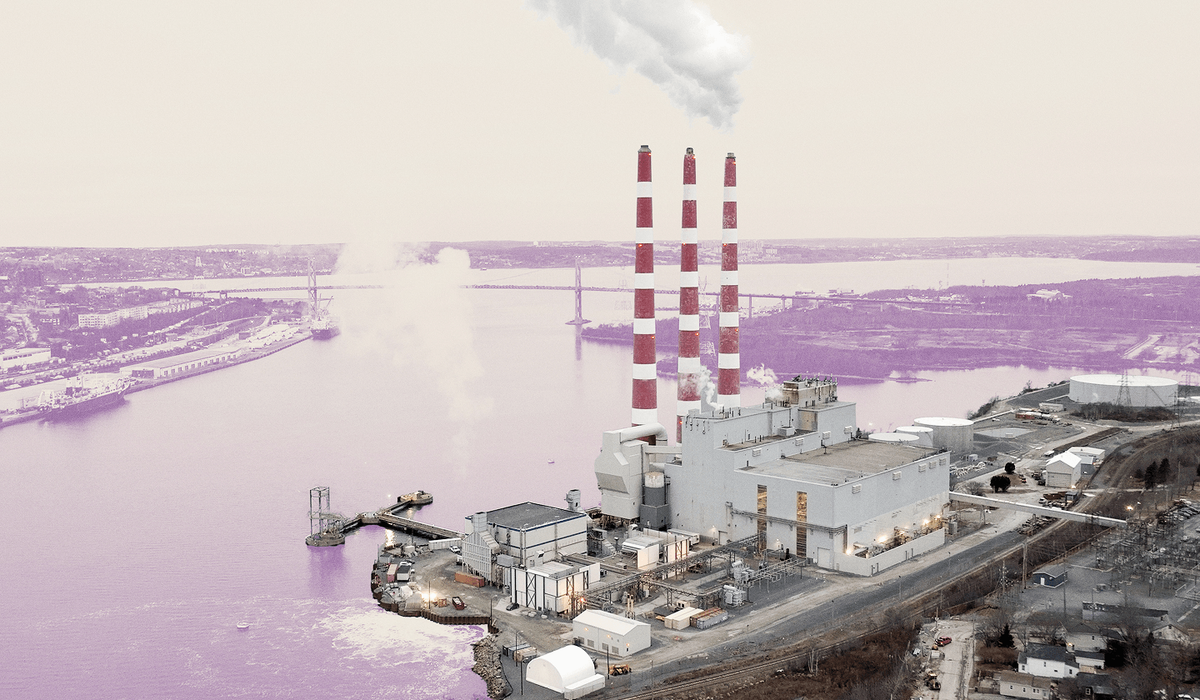
For more than 60 years, the three smokestacks of the Tufts Cove Generating Station have stood as a landmark on the Dartmouth waterfront. Candy-striped in red and white, the towers are instantly familiar to the thousands of commuters who pass them every day as they cross Halifax Harbour – and to millions more who’ve seen them in the background of the hit TV series Trailer Park Boys, lending the show a gritty industrial authenticity. Tufts Cove supplies a significant share of the Halifax area’s electricity – and it’s produced an outsized portion of its greenhouse gas emissions as well over the years, first burning coal and fuel oil and now mainly natural gas.
The fall of 2023, though, brought a slight alteration to the landscape: a white steel sea container installed at the base of the towers by a local startup called Planetary Technologies. Seawater that the power plant pulls from the harbour to cool its turbines is now being pumped through the container, where it is mixed with a slurry of magnesium hydroxide before it’s pumped back into the ocean. Most people know magnesium hydroxide as the main ingredient of milk of magnesia, and that’s how it’s working here. It’s a kind of antacid for the ocean, reducing the water’s acidity while increasing its ability to absorb carbon. And it could be the cornerstone of a new industry – a sub-sector of the carbon removal business known as “ocean alkalinity enhancement” (or OAE) that fosters ambitions of providing antacids for much more of the two-thirds of the planet covered by ocean, and could become a significant tool in the battle against the climate crisis.
A substantial amount of the carbon dioxide that human industry has produced over the past two centuries – about 30 per cent – has been absorbed into the ocean, where it’s transformed into weak carbonic acid. This has reduced the average pH of the oceans from 8.2 to 8.1 since the start of the industrial age. (The pH scale is logarithmic, so this represents a 30 per cent increase in acidity.) This process is known as ocean acidification, and it is but one of the many ecological tragedies of climate change.
Back in 2016, Mike Kelland, now Planetary’s CEO, was living in Ottawa and wrapping up 25 years as an entrepreneur and executive in software and other IT-related fields. He was looking for a more meaningful kind of innovation to work on when he met Greg Rau, a research scientist from the University of California at Santa Cruz. Rau had developed a technique for boosting the ocean’s capacity to absorb carbon dioxide but was struggling to find interest and investment. Kelland was captivated by the seemingly limitless potential of a technology so straightforward it required little more than blending seawater and antacid together and pumping them into the ocean – a process that could be dropped in almost anywhere. “The systems are very simple,” he says. “We call it a tank on a tarp.”
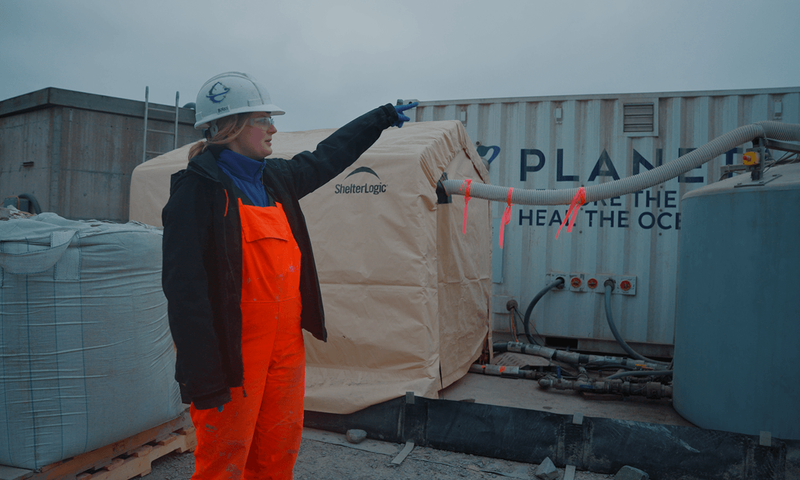
Having built his tech career in Ottawa, Kelland knew how to navigate the federal government’s byzantine ecosystem of funding for early-stage companies. In short order, Planetary Technologies was up and running in Halifax, taking full advantage of the highly educated local workforce and especially the expertise in oceanography centred around Dalhousie University.
Planetary launched its first alkalinity enhancement tests at Tufts Cove in 2023. Within two years – breakneck speed for an unproven carbon removal technology – the company’s novel approach to OAE was established as safe enough to scale up and legitimate enough to earn the company the world’s first independently verified carbon removal credits, issued by the carbon registry startup Isometric. This rapid progress helped Planetary attract $31 million in offtake purchases from Frontier Climate, an aggregate fund that has committed to buying more than $1 billion in certified carbon credits by 2030 on behalf of global tech companies like Google, Stripe and Shopify, to help them meet their net zero pledges.
“It’s proven thus far quite successful,” says Katja Fennel, a professor of oceanography at Dalhousie University who participates in a research project monitoring the effectiveness and safety of OAE technologies. “I think it really is quite remarkable what has been achieved in a short period of time.”
The long-term potential could be quite remarkable, too. Planetary claims it will be able to deliver large-scale carbon removal at between $50 and $160 per tonne, depending on the availability and cost of feedstocks for each project. (The magnesium hydroxide being used at Tufts Cove is likely to be replaced eventually by much cheaper and more plentiful feedstocks such as calcium.) At that price, OAE could be viable at the scale the United Nations’ Intergovernmental Panel on Climate Change has called for in the quest to keep global warming below 2°C – approximately 10 gigatonnes of carbon removal per year. (A gigatonne is one billion tonnes, roughly one and a half times Canada’s annual emissions.) Kelland cites internal studies that have examined the available alkaline feedstocks near the world’s coasts and estimated that OAE could, in theory, take on as much as 2.9 gigatonnes of that work.
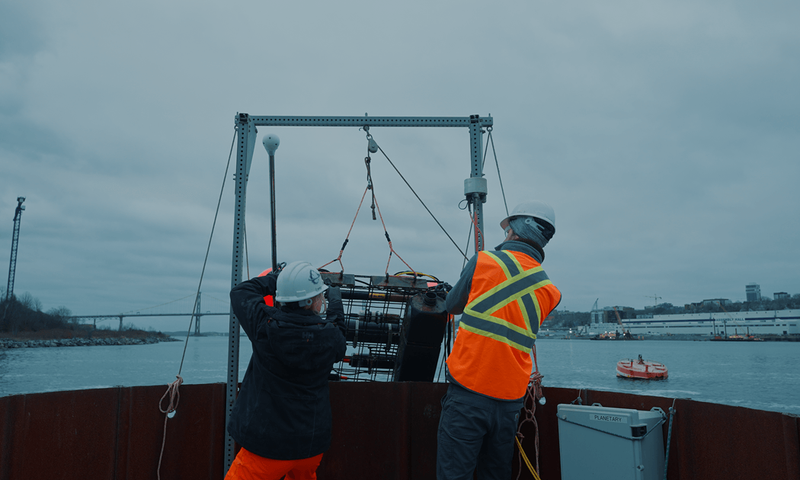
At present, Planetary is nowhere near planetary in its scale. The company’s Tufts Cove project is capable of removing 25,000 tonnes of carbon dioxide from the air per year if it’s running flat-out (and because it’s a test site, it hasn’t been). Planetary will use the offtake money from Frontier Climate to expand that rate to about 100,000 tonnes per year by 2030. Kelland also points to a “pipeline” of projects in development that could expand its capacity to nearly three million tonnes. That would be extraordinary growth – but still just a few drops in the ocean.
A single startup company proving new technology in an infant industry can only move so fast, though, as Kelland acknowledges. “Last year, we put the first credits on the registry ever for this technology. We won an XPRIZE and we got on the Global Cleantech 100 list. There are all these milestones that we hit over and over again last year. Now we put our heads down and do the work.”
Planetary is not alone in its carbon removal quest, even just on the Nova Scotia coast. Another alkalinity enhancement company called CarbonRun has emerged from the labs of Dalhousie University to earn first-of-a-kind carbon removal credits in recent months. CarbonRun’s approach is called “river liming,” and it involves pumping crushed limestone into rivers as they flow to the sea. The system was originally developed to combat the impacts of acid rain on salmon-spawning streams, but it is proving to be equally effective at boosting the capacity of ocean-bound rivers to absorb carbon dioxide. CarbonRun has a test facility on the West River in northeastern Nova Scotia, and it received the world’s first carbon removal credits for a river-liming project at a second site it operates in Norway.
The early results are promising – both for the world’s oceans and for Nova Scotia’s clean-tech sector, which might be seeing the emergence of a homegrown cluster. But the problem remains as vast as the Atlantic itself. “Planetary has removed 2,000 tonnes of carbon dioxide,” says Fennel. “Three years ago, if you had said that, I would have said, ‘Wow, it’s great what they’ve accomplished.’ But it has to be scaled up by multiple orders of magnitude. And whether that can be done – it’s a tremendous challenge.”
Meanwhile, the three candy-striped smokestacks at Tufts Cove continue to add their small share to the scale of that challenge, day after day. In a generation, they might instead be landmarks of a different sort, marking the spot where the antacids the world’s oceans so desperately need were first delivered at oceanic scale.