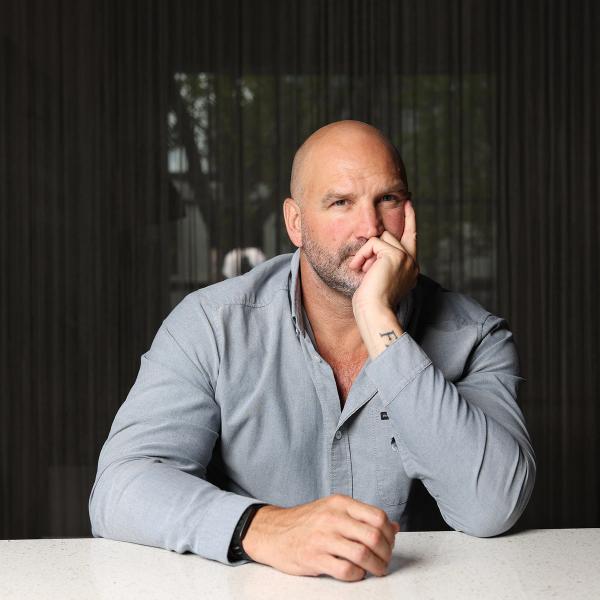
Bryan Danielson believes in the motivational power of stories. On his Not Sorry Substack, he writes about Canadian entrepreneurs who have built world-beating companies despite the widespread belief that leaving for the United States is necessary to reach the top in many areas of technology. Originally from Hamilton, Ont., Danielson is based at the Center for Entrepreneurial Studies at the Stanford Graduate School of Business in California, where he creates case studies of companies for business students. During a recent conversation, we discussed the importance of showing entrepreneurs they can succeed in Canada.
Q: A 2025 report from a venture capital fund is headlined Where have all the Canadian startups gone? Why do founders seem to have such a negative perception of Canada?
A: Canada’s gotten better at funding earlier-stage companies. But we have a growth equity problem. There just isn’t that much money in the system [to allow] a company to really grow rapidly, and that’s where we often see more American or U.S.-centric investors saying, “Hey, we can give you $200 [million] or $300 million. Come and incorporate in Delaware. We have the customers here; it’ll be easier for you to hire talent; it’ll just make your life easier.” And, as the data suggests more often than not, that tends to be the case.
Q: That study about Canadian startups also shows about only a third of the ones launched by Canadians are actually in Canada.
A: Having spoken to maybe hundreds of founders over the past six months, it’s been striking to me how often I’ve heard, especially from younger founders, “I knew I wanted to start a company, so I just incorporated in Delaware because … if you want to succeed you have to incorporate in Delaware.”
All the stuff like capital, communities, grants and programs don’t really mean much if, from the get-go, everyone’s saying, “I’m not going to pay attention to that because I’m inspired to go away.” So, that’s why I’ve been so interested in the storytelling gap, because if we can show we have very successful winners in Canada [who] are trying to do interesting things, then at the very least we can capture some people and say, “Hey, look, you could stay here.” If they still choose to go, that’s okay. I’d be a hypocrite being in Silicon Valley and saying, “No, you can’t leave. You have to stay.” But the point is, know it’s a path, know you can go back and you can move freely between the two.
Q: You’ve written about a “talent paradox” in artificial intelligence, where Canada produces five per cent of AI researchers and only 0.7 per cent of AI computing capacity.
A: We have world-class researchers, second to none. If you think of the most renowned researchers in the world, like Geoffrey Hinton in Toronto, Yoshua Bengio at MILA [Quebec Artificial Intelligence Institute] in Montreal and Richard Sutton at Amii [Alberta Machine Intelligence Institute] in Edmonton, it’s clear there’s a gravitational pull towards research and talent. Where we tend to fall off is that compute capacity, companies coming out of that and startups.
Q: You’ve written that 2025 was “the year we got loud.” What do you mean by that?
A: There is this very clear schtick around, like, “Oh, interesting things are happening in Canada. We’re taking bolder policies or laying out a grander vision.” So, what I mean by “loud” is it felt like there was this newfound patriotism. People started to step out a bit and say, “I want to do something. I want to try something new. It feels like an exciting time to step outside my comfort zone.”
Q: Is that linked to the Trump challenge?
A: I often shy away from talking about geopolitics. That being said, I think there’s a very clear correlation, not only between Canada but probably just the world, with the disruption that has happened. We’re kind of being united as a result of what’s happening, and naturally that fuels this kind of loud energy that started in 2025.
Q: You call your Substack Not Sorry. Why is that the phrase you chose?
A: Because intrinsically as a Canadian it catches your eye, because “sorry” is a good thing that’s part of our identity. We should continue to be polite and kind and caring and all the values and virtues and principles that make us unabashedly Canadian. But we can add an element of unapologetic-ness that allows us to associate with being ambitious, relentless, winning. So, this is not me suggesting that if you’re wrong in an argument and upset someone’s feelings you shouldn’t say sorry. It’s how can I catch attention in a positive way that is kind of fun for a Canadian to think about?
One of the most powerful things of being in Silicon Valley is the sense of just be yourself, be unapologetic, go for it, whatever means something to you, say it out loud. People are not afraid to fail, because there’s a very abundant mindset of “I’m going to try things with people, I’m going to fail 10 times, and maybe on the 11th time I’ll get it right.”
Q: Are there things that need to be done on the policy front? Are we holding ourselves back?
A: I would like to see us channel our resources into a couple of priority areas where we feel we could win globally, and dedicate policy, infrastructure and capital to those things. Two that come to mind are energy and grid infrastructure and the other is agriculture and agricultural technology. How do you create pockets of density? Pick a couple of areas and just go all in around policy levers that could allow us to attract talent globally and keep our talent at home.
Q: Why do you think telling stories is key?
A: I think there’s nothing more powerful than a good story. You never know what someone’s going to look at and draw inspiration from and then dedicate maybe their life to something they never thought about. No amount of data is ever going to do that.
The goal is not to convince. The goal is to generate interest, excitement and enthusiasm. The intent is to show that people are doing interesting, successful, ambitious things in Canada, and winning while doing it, and those inspirational stories deserve to be told.
It’s important from a domestic angle, in the hopes that some people choose to stay. On the global stage, it’s equally important, because if our goal is to win in a couple of priority areas, like energy, you also need that gravitational pull to say, “Hey, look at this country or group of people [who] are incredible, whether that person is in Canada or it’s David Baszucki at Roblox or Michelle Zatlyn at Cloudflare, who are also Canadian and created generational companies.” It shifts that narrative of “Okay, Canadians say sorry a lot” and they start to associate us with “Oh wow, these people have phenomenal values, and they win a bunch.” I want more of that.
Q: Is there a Canadian success story you find particularly powerful or inspiring?
A: The story I did on PointClickCare with Mike Wessinger is a phenomenal one. Before software-as-a-service was a thing, he decided to create this company with his brother Dave. They started in Mississauga selling into nursing homes. They realized software was very outdated and all the data was stored on these clunky servers. They figured out a way to store patient information in the cloud, which at the time was not very well known, to save both time and cost for these providers.
The interesting thing they did was to say, “Rather than pay us a bunch of money up front, give us money every month and if you hate us, kick us out.” It was much easier [for providers] to say, “Okay, I’ll give you a couple of thousand dollars rather than $300,000 for this technology [that] I know nothing about, to an industry that’s unproven.” It’s since become the largest long-term-care software provider in North America. They’ve scaled to over $1 billion. [The company is privately held, but according to one estimate in late 2024, it would then have been valued at US$7 billion if publicly traded.]
Q: In the case studies you write for Stanford MBA students, is there one that stands out as particularly instructive for Canadians?
A: I like the story of Kevin Taweel, who grew up in P.E.I. and built the largest mobile device protection company in the world. In 1995, he and his co-founder acquired a small roadside assistance company in Houston called Road Rescue for about $8 million. It served wireless carriers. They quickly realized the wireless channel itself was the real opportunity, pivoted into handset insurance [which covers the cost of repairing or replacing a smartphone that has been lost, stolen or accidentally damaged] and renamed the company Asurion.
Taweel went to Houston for one reason: that’s where Road Rescue was, not because Houston was a tech hub or a financial centre or where smart people were supposed to go. The deal was there, so he went. A kid from P.E.I. built one of the highest-returning investments in history by chasing a specific opportunity in a place nobody would have told him to move to. If you look for reasons you can’t build something big in Canada, you’ll find them. If you look for the right opportunity instead, you’ll find that, too.
This interview has been edited for clarity and length.