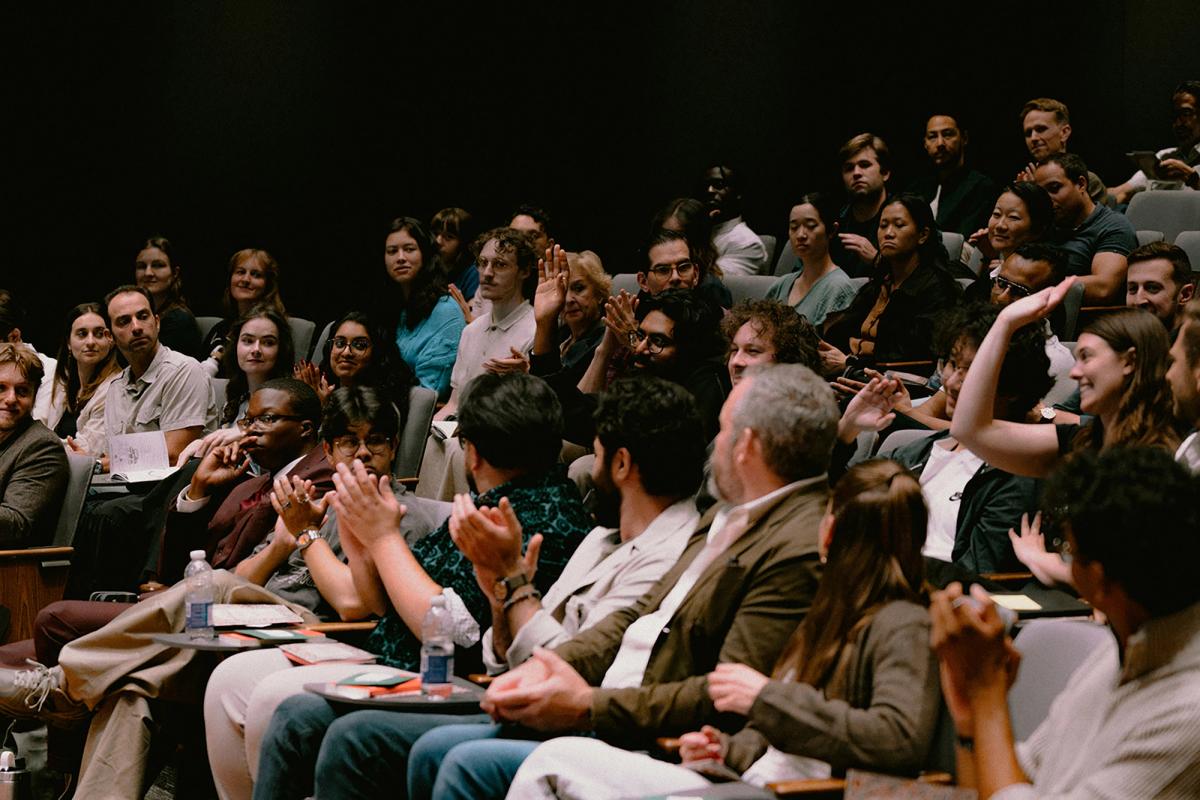
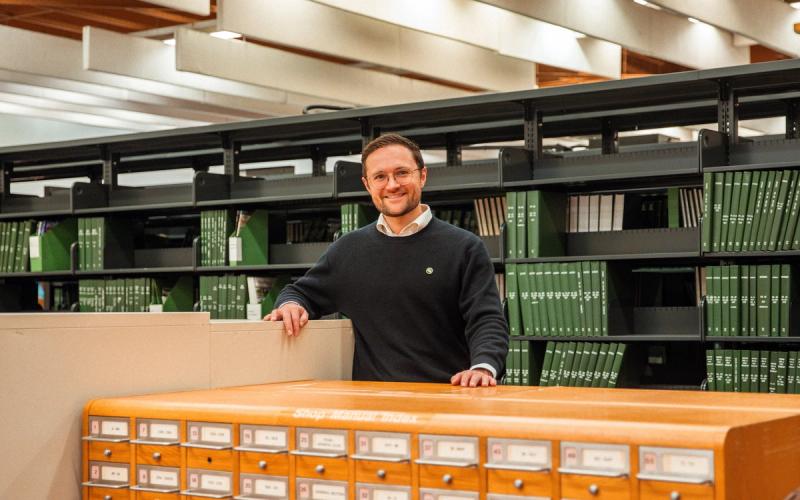
In his past life as a Build Canada co-founder, Benjamin Parry wrote policy papers to support Canadian entrepreneurs. As he puts it, his goal was to make their complex problems clear. Now, as the head of The Toronto Society for the Diffusion of Useful Knowledge, he’s doing the same for the city he loves, taking a big idea that could shape Toronto and placing it in the hands of a skilled speaker who spins it into a talk for a live audience.
Four seasons in, with topics spanning “Why everybody is religious” to “How to tell if someone’s lying,” tickets are selling out. On Nov. 19, Ross Douthat, a longtime New York Times columnist and now a 60 Minutes correspondent – fresh off an exclusive interview with President Donald Trump – will be examining the question of what, exactly, will survive the 21st century.
Here, Parry tells Be Giant which ideas sell the most tickets, why he’s pro-fellowship and anti-community – and what’s next for the movement he’s creating.
Get our new book for free.
Subscribe to our newsletter and we’ll mail you a printed copy.
The Toronto Society for the Diffusion of Useful Knowledge is quite the handle.
I kind of stole it from a similarly named 18th-century organization, The Society for the Diffusion of Useful Knowledge, which used to print pamphlets and maps for lectures it held in the U.K. There was also a 19th-century knockoff of this in the U.S. called the Boston Society for the Diffusion of Useful Knowledge, which had just incredible ranks including [Henry David] Thoreau and [Ralph Waldo] Emerson.
What exactly do you mean by “useful knowledge”? Isn’t all knowledge useful in some way?
Joel Mokyr, who won the Nobel Prize last year in economics, uses the idea of “useful knowledge” to explain what happened in the Industrial Revolution – the combination of theoretical knowledge with practical knowledge, and how it led to a takeoff in economic development. I really liked the idea that useful knowledge is essential to the positive transformation of our world.
Do you mean that these talks are meant to be kind of a civic how-to?
Our lectures are practical in a sense, but they’re not technical lectures – you’re not going to learn how to build a neural net. It’s more about the practicality of topics like “What leads to great economic productivity?” and “How to become an effective political actor.”
Which topics sell out the fastest?
People love the ones about cities and urbanism, AI and technology, philosophy and psychology.
Which was the most polarizing?
We always get a healthy range of responses, and I don't think any topic yet has received universal assent or dissent. So even when there are ideas that cause principled disagreements – like Coby Lefkowitz’s September 2025 talk on building beautiful cities – it doesn’t lead to controversy.
How much does it matter that people gather in person, instead of online, to explore big civic questions?
The internet is very much a “bits” business. Podcasts and YouTube videos and blogging – it’s infinitely scalable; you can reach everybody through that computer screen. But in person, there’s no pausing the video, switching contacts, looking at your phone to try something else. [It’s about] creating an environment where you can pay a particular kind of attention, and also be surrounded by other people who have given these ideas the same kind of attention. This is deeply transformative for people in a way that listening to something on a podcast or reading something isn’t.
Even these very abstract questions like “What is the good, the true and the beautiful?” You read a paragraph about that and you can very often walk away thinking, “That didn’t really mean much to me.” But when you look someone in the eye and you both see each other and the way that they’re feeling and what the concept means to them and you actually have a dialogue about it, these concepts can become very practical and very real, very fast.
What is it about this moment in time that lends itself to the revival of the salon?
We’re still recovering from the pandemic and realizing again just how important in-person spaces are. There’s also been a long-term trend for over 50 years of increased isolation and lower social engagement. Our speakers and audience members want to find a set of peers they can collaborate with who can help them sharpen their ideas and also work with them to complete original projects in areas like software, education, business and politics.
I’ve heard you say you don’t like it when people call what you’re building a “community.” Is that true?
I don’t love the term. It ends up getting co-opted. Very often, “community” becomes much more [of an] identity thing. It’s a symbol that you’ll put on your Twitter bio, rather than something you’re actually willing to make some kind of sacrifice for, which is what those really valuable special-interest groups actually do.
You came to Toronto from the U.K., where salons have been part of the fabric of British life for hundreds of years. Here, not so much.
I'm not sure it’s true that there isn’t such a rich history of Canadian salon culture. The intellectual scenes that were often centred on bars and clubs were fundamental in setting up the civic and intellectual life of this country, and it’s where many of the fathers of Confederation met and did their most important work.
Does a cities-focused project like this have the potential to be nation-building?
I'm a local thinker, and the Toronto Society is interested in the things that are right in front of it. We care first about the people who are committed to the organization, then about the broader audience that comes to our events, then about the city and beyond.
The transformation that we want to effect is in the lives of individuals. There are no specific aims for nation-building work. But a nation is really just a collection of cities, and every decision that affects a nation will happen in a city. If you want to transform a nation, you have to transform its cities first.