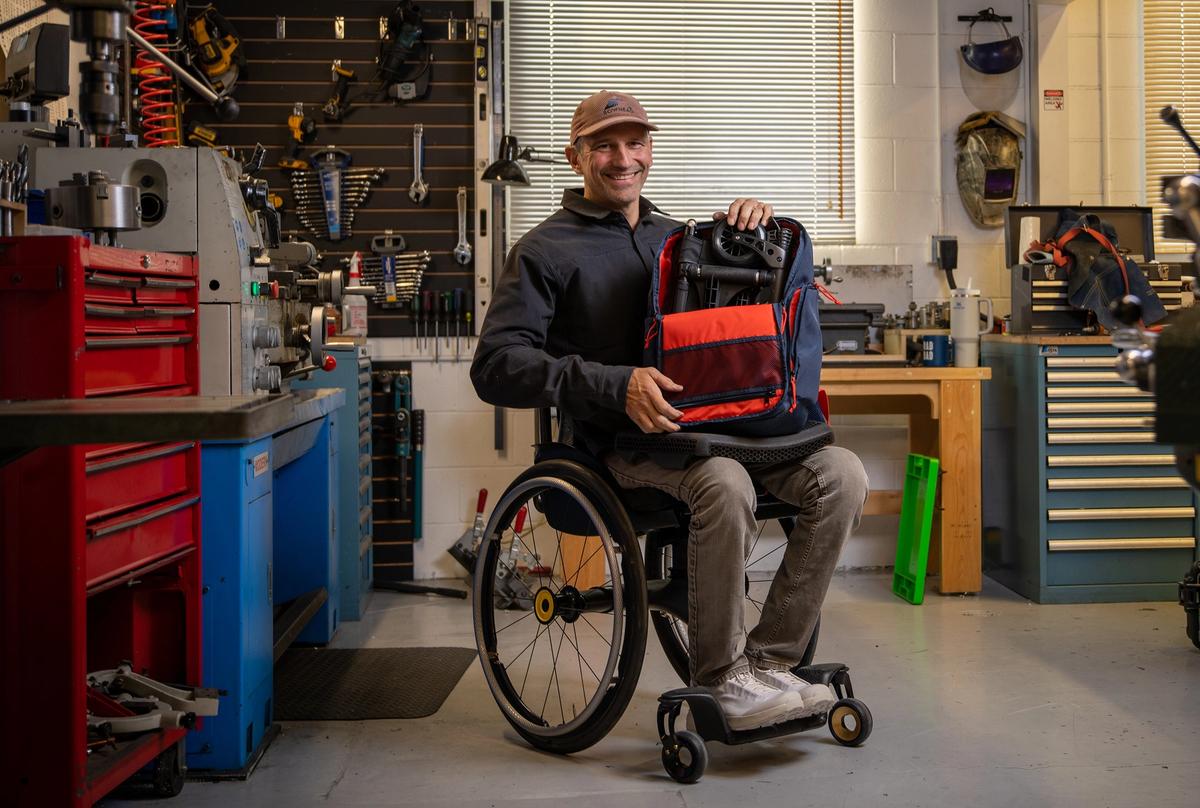
Christian Bagg’s face was flushed when he rode his bike through one of the bay doors off the alley behind Bowhead Corp. on a Tuesday morning this summer. Looking down the alley behind the two-storey building – a nearly 15,000-sq.-ft. warehouse in the west end of Calgary stocked with the bikes Bowhead makes for people with mobility-related disabilities – you can see a 90-metre-tall ski jump on top of a ridge overlooking the river valley, a relic of the city’s time as an Olympic host. A bike trail under the big jump bears the name Bowhead, a suitable asset for a company that’s increasing the profile of adaptive mountain biking around the world.
The RX, the bike Bagg rolled in on that day, has three wheels – two in the front and a rear wheel that is propelled by an e-assisted, hand-crank drivetrain. One of Bowhead’s signature innovations is an articulating front assembly that allows riders to lean into corners and roll over uneven terrain in a way that feels similar to a two-wheeled mountain bike. Bagg, who founded the company in 2018 and acts as its chief technology officer, won a Governor General’s Innovation Award in 2024 for the bike’s unique design and impact.
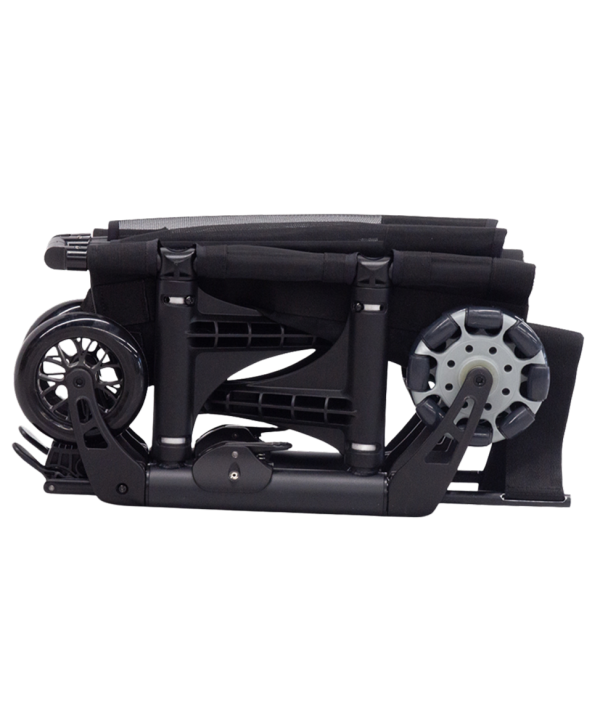
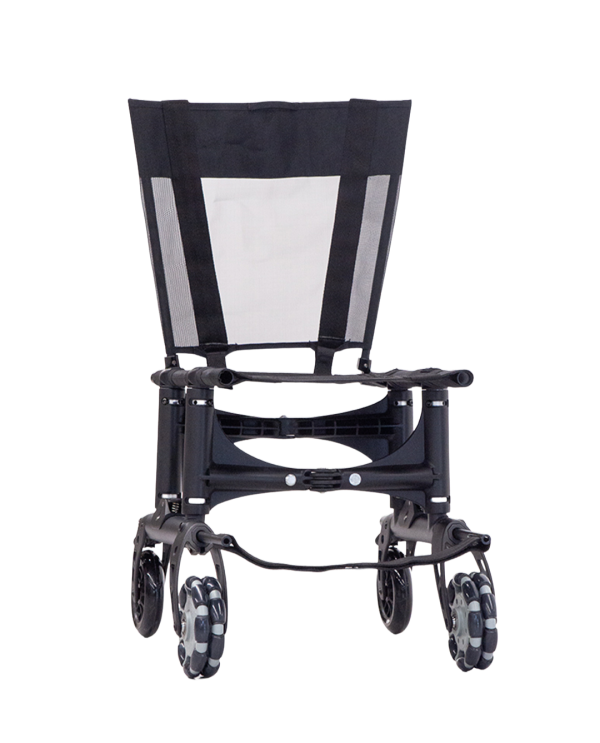
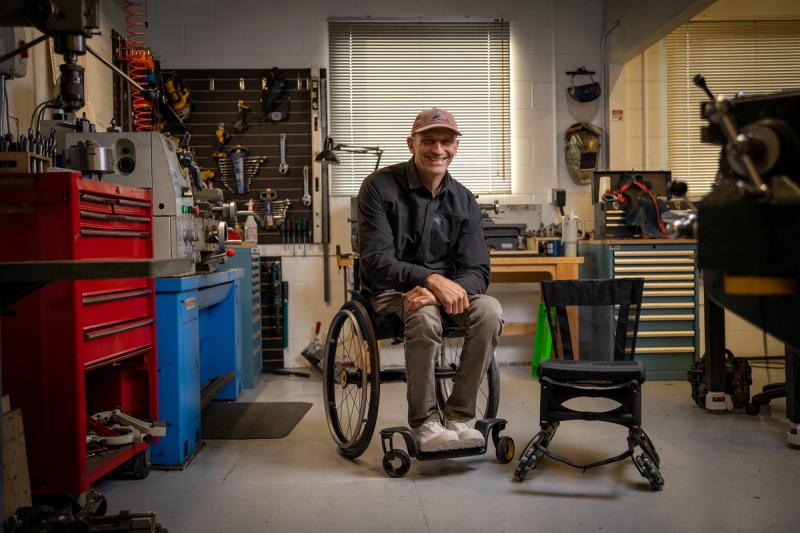
His latest invention, however, isn’t meant for off-roading. The Nano is a new kind of wheelchair but looks more like the type of collapsible chair you might bring to a music festival or on a backpacking trip. It weighs less than 10 pounds and folds up to fit inside a backpack or an overhead compartment or under a seat on an airplane.
Get our weekly newsletter - the people, places, and ideas revealing where Canada is headed.
Bagg, who is 51 and broke his back in a snowboarding competition in 1996, has been tinkering with some version of the Nano for a decade, using it whenever he flies. He built it with the goal of making air travel less stressful for people with disabilities.
The Nano isn’t for everyone. You need the upper-body strength to transfer yourself in and out of the chair and pull yourself through an environment. But the fact that it’s lower to the ground, lighter and narrower than a wheelchair means that it opens up a new vista of spaces and possibilities.
The 27-member team at Bowhead has been hearing from customers about other potential uses for the new chairs, too. Someone from India emailed to see if the Nano would fit in the aisles of trains. Another said they plan to use it for gardening. Several mentioned finally having a way to access a tight space, like a storage room in their house or the shower in a hotel bathroom.
The most recent Canadian Survey on Disability found that 27 per cent of people over the age of 15, or about eight million Canadians, reported having at least one disability in 2022. And of those millions, 60 per cent told Statistics Canada that they encountered barriers accessing indoor and outdoor spaces. A study published in 2023 called Mapping Our Cities for All, led by Victoria Fast, an associate professor at the University of Calgary’s department of geography, found that close to 60 per cent of public-facing businesses mapped in Calgary, Vancouver and Ottawa were inaccessible, or partially inaccessible, to people with disabilities. And the demand for new assistive devices is only increasing as the population in Canada and the U.S. continues to age.
Arielle Rausin was one of a handful of people who got an early-release prototype. She works for the United Spinal Association and wrote a review of the Nano for the American advocacy group’s online publication, New Mobility. “I really love it, so I’m pushing to keep it,” she says. The 33-year-old was paralyzed from the waist down in a car accident when she was 10 years old. She’s an avid traveller, used to compete in wheelchair track and field for Team USA and has been on the lookout for a device like the Nano for years.
Part of the hassle of air travel as a wheelchair user, explains Rausin, is the extra time it takes at each of the various steps before takeoff, from waiting in line at the check-in desk to getting to the gate early. Airlines have their own versions of an aisle chair – narrow wheelchairs used to transport travellers with disabilities down the aisle of a plane – but they’re clunky, institutional-looking devices that require staff to operate them. Airline staff have various levels of training, or a lack of it, and strapping someone to the chair involves a lot of physical contact. “It does feel a little bit like a straitjacket,” Rausin says. She’s nearly missed flights because the people trained to use the airline-issued chair didn’t get to the gate on time. “The Nano chair solves all of those problems for me because I can do it fully independently and I don’t need any staff or caregiver assistance or anything at all.”
During a flight, a person has to alert a flight attendant and initiate the entire process all over again if they need to use the washroom. “I used to dehydrate myself and try not to eat or drink for a whole two days before I would fly to minimize the times that I’d have to use the restroom on a flight,” Rausin says. With the Nano, she can pull the chair out of her backpack, unfold it, then guide herself down the aisle. “It really just takes away all of that anxiety of having to give up my autonomy,” she says.
Alana Nichols, an American Paralympian and adaptive surfer, echoed Rausin’s enthusiasm. In a post on Instagram, she wrote, “After 25 years of travelling with a disability, I got myself on and off a plane independently! I also went to the restroom on the airplane WHENEVER I WANTED!!”
Airlines are starting to pay attention. Air Canada and Qantas have noticed Bowhead’s social media interactions and have reached out to learn more about how they can support people using these travel chairs on their planes.
The only downside, Rausin says, is the price point. The Nano costs US$1,499. The 3D-printed seat cushion is another US$299. You can buy a transport wheelchair, one without the large rear wheels for self-propulsion, at Canadian Tire for about $350. They’re designed to fold up and fit in the trunk of a car; they require the help of a caregiver and don’t meet the stringent criteria required for flight.
The Nano, meanwhile, has been tested for a weight up to 550 pounds to account for the G-forces involved in turbulence. There are a couple of other existing models of wheelchairs created specifically for planes, but they’re marketed toward airlines rather than to the general public.
Kelly Matheson-King, Bowhead’s CEO, acknowledges that the company has received comments from the public about the high price. “Bowhead is trying to support the community with really highly engineered, top-quality products,” she says. “So there’s always a trade-off that we’re working with to do the best we can to make our products accessible to as many people as possible.”
But both Rausin and Bagg believe that people with disabilities are in a unique position to benefit from new kinds of devices and technologies. “I have so many problems I feel that I face with accessibility in my day-to-day life that I know there could be solutions for,” Rausin says. “I just don’t have the capacity to build them myself.”
And so Bagg, who has a background as a machinist, and his team continue to innovate. As the company has grown, especially with the addition of Matheson-King at the helm, Bagg has been freed up to spend more time doing what he does best. He has a full machine shop in the basement of his house. He sketches out rough ideas on a tablet whenever he thinks of them, but down in his subterranean lab among his lathes, drill presses and 3D printers is where he really taps into his creative process.
Bagg estimates that he has used some version of the Nano on 150 flights. One of the most rewarding aspects of using the travel chair is how it can flip the interaction he has with flight attendants. Instead of feeling like a source of stress, he gets to show them something they’ve never seen before. “It really is more of a social innovation than a mechanical one,” Bagg says. “It is universal that I will have a conversation with the flight attendants.”
The Bowhead way, a philosophy Bagg referred to several times during my visit to the company’s warehouse, is to develop new tools that restore someone’s sense of agency and empower their appetite for adventure. It’s not about waiting for other people to help. The company’s lineup of bikes, for example, has a narrower wheelbase than other adaptive mountain bikes so they can roam freely on standard trail systems.
“We’ll use technology,” he says, “to find our way through it.”