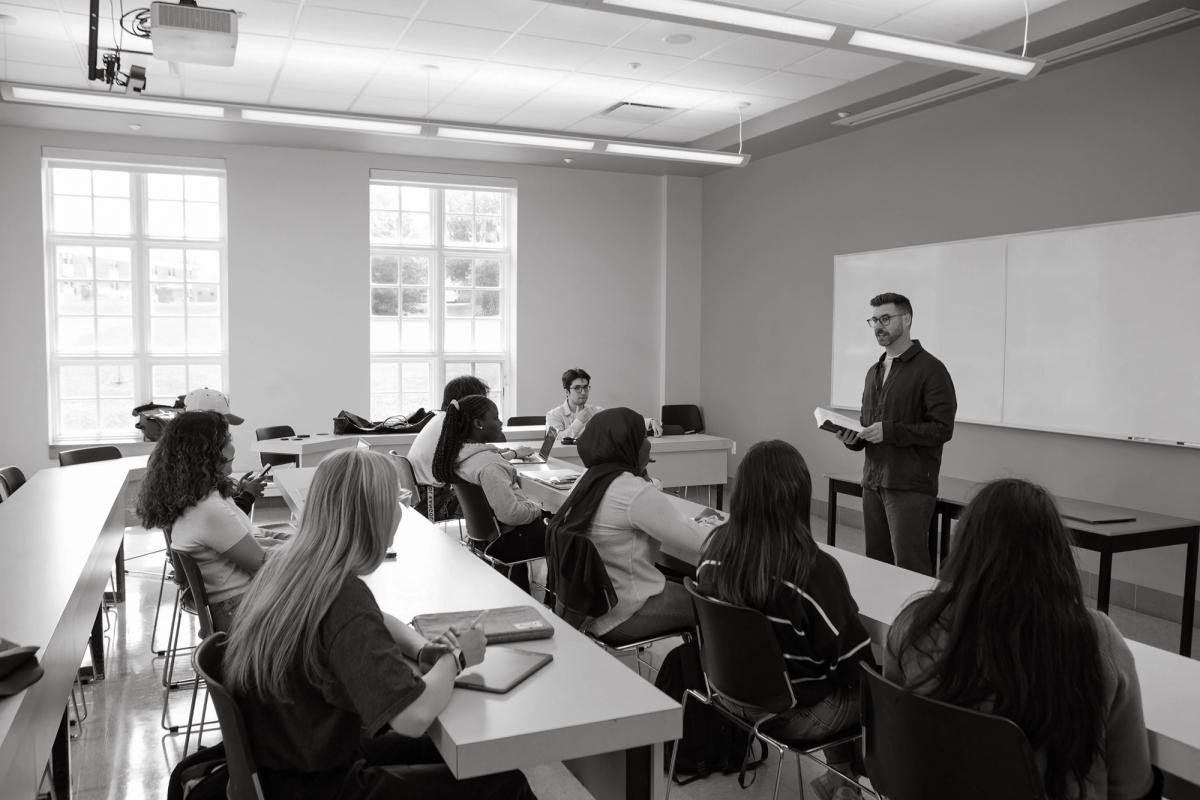
Earlier this year, in the depths of the Fredericton winter, professor Matt Dinan cracked the hefty spine of Fyodor Dostoyevsky’s The Brothers Karamazov for the first time. This was embarrassing: Dinan is the director of the Great Books program at St. Thomas University, and there he was, at age 40, only just broaching one of the greatest books of all. But rather than cower in shame, Dinan embraced his beginner’s mind and ploughed through the thousand-ish pages alongside a class of third-year students he was co-teaching in a course themed Faith and Reason. The result was a pedagogical breakthrough, as he wrote in a viral essay for the New York Times. No one, neither student nor professor, could put the book down: for a semester, Brothers K fever seized the classroom, unleashing fiery existential debates and the kind of textual dissection that older people assume Gen Z reserves for the Instagram accounts of K-pop stars. By becoming a student again himself, Dinan’s passion ignited the same in his students. And big books spark big questions. Learning how to ask them, he says, is the best weapon against superficiality in the algorithmic age.
Get our weekly newsletter—the people, places, and ideas revealing where Canada is headed.
I think a lot of us have forgotten the thrill of connecting fully with a book. Can you describe what it was like to fall deeply into The Brothers Karamazov for the first time?
I felt like I was an undergraduate again. I was thinking about it all the time and sneak-reading. When I would have a meeting on Teams, I’d turn my camera off and read The Brothers K. I didn’t look at what time it was. I couldn’t stop mid-chapter. I had a kind of vigour and energy that is certainly not usually the case in February.
And your students got similarly obsessed. What do you think it is about this particular book that resonated?
It was all anybody was talking about. I mean, it’s got it all, right? At one point, Alyosha has this vision of the whole cosmos coming to him and dwelling within him, from gazing up at the stars. And one of our students said, “Well, the book feels like this too.” It’s got the whole world in it.
A lot of us are panicked about the decline in reading, but you’ve written that the real problem isn’t attention spans; it’s a lack of passion. Yet if you hang out with young people, they are quite passionate, just maybe not about the things we want them to be, like Minecraft or YouTube. Can you unpack “passion”?
I’m using passion in the way that the philosopher Søren Kierkegaard used it, as a basic orientation toward things that give shape to one’s life. We might be really into Minecraft, and it’s possible that it could give a full shape to your life, that you’d be willing to die for Minecraft, I guess. But our phones want us to have shallow, frequent engagement. And passion is more than that, a kind of vitality that comes from the pursuit of the most important things in life.
You work in a small, publicly funded liberal-arts college, and that’s a hard sell these days. Earlier this year, our premier in Ontario called humanities students “basket weavers.” What do you say to policymakers who tether education so tightly to economic output?
It’s short-sighted to fully industrialize education, because you don’t get a good nurse by taking that approach. You get good health care from people who care about the good of their community and think that human life is worth preserving. And that perspective doesn’t come from nowhere. It comes from intense engagement with [big] questions about what it means to be human.
Especially in an age when we’re tempted to outsource so much of our thinking to computers, the need for passionate learners is stronger than it’s ever been. There are all sorts of negative externalities that come about when we just cease to think. The human questions won’t answer themselves. They’ll be answered by charlatans and malign influences on the internet. I think that those of us who are in liberal education, humanists especially, need to stop apologizing for what we study – to assert that no, actually, these are the most important things.
So you finished the book, obviously. How did it feel?
We were having a race, a couple of the students and I, to see who could finish it first. I herniated a disc while I was skiing over reading week, so I was stuck in bed for a week and all I did was read Brothers K, and I finished it before my students. I cried.